Close Menu
  • Home
  • UNSUBSCRIBE
  • News
  • Lifestyle
  • Tech
  • Entertainment
  • Sports
  • Travel
Facebook X (Twitter) WhatsApp
Trending
  • Do you really have to wash rice before you cook it?
  • Neuroscientists are searching for the ‘cellular substrate of loneliness’
  • Bow-Wow, Ding-Dong, Pooh-Pooh: Expert explains early theories of how human language evolved — and their silly names
  • Famous child mummies in Andes may belong to kids who were sacrificed to ‘ritually anchor’ the Inca’s presence as their empire expanded
  • Artemis II crew captures rare double auroras on the dark side of Earth as they zoom toward the moon — Space photo of the week
  • Has all the water on Earth been peed before?
  • ‘This might be the point of no return’: Experts on the current measles outbreak and where we go from here
  • NASA’s experimental X-59 jet breaks sound barrier for 1st time in step toward ‘quiet supersonic’ technology
Facebook X (Twitter) WhatsApp
Baynard Media
  • Home
  • UNSUBSCRIBE
  • News
  • Lifestyle
  • Tech
  • Entertainment
  • Sports
  • Travel
Baynard Media
Home»Lifestyle»‘It epitomises the strangeness of Sutton Hoo’: 6th-century bucket found at Anglo-Saxon ship burial holds human cremation
Lifestyle

‘It epitomises the strangeness of Sutton Hoo’: 6th-century bucket found at Anglo-Saxon ship burial holds human cremation

EditorBy EditorMay 20, 2025No Comments3 Mins Read
Share Facebook Twitter Pinterest LinkedIn Tumblr Reddit Telegram Email
Share
Facebook Twitter LinkedIn Pinterest Email

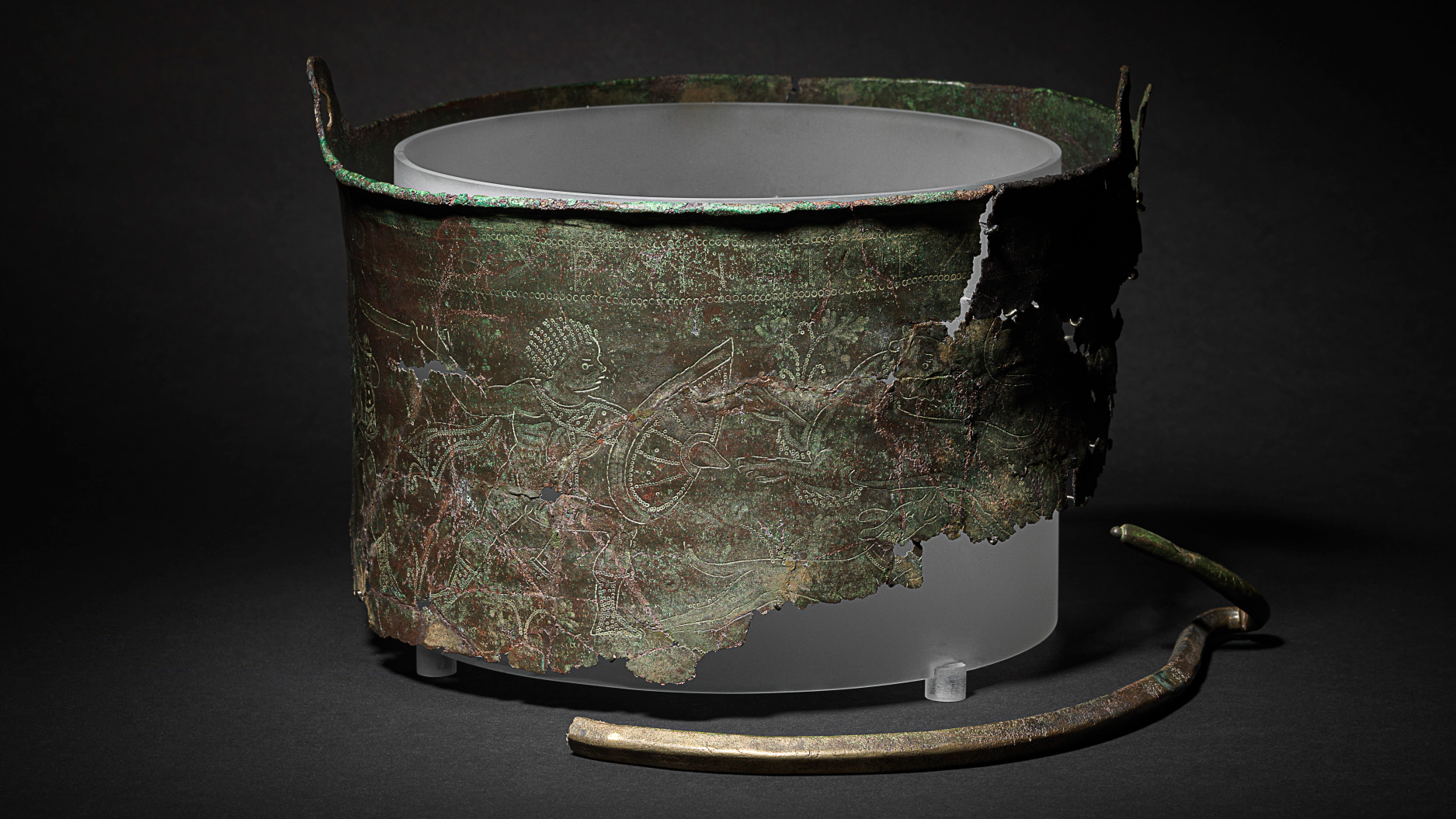
A copper bucket found at Sutton Hoo in England decades ago is much more than a pretty artifact: A new micro-excavation of the sixth-century container reveals it held the cremated remains of an elite individual, along with animal bones and an antler comb.

The copper-alloy Bromeswell Bucket was found in 1986 at the Anglo-Saxon ship burial site of Sutton Hoo, but the Byzantine-era bucket predates the ship by at least a century and was likely imported from Turkey.

Ahead of the summer of excavation at Sutton Hoo — which involves a team of archaeologists, conservators and volunteers from the U.K. TV series “Time Team,” the U.K.’s National Trust and FAS (Field Archaeology Specialists) Heritage — experts analyzed the contents of the fragmentary bucket, which depicts a North African hunting scene. Previous research that analyzed the inscription, which in Greek read “Use this in good health, Master Count, for many happy years,” suggested the bucket may have been a diplomatic gift.


You may like

In the new investigation, experts with York Archaeological Trust micro-excavated the bucket, National Trust representatives said in a statement Tuesday (May 20). As they removed the soil from the bucket, the researchers discovered cremated human bones, including fragments of a skull and an ankle, that may have been placed in a bag that has since decomposed.

“We knew that this bucket would have been a rare and prized possession back in Anglo-Saxon times,” Angus Wainwright, an archaeologist at the National Trust, said in the statement. “Now we know it was used to contain the remains of an important person in the Sutton Hoo community.”

Related: Mysterious origin of iconic Sutton Hoo helmet possibly revealed in new research

Image 1 of 2

Bromeswell bucket micro-excavation
(Image credit: FAS Heritage)

A photograph of the contents of the Bromeswell Bucket reveals fragmented bones and a fine-toothed comb.

we see a blue gloved hand use tweezers to do a micro-excavation of the Bromeswell bucket's contents.
(Image credit: James Dobson / National Trust)

An expert separates fragments of bone from the Bromeswell Bucket.


But so far, little is known about the person whose cremated bones were buried in the Bromeswell Bucket.

Get the world’s most fascinating discoveries delivered straight to your inbox.

A comb made from antler was discovered with the bones, but experts suggest that both men and women used combs in Anglo-Saxon times to care for their personal appearance and to control lice. Animal bones found in the bucket are fragmentary but hint at a possible horse sacrifice.

Small amounts of cremated bone will be radiocarbon-dated to better understand how the bucket fits into the Sutton Hoo site. Ancient DNA may also survive on the comb itself, which could potentially reveal the deceased’s sex.

While Sutton Hoo is best known for its magnificent ship burial, the area was densely populated and part of a busy trade network in the sixth and seventh centuries. The Sutton Hoo treasures are diverse, including pagan and Christian artifacts, and were brought there from all over Europe and the Middle East.

The Bromeswell Bucket “is a remarkable mixture — a vessel from the southern, classical world containing the remains of a very northern, very Germanic cremation,” Helen Geake, an Anglo-Saxon expert for “Time Team,” said in the statement. “It epitomises the strangeness of Sutton Hoo.”

Excavation at Sutton Hoo is ongoing through June 13.

“This next phase of the dig offers an incredible opportunity to continue uncovering the secrets of Sutton Hoo, and we can’t wait to see what new discoveries await us in 2025,” Tim Taylor, creator and producer of “Time Team,” said in the statement.


Stonehenge quiz: What do you know about the ancient monument?

Source link

Share. Facebook Twitter Pinterest LinkedIn Tumblr Email
Previous ArticleVenus may be geologically ‘alive’ after all, shocking analysis of 30-year-old NASA data reveals
Next Article Viking Age women may have wielded weapons when pregnant, sagas and ancient artifacts hint
Editor
  • Website

Related Posts

Lifestyle

Do you really have to wash rice before you cook it?

June 15, 2026
Lifestyle

Neuroscientists are searching for the ‘cellular substrate of loneliness’

June 14, 2026
Lifestyle

Bow-Wow, Ding-Dong, Pooh-Pooh: Expert explains early theories of how human language evolved — and their silly names

June 14, 2026
Add A Comment

Comments are closed.

Categories
  • Entertainment
  • Lifestyle
  • News
  • Sports
  • Tech
  • Travel
Recent Posts
  • Do you really have to wash rice before you cook it?
  • Neuroscientists are searching for the ‘cellular substrate of loneliness’
  • Bow-Wow, Ding-Dong, Pooh-Pooh: Expert explains early theories of how human language evolved — and their silly names
  • Famous child mummies in Andes may belong to kids who were sacrificed to ‘ritually anchor’ the Inca’s presence as their empire expanded
  • Artemis II crew captures rare double auroras on the dark side of Earth as they zoom toward the moon — Space photo of the week
calendar
June 2026
M T W T F S S
1234567
891011121314
15161718192021
22232425262728
2930  
« May    
Recent Posts
  • Do you really have to wash rice before you cook it?
  • Neuroscientists are searching for the ‘cellular substrate of loneliness’
  • Bow-Wow, Ding-Dong, Pooh-Pooh: Expert explains early theories of how human language evolved — and their silly names
About

Welcome to Baynard Media, your trusted source for a diverse range of news and insights. We are committed to delivering timely, reliable, and thought-provoking content that keeps you informed
and inspired

Categories
  • Entertainment
  • Lifestyle
  • News
  • Sports
  • Tech
  • Travel
Facebook X (Twitter) Pinterest WhatsApp
  • Contact Us
  • About Us
  • Privacy Policy
  • Disclaimer
  • UNSUBSCRIBE
© 2026 copyrights reserved

Type above and press Enter to search. Press Esc to cancel.