
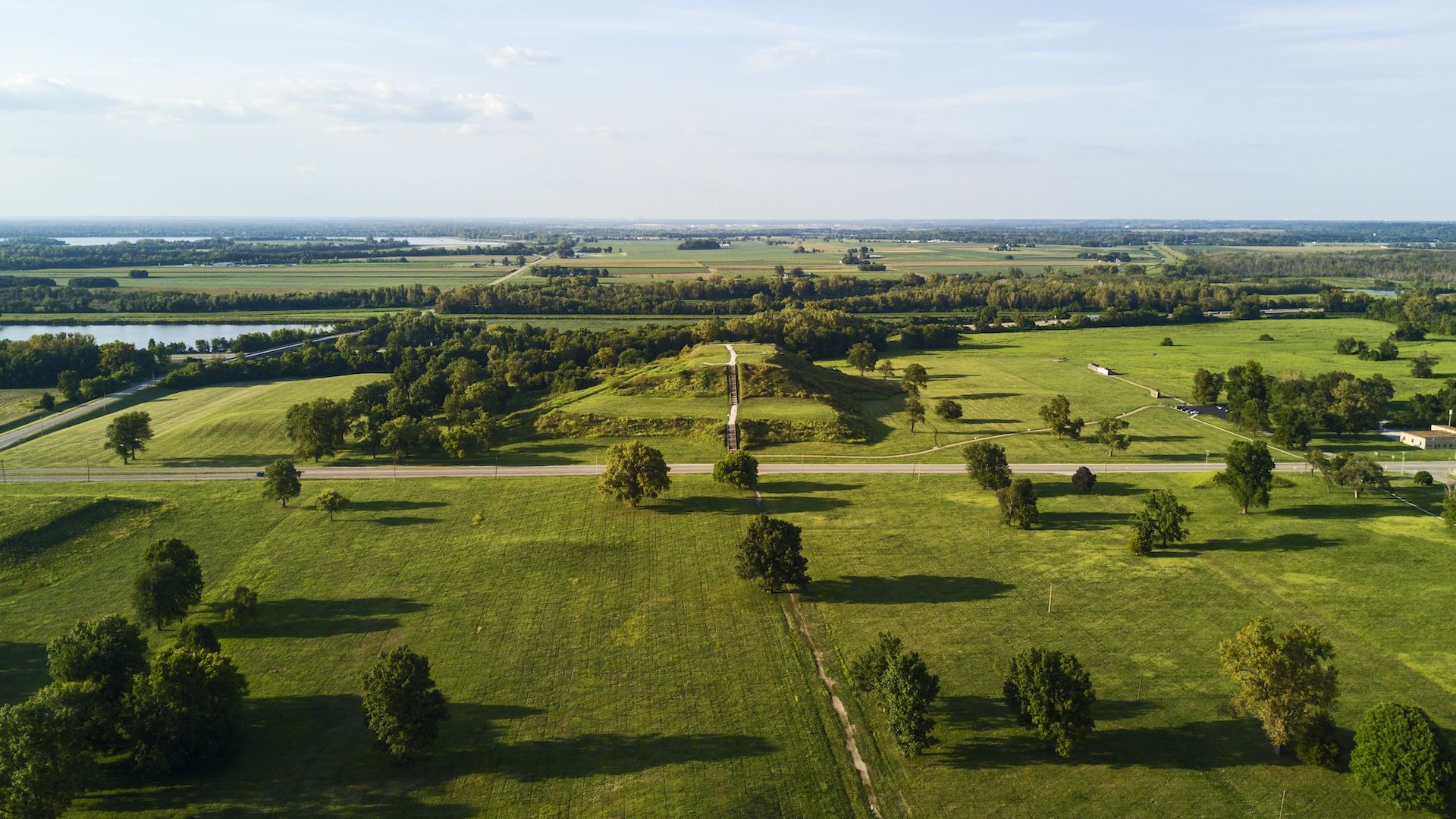
Around 900 years ago, Indigenous Americans at Cahokia — the largest pre-Columbian city north of Mexico until colonial times — felled a giant tree and transported it more than 110 miles (180 kilometers) to serve as a monumental marker post, a new study finds.
The tree, known as the Mitchell Log, is the largest marker post of its kind in Cahokia, which is now known for its earthen mounds in southwestern Illinois.
By pinpointing the exact dates when the Mitchell Log was erected and removed, the researchers behind the new study, published Oct. 3 in the journal PLOS One, have created the most precise timeline yet of Cahokia’s rise to power and subsequent decline. Additionally, by determining where the marker post came from, the researchers raise new questions on the transport of thousands of similar marker posts during the peak influence of Cahokia.
A big city
The city of Cahokia had a population of up to 20,000 people at its peak between 1050 to 1200.
“Cahokia grew rapidly in the late 11th century, with immigrants forming as much as a third of the population, before reaching its height in the mid-12th century when Cahokian goods, people, and ideas reached from the Gulf Coast up into the Great Plains,” study first author Nicholas Kessler, an assistant research professor at the Laboratory of Tree-Ring Research at the University of Arizona, and study co-author Erin Benson, an Eastern Woodlands archaeologist at the University of Illinois Urbana-Champaign, told Live Science in an email.
During this time, the Cahokians erected large monumental structures called marker posts. These posts were hewn from massive tree trunks and typically placed near communal courtyards, atop pyramid mounds and in prominent buildings.
“In the precontact Cahokian world, poles were often placed in special places (plazas, mounds, temples), where they acted as axis mundis, physically connecting the upper, middle, and under worlds and helping mediate those powers and people’s relationships with them,” Kessler and Benson said.
However, by 1200, Cahokia’s political, social and economic influence was waning, and marker posts were no longer erected.

In an effort to better understand the timeline and origin of the Mitchell Log, the team radiocarbon-dated the post and researched its provenance. They did this by examining the ratios of strontium isotopes, which are atoms of the element strontium that have differing numbers of neutrons in their nuclei. Strontium occurs naturally within the bedrock and has a unique isotopic signature depending on location. This signature acts like a fingerprint and is passed down with minor differences into the water and plants that grow upon it. By examining the signature found within an animal or plant, researchers can determine from which bedrock they originally came from.
The scientists found that the once 59-foot-tall (18 meters) and 4.4- to 5.5-ton ( 4 to 5 metric tons) log had been most likely sourced from over 110 miles away from southern Illinois.
The Cahokia people likely transported the log by floating or rafting the log upstream, Kessler and Benson said. “Alternatively, they may have simply carried it overland via trails and roads that surely connected Cahokia to surrounding communities,” the authors said.
With the help of cosmic events archived in the tree’s rings, the tree’s felling was dated to 1124, coinciding with the timeframe in which the city was at its peak. These cosmic events are characterized by sudden spikes in cosmic radiation, specifically radiocarbon, usually caused by solar storms or supernovas. Trees grow one tree ring annually, which stores radiocarbon, so these sudden spikes are recorded in their rings and can be used to pinpoint a specific calendar year.
Assuming the Mitchell Log remained standing for one or two generations before natural decay set in, prompting its removal, the marker post likely stood until between 1150 and 1175. This timeframe corresponds to when nearby ceremonial centers were being abandoned at the onset of Cahokia’s decline, providing greater insight into the timing of this event, the researchers said.
During the second half of the 12th century, Cahokia underwent various changes, including increased droughts, shifts in the types of exotic goods being traded, the transformation of public spaces and the construction of mounds, the researchers explained in their study.
Whether all of Cahokia’s marker posts were extracted around this time remains a question the authors hope to answer in future studies. In any case, evidence shows that by 1200, no new marker posts were being emplaced in Cahokia. By 1400, the city was abandoned for reasons that are still unknown to archaeologists.
