Close Menu
  • Home
  • UNSUBSCRIBE
  • News
  • Lifestyle
  • Tech
  • Entertainment
  • Sports
  • Travel
Facebook X (Twitter) WhatsApp
Trending
  • Chinese medical practitioners used extremely toxic plant as a topical anesthetic 600 years ago, study finds
  • Bead net funerary shroud: A 2,500-year-old beaded veil from Egypt depicting the deceased’s transformation into Osiris
  • Rare genetic disease makes scientists reconsider what the ‘seat of fear’ in the brain really is
  • It’s illegal to repair most of our devices. There’s a surprising reason for that.
  • Jupiter’s Ganymede, the largest moon in the solar system, may be heating up
  • Bizarre patterns on Venus have scientists puzzled
  • Scientists trained an AI model using an IBM quantum computer — and it answered questions correctly that the base model couldn’t
  • How did animals survive the asteroid that killed the dinosaurs?
Facebook X (Twitter) WhatsApp
Baynard Media
  • Home
  • UNSUBSCRIBE
  • News
  • Lifestyle
  • Tech
  • Entertainment
  • Sports
  • Travel
Baynard Media
Home»Lifestyle»Incredible, first-of-their-kind images show an orca being born in Norway — and the rest of its pod forming a protective circle
Lifestyle

Incredible, first-of-their-kind images show an orca being born in Norway — and the rest of its pod forming a protective circle

EditorBy EditorNovember 7, 2025No Comments3 Mins Read
Share Facebook Twitter Pinterest LinkedIn Tumblr Reddit Telegram Email
Share
Facebook Twitter LinkedIn Pinterest Email

Scientists in Norway have witnessed the birth of a baby orca in the wild, first-of-their-kind pictures show.

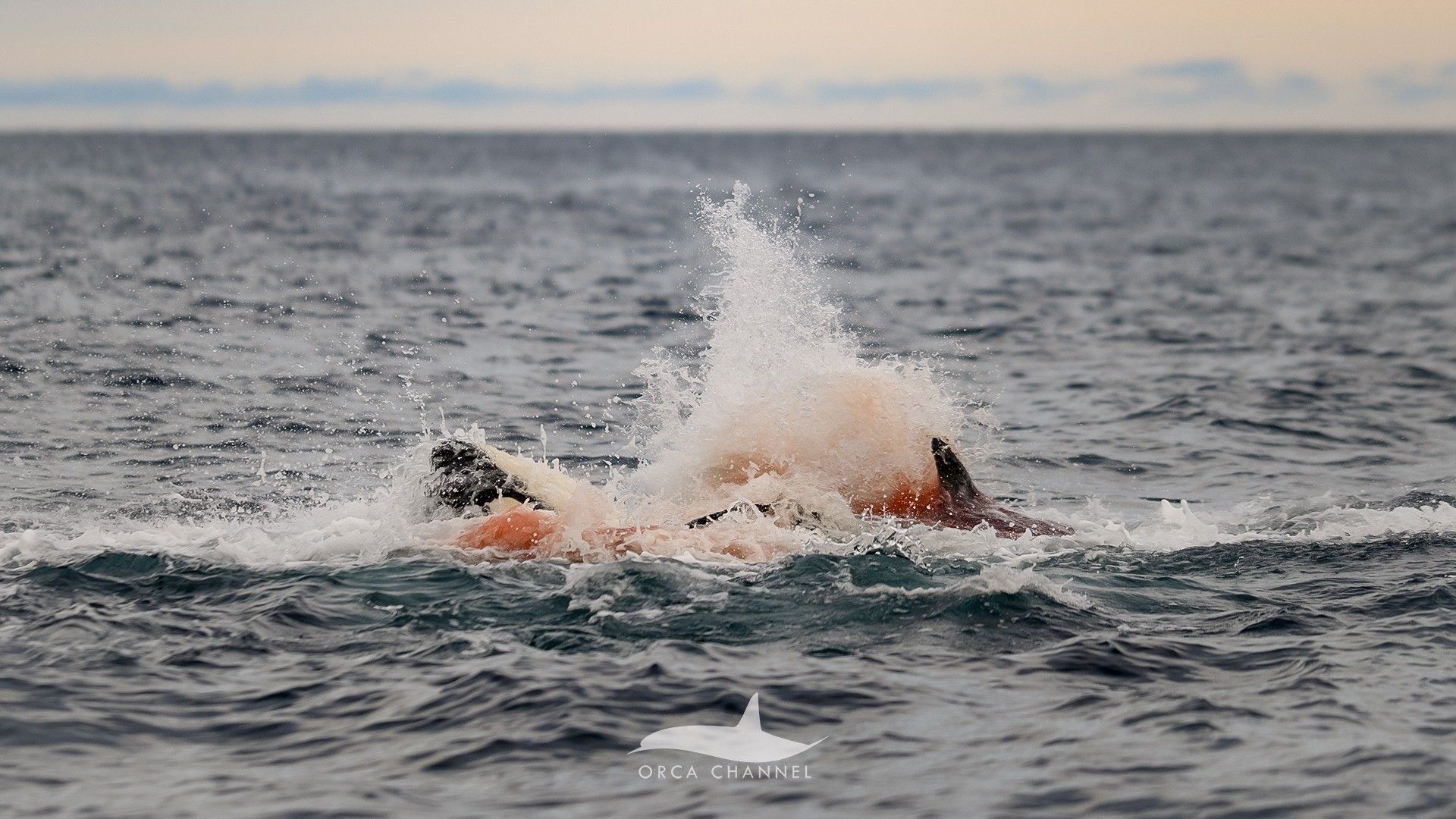
The researchers were observing a group of orcas (Orcinus orca) during a whale-watching trip off the coast of Skjervøy in the Arctic Circle when the water around the animals suddenly turned crimson with blood, they said.

“We were floating calmly and watching the feeding, when all of a sudden, close to the boat, there was blood spilling and splashing everywhere,” Krisztina Balotay, a photographer and videographer at Orca Channel, a boat tour company that also gathers marine mammal data in Norwegian waters, wrote in a Facebook post on Nov. 2.


You may like

“At first, I had no idea what was going on,” Balotay wrote in the post. “A moment later, I saw a little head pop above water. As it turned out, a female gave birth right next to us.”

Moments after the calf was born, the rest of the group formed a protective circle around it. The orcas, mostly females and juveniles, were unusually energetic and seemed to be forcefully pushing the newborn toward the surface, which worried the team on the boat at first.

“We observed them carrying the calf on their back and holding it above water for air,” Balotay wrote. “I was not sure if it was alive.”

Scientists with the Norwegian Orca Survey, a research and conservation organization, flew a drone above the orcas to take a closer look. They also asked five other whale-watching boats that were on the scene to clear the area so the animals could calm down, representatives of the survey wrote in a Facebook post on Nov. 3.

Get the world’s most fascinating discoveries delivered straight to your inbox.

Image 1 of 5

Orcas hold a newborn calf up to the surface.
Immediately after the birth, the orcas formed a protective circle around the calf.(Image credit: Krisztina Balotay)

Orcas push a newborn calf up to the surface of the water.
The orcas forcefully pushed the calf to the surface so it could breathe.(Image credit: Krisztina Balotay)

A newborn orca surrounded by other orcas in Norway.
The newborn orca’s coloration is slightly more orange than that of adults.(Image credit: Krisztina Balotay)

A newborn orca calf and its pod swim along the shore in Norway.
After 15 minutes of struggle, the orca calf was able to swim on its own.(Image credit: Krisztina Balotay)

Orcas swimming with a newborn calf.
Eventually, the orca group could swim off. The calf was alive and well.(Image credit: Krisztina Balotay)

Footage from the drone showed that the calf had struggled to stay afloat for the first 15 minutes after birth, but that it was alive and well after that.

“The mother was identified as NKW-591, a known female first identified in 2013,” the representatives wrote. “She has had multiple offspring and is therefore an experienced mother.”

The calf’s dorsal fin was bent, but this is to be expected in the hours after a newborn emerges from the womb, Balotay noted in Orca Channel’s post. “It was so amazing to watch something like this in the wild,” she added.

This is the first documented case of an orca being born in the wild and of its first hour alive, Norwegian Orca Survey representatives wrote on Facebook. The team followed the orcas until darkness fell, maintaining a distance of more than 1,000 feet (300 meters) so as not to disturb the animals. “We also ensured the whales’ space was protected by stopping additional boats from approaching,” they said.

The Norwegian Orca Survey hope they will encounter this orca group and the calf again in the coming weeks. In the meantime, researchers will collate the data they collected during and after the birth for a study.

“Documenting calf survival remains one of the core objectives of our long-term research,” they said.

Source link

Share. Facebook Twitter Pinterest LinkedIn Tumblr Email
Previous ArticleDOL launches 175 H-1B visa abuse investigations to protect American jobs
Next Article FAA-mandated flight reductions at major airports begin
Editor
  • Website

Related Posts

Lifestyle

Chinese medical practitioners used extremely toxic plant as a topical anesthetic 600 years ago, study finds

May 26, 2026
Lifestyle

Bead net funerary shroud: A 2,500-year-old beaded veil from Egypt depicting the deceased’s transformation into Osiris

May 25, 2026
Lifestyle

Rare genetic disease makes scientists reconsider what the ‘seat of fear’ in the brain really is

May 25, 2026
Add A Comment

Comments are closed.

Categories
  • Entertainment
  • Lifestyle
  • News
  • Sports
  • Tech
  • Travel
Recent Posts
  • Chinese medical practitioners used extremely toxic plant as a topical anesthetic 600 years ago, study finds
  • Bead net funerary shroud: A 2,500-year-old beaded veil from Egypt depicting the deceased’s transformation into Osiris
  • Rare genetic disease makes scientists reconsider what the ‘seat of fear’ in the brain really is
  • It’s illegal to repair most of our devices. There’s a surprising reason for that.
  • Jupiter’s Ganymede, the largest moon in the solar system, may be heating up
calendar
May 2026
M T W T F S S
 123
45678910
11121314151617
18192021222324
25262728293031
« Apr    
Recent Posts
  • Chinese medical practitioners used extremely toxic plant as a topical anesthetic 600 years ago, study finds
  • Bead net funerary shroud: A 2,500-year-old beaded veil from Egypt depicting the deceased’s transformation into Osiris
  • Rare genetic disease makes scientists reconsider what the ‘seat of fear’ in the brain really is
About

Welcome to Baynard Media, your trusted source for a diverse range of news and insights. We are committed to delivering timely, reliable, and thought-provoking content that keeps you informed
and inspired

Categories
  • Entertainment
  • Lifestyle
  • News
  • Sports
  • Tech
  • Travel
Facebook X (Twitter) Pinterest WhatsApp
  • Contact Us
  • About Us
  • Privacy Policy
  • Disclaimer
  • UNSUBSCRIBE
© 2026 copyrights reserved

Type above and press Enter to search. Press Esc to cancel.