Close Menu
  • Home
  • UNSUBSCRIBE
  • News
  • Lifestyle
  • Tech
  • Entertainment
  • Sports
  • Travel
Facebook X (Twitter) WhatsApp
Trending
  • Flesh-eating screwworm found in Texas cow. Are humans at risk?
  • New Velociraptor cousin was a ‘4-winged’ dragon that hunted prey from the trees of ancient China, fossil find hints
  • AI models are teaching each other ‘violent and antisocial’ traits through hidden data signals, study finds — and scientists can’t figure out why
  • Scientists race to collect the last seeds from a critically endangered tree before it goes extinct
  • What’s the deepest cave in the world?
  • ‘Crystals’ of space-time could be the origins of certain rare black holes, theoretical study hints
  • AI could consume up 3% of world’s electricity the UN warns
  • Kaleidoscopic meteorite could be a piece of a ‘lost world’ from the early solar system — Space photo of the week
Facebook X (Twitter) WhatsApp
Baynard Media
  • Home
  • UNSUBSCRIBE
  • News
  • Lifestyle
  • Tech
  • Entertainment
  • Sports
  • Travel
Baynard Media
Home»Lifestyle»Incomplete remains of world’s ‘youngest’ impact crater spotted lurking in Chinese forest — Earth from space
Lifestyle

Incomplete remains of world’s ‘youngest’ impact crater spotted lurking in Chinese forest — Earth from space

EditorBy EditorFebruary 24, 2026No Comments4 Mins Read
Share Facebook Twitter Pinterest LinkedIn Tumblr Reddit Telegram Email
Share
Facebook Twitter LinkedIn Pinterest Email

QUICK FACTS

Where is it? Yilan crater, Heilongjiang province, China [46.38232967, 129.31209278]

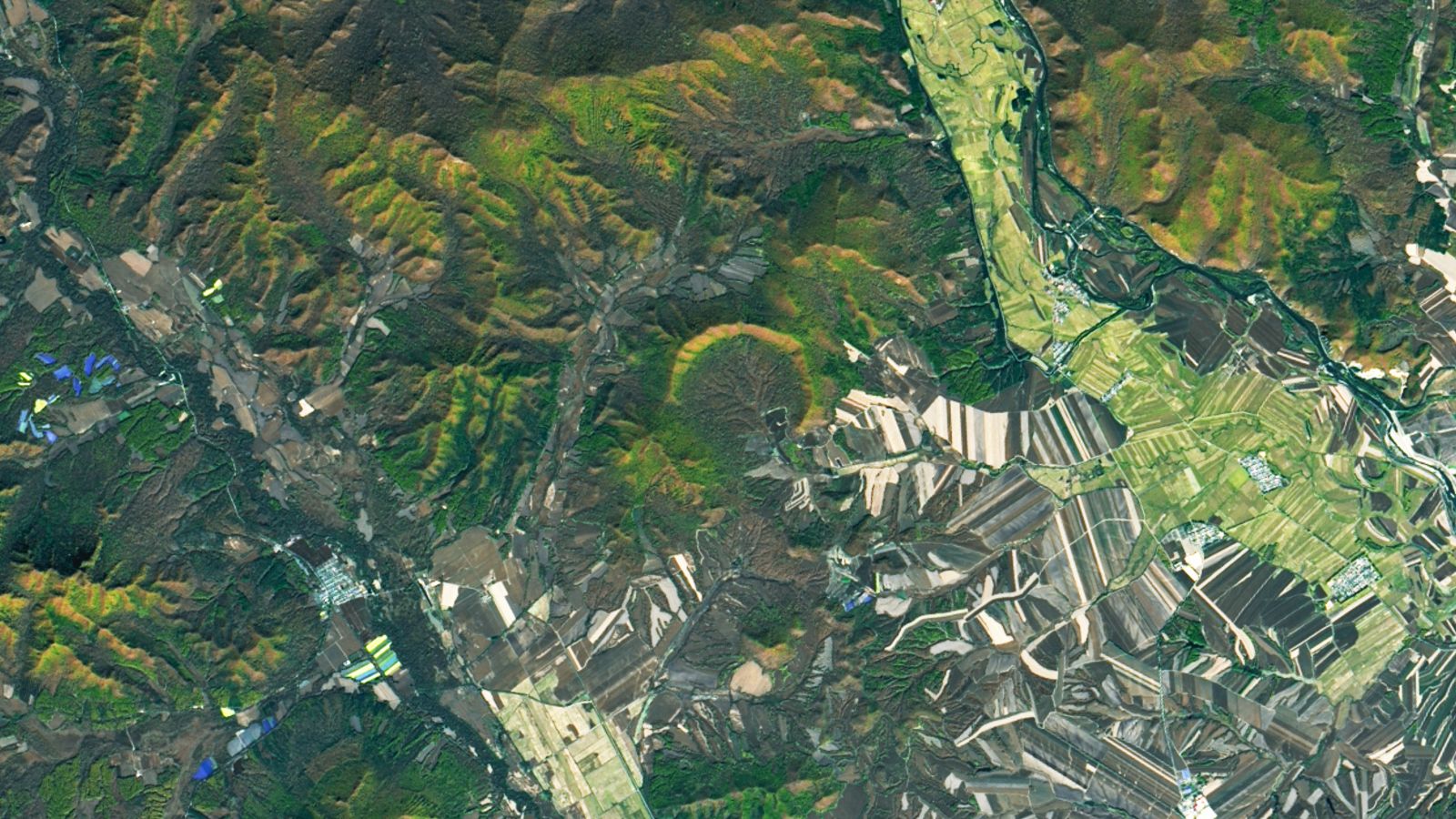
What’s in the photo? The incomplete remains of the world’s youngest impact structure

Which satellite took the photo? Landsat 8

When was it taken? Oct. 8, 2021

This striking satellite photo shows a recently uncovered meteor crater in China that is likely the youngest impact structure on Earth and the largest in its wider age bracket. The horseshoe-shaped depression is also only the second impact crater ever discovered in the country.

The Yilan crater is an incomplete, nearly circular impact crater located in the Lesser Xing’an (also spelled Khingan) mountain range of China’s Heilongjiang province, around 12.5 miles (20 kilometers) northwest of the town of Yilan. It is approximately 1.15 miles (1.85 km) across at its widest point, and its ringed walls reach up to 500 feet (150 meters) above the crater floor.

Chinese researchers discovered that the incomplete ring was an impact crater in mid-2021, around three months before this photo was taken. Until then, it had largely gone unnoticed because it is surrounded by thick forests. Although locals knew about the structure, they called it Quanshan, meaning “circular mountain ridge,” which suggests they had no idea of its extraterrestrial origins.


You may like

However, when the research team dug up to 1,440 feet (440 m) beneath the crater’s floor, they found “shocked quartz, melted granite, glass containing holes formed by gas bubbles, and tear-drop-shaped glass fragments” — all clear signs that a sizable space rock had slammed down there, according to NASA’s Earth Observatory.

Carbon dating revealed that the crater formed sometime between 46,000 and 53,000 years ago, meaning it could be the youngest of the roughly 200 major impact craters on Earth.

Photograph of Yilan city along the banks of a river

The newly discovered crater is around 12.5 miles northwest of the town of Yilan in Heilongjiang province. (Image credit: Getty Images)

Until this discovery, the most widely accepted “youngest major crater” on Earth was Barringer Crater (also known as Meteor Crater) in Arizona, which dates back 50,000 years, according to the Lunar and Planetary Institute. Given the uncertainty around the Yilan crater’s age, researchers cannot be sure that it is younger than Barringer Crater, although it is thought likely.

The Yilan crater is also the largest of any impact crater under 100,000 years old, so it beats another record previously held by Barringer Crater, which is around 0.75 mile (1.2 km) across.

Get the world’s most fascinating discoveries delivered straight to your inbox.

As you can see in the satellite photo, the southern third of the crater’s rim is missing. Researchers are unsure exactly when or how this section of the crater’s rim disappeared. However, sediment found on the crater’s floor hints that there was formerly a lake within the crater, which strongly suggests that the structure was once fully intact, according to the Earth Observatory.

Chinese craters

The Yilan crater is the first impact crater to be discovered in China since the 1.1-mile-wide (1.8 km) Xiuyan crater in Liaoning province, which dates back to between 330,000 and 1.1 million years ago, was confirmed in 2009.

Given how large China is — around the same size as the U.S. by land area — it has long been a mystery as to why more impact craters haven’t been found there. However, others have been uncovered following the discovery of the Yilan crater.

In September 2023, scientists discovered a third Chinese crater, around the same size as the Yilan crater. Carved into the summit of a mountain near the North Korean border, the crater dates back at least 150 million years.

Then, in October 2025, scientists confirmed a fourth impact structure, dubbed the Jinlin crater, on a mountain near Zhaoqing in China’s Guangdong province. This crater is only around 3,000 feet (900 m) wide and may date to as recently as the current epoch, known as the Holocene, which began 11,700 years ago, according to Sci News, although its age is unconfirmed.


An astronaut photo showing a section of the Great Dyke of Zimbabwe
‘Geological marvel’ in Zimbabwe

A 2010 astronaut photo shows off the astonishing scale of the Great Dyke of Zimbabwe, which stretches over 340 miles. The lengthy structure is full of extremely valuable minerals that fuel a massive mining industry.

Astronaut photo of the point where a glacier, green river and blue lake meet in a valley system in Patagonia
Glacier, lake and river ‘touch’

A 2021 astronaut photo shows a triple valley system in Argentina’s Los Glaciares National Park where a massive climate-resilient glacier, a pristine turquoise lake and a murky green “river” come together.

A satellite photo of a desert covered in streaks of white snow
Rare snow in Atacama desert

A 2025 satellite photo shows intricate snowy stripes painted across Chile’s Atacama Desert. The icy weather temporarily put one of the world’s most powerful telescopes into “survival mode.”

Source link

Share. Facebook Twitter Pinterest LinkedIn Tumblr Email
Previous ArticleHow to turn on Bluesky’s dark mode
Next Article The upstart hard-right party on the march in Britain
Editor
  • Website

Related Posts

Lifestyle

Flesh-eating screwworm found in Texas cow. Are humans at risk?

June 8, 2026
Lifestyle

New Velociraptor cousin was a ‘4-winged’ dragon that hunted prey from the trees of ancient China, fossil find hints

June 8, 2026
Lifestyle

AI models are teaching each other ‘violent and antisocial’ traits through hidden data signals, study finds — and scientists can’t figure out why

June 8, 2026
Add A Comment

Comments are closed.

Categories
  • Entertainment
  • Lifestyle
  • News
  • Sports
  • Tech
  • Travel
Recent Posts
  • Flesh-eating screwworm found in Texas cow. Are humans at risk?
  • New Velociraptor cousin was a ‘4-winged’ dragon that hunted prey from the trees of ancient China, fossil find hints
  • AI models are teaching each other ‘violent and antisocial’ traits through hidden data signals, study finds — and scientists can’t figure out why
  • Scientists race to collect the last seeds from a critically endangered tree before it goes extinct
  • What’s the deepest cave in the world?
calendar
June 2026
M T W T F S S
1234567
891011121314
15161718192021
22232425262728
2930  
« May    
Recent Posts
  • Flesh-eating screwworm found in Texas cow. Are humans at risk?
  • New Velociraptor cousin was a ‘4-winged’ dragon that hunted prey from the trees of ancient China, fossil find hints
  • AI models are teaching each other ‘violent and antisocial’ traits through hidden data signals, study finds — and scientists can’t figure out why
About

Welcome to Baynard Media, your trusted source for a diverse range of news and insights. We are committed to delivering timely, reliable, and thought-provoking content that keeps you informed
and inspired

Categories
  • Entertainment
  • Lifestyle
  • News
  • Sports
  • Tech
  • Travel
Facebook X (Twitter) Pinterest WhatsApp
  • Contact Us
  • About Us
  • Privacy Policy
  • Disclaimer
  • UNSUBSCRIBE
© 2026 copyrights reserved

Type above and press Enter to search. Press Esc to cancel.