Close Menu
  • Home
  • UNSUBSCRIBE
  • News
  • Lifestyle
  • Tech
  • Entertainment
  • Sports
  • Travel
Facebook X (Twitter) WhatsApp
Trending
  • New robotic heart mimics common, mysterious condition to help researchers study it
  • Canon EOS R6 III review: A wildlife wonder
  • Medieval babies and adults buried together in Sweden were not related, archaeologists discover — raising big questions about early Christian burial practices
  • NASA is creating a fifth state of matter on the ISS, thanks to an upgrade to a mini-fridge-sized quantum lab
  • New sodium metal battery design charges in just 4 minutes and retains its capacity for years
  • Quantum computing wielded to create extremely rare material critical to nuclear fusion
  • Scientists build tiny ‘diving suit’ for cockroaches, turning them into search-and-rescue cyborgs
  • Physicists develop the first working model of quantum mechanics using only ‘real’ numbers
Facebook X (Twitter) WhatsApp
Baynard Media
  • Home
  • UNSUBSCRIBE
  • News
  • Lifestyle
  • Tech
  • Entertainment
  • Sports
  • Travel
Baynard Media
Home»Lifestyle»In a cosmic first, astronomers spot the exact moment a new planet system is being born around an alien star
Lifestyle

In a cosmic first, astronomers spot the exact moment a new planet system is being born around an alien star

EditorBy EditorJuly 19, 2025No Comments3 Mins Read
Share Facebook Twitter Pinterest LinkedIn Tumblr Reddit Telegram Email
Share
Facebook Twitter LinkedIn Pinterest Email

For the first time ever, scientists have captured incredible images of an alien star system being born.

The image shows the very earliest moments of planet formation, when hot minerals are just beginning to solidify around a distant star, according to a statement. The researchers published their findings July 16 in the journal Nature.

Two telescopes worked together to reveal outflows of hot minerals around HOPS-315, which is a baby star like our sun roughly 1,300 light-years from Earth.


You may like

Initially, NASA’s James Webb Space Telescope (JWST) spotted “stuff coming from close to the star, but it wasn’t in the planet-forming region,” study co-author Edwin Bergin, a star formation specialist at the University of Michigan, told Live Science.

His team then used the Atacama Large Millimeter/submillimeter Array (ALMA), which is a set of antennas in the Chilean desert, to trace the outflow back to the protoplanetary disk — the dense disk of matter around a young star, where clumps of gas and dust can collapse into larger objects like planets.

“Then that unlocked everything,” Bergin said. It’s the first time that planet-forming solids have ever been detected, he said – which could help researchers better understand how our own solar system was born.

Related: Scientists discover rare planet at the edge of the Milky Way using space-time phenomenon predicted by Einstein

Get the world’s most fascinating discoveries delivered straight to your inbox.

Our solar system came into existence roughly 4.5 billion years ago in a cloud of gas and dust. As our sun formed and evolved, other materials gradually condensed into small solids, which grew by colliding and accreting into asteroids and comets, then in some cases, planetesimals and planets.

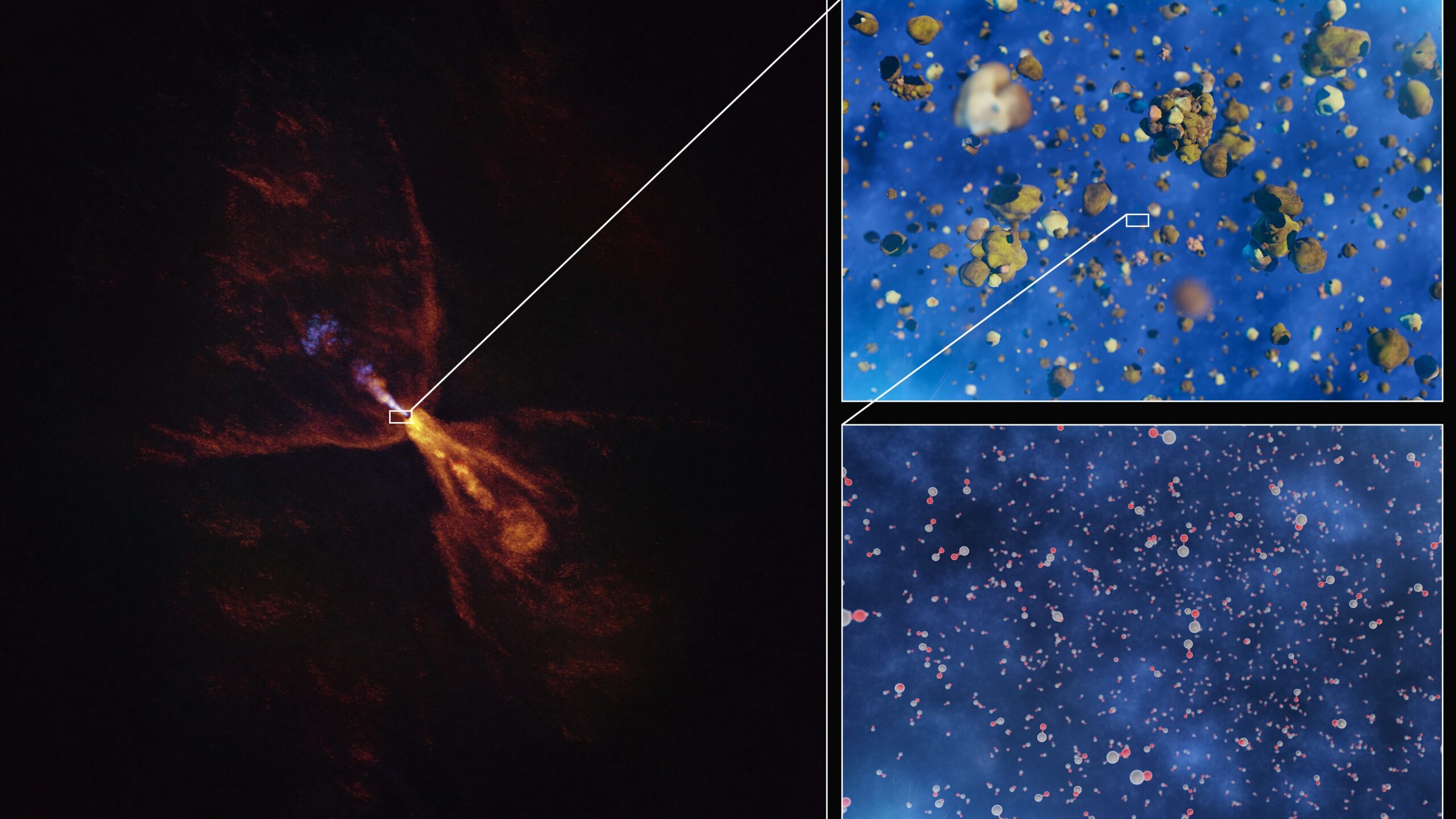
A close-up view of HOPS-315, taken with the ALMA array.

The young star HOPS-315 is erupting with twin jets of stellar radiation. The orange regions show carbon monoxide blowing away from the star, while the blue regions show silicon monoxide. The silicon monoxide will condense into solid silicate minerals. (Image credit: ESO/L. Calçada/ALMA(ESO/NAOJ/NRAO)/M. McClure et al.)

The very earliest phases of this process are tough to spot in other systems, Bergin said, and the phase lasts just 100,000 to 200,000 years, he noted. But learning more about what happens in this moment is crucial, because when minerals begin to condense, organics also form.

The new image shows carbon monoxide – represented in orange – blowing away from the star in a butterfly-shaped outflow, with a blue jet of silicon monoxide shining like an alien spine. A disk of gaseous silicon monoxide surrounding the area was also revealed, just as the gas was solidifying into silicates.

Earth and similar rocky planets like it formed as silicates and carbon came together, Bergin explained. Other research using ancient meteorites – formed in this same era – show these space rocks are full of crystalline minerals, containing silicon monoxide.

These solids are always moving about in the hot and windy conditions of a young star system, creating a rich environment for rocks to bind to each other. “The story of planetary formation is the story of motion and movement,” Bergin noted.

The researchers are hoping to use ALMA again to probe other young star systems that may have similar outflows, he added.

Source link

Share. Facebook Twitter Pinterest LinkedIn Tumblr Email
Previous ArticleColbert’s ‘Late Show’ lost $40 million yearly before CBS cancellation
Next Article Trump sues for $10 billion over WSJ’s Epstein report
Editor
  • Website

Related Posts

Lifestyle

New robotic heart mimics common, mysterious condition to help researchers study it

July 11, 2026
Lifestyle

Canon EOS R6 III review: A wildlife wonder

July 10, 2026
Lifestyle

Medieval babies and adults buried together in Sweden were not related, archaeologists discover — raising big questions about early Christian burial practices

July 10, 2026
Add A Comment

Comments are closed.

Categories
  • Entertainment
  • Lifestyle
  • News
  • Sports
  • Tech
  • Travel
Recent Posts
  • New robotic heart mimics common, mysterious condition to help researchers study it
  • Canon EOS R6 III review: A wildlife wonder
  • Medieval babies and adults buried together in Sweden were not related, archaeologists discover — raising big questions about early Christian burial practices
  • NASA is creating a fifth state of matter on the ISS, thanks to an upgrade to a mini-fridge-sized quantum lab
  • New sodium metal battery design charges in just 4 minutes and retains its capacity for years
calendar
July 2026
M T W T F S S
 12345
6789101112
13141516171819
20212223242526
2728293031  
« Jun    
Recent Posts
  • New robotic heart mimics common, mysterious condition to help researchers study it
  • Canon EOS R6 III review: A wildlife wonder
  • Medieval babies and adults buried together in Sweden were not related, archaeologists discover — raising big questions about early Christian burial practices
About

Welcome to Baynard Media, your trusted source for a diverse range of news and insights. We are committed to delivering timely, reliable, and thought-provoking content that keeps you informed
and inspired

Categories
  • Entertainment
  • Lifestyle
  • News
  • Sports
  • Tech
  • Travel
Facebook X (Twitter) Pinterest WhatsApp
  • Contact Us
  • About Us
  • Privacy Policy
  • Disclaimer
  • UNSUBSCRIBE
© 2026 copyrights reserved

Type above and press Enter to search. Press Esc to cancel.