Close Menu
  • Home
  • UNSUBSCRIBE
  • News
  • Lifestyle
  • Tech
  • Entertainment
  • Sports
  • Travel
Facebook X (Twitter) WhatsApp
Trending
  • Don Juan Pond: Antarctica’s salty, syrupy lake that never freezes, even when it’s minus 58 F
  • Withings ScanWatch 2 review: Style meets next-level health monitoring
  • AI Chatbots are turbo-charging violence against women and girls: We urgently need to regulate them | Yvonne McDermott Rees
  • ‘The biggest El Niño event since the 1870s’: ‘Super’ El Niño is now the most likely scenario by the end of this year ‪—‬ and the humanitarian cost could be huge
  • Antarctica’s sudden sea ice loss is one of the most extreme and confusing events in the modern climate record. Scientists now know why it’s happening.
  • ‘I heard gasps’: Artemis II astronauts reveal inside story of their mind-bending solar eclipse
  • A pill can stop people from developing COVID after being exposed to the virus, trial finds
  • ‘There are 4 people in those pixels’: Earth-based telescope snapped Artemis II crew orbiting the moon
Facebook X (Twitter) WhatsApp
Baynard Media
  • Home
  • UNSUBSCRIBE
  • News
  • Lifestyle
  • Tech
  • Entertainment
  • Sports
  • Travel
Baynard Media
Home»Lifestyle»If aliens existed on Mars 3.7 billion years ago, they would have needed umbrellas
Lifestyle

If aliens existed on Mars 3.7 billion years ago, they would have needed umbrellas

EditorBy EditorJuly 20, 2025No Comments4 Mins Read
Share Facebook Twitter Pinterest LinkedIn Tumblr Reddit Telegram Email
Share
Facebook Twitter LinkedIn Pinterest Email

Mars was a rainier, wetter place than planetary scientists previously thought, according to a new study of ancient, inverted river channels that span more than 9,000 miles (14,484 kilometers) in the Red Planet’s southern Noachis Terra region.

“Our work is a new piece of evidence that suggests that Mars was once a much more complex and active planet than it is now, which is such an exciting thing to be involved in,” study leader Adam Losekoot of the U.K.’s Open University said in a statement.

We’ve known Mars was once a wet planet ever since the Mariner 9 orbiter mission from the ’70s photographed a surface covered in dried-up river channels. These channels were dated back to over 3.5 billion years ago. However, channels cut into the ground are not the only evidence for running water on Mars.


You may like

When that water ran-off, or evaporated, it left sedimentary deposits. Sometimes we see these in craters that were once lakes filled with water: NASA’s Curiosity rover is exploring Gale Crater, which has a central three-mile-tall (five-kilometer-tall) peak covered in sediment.

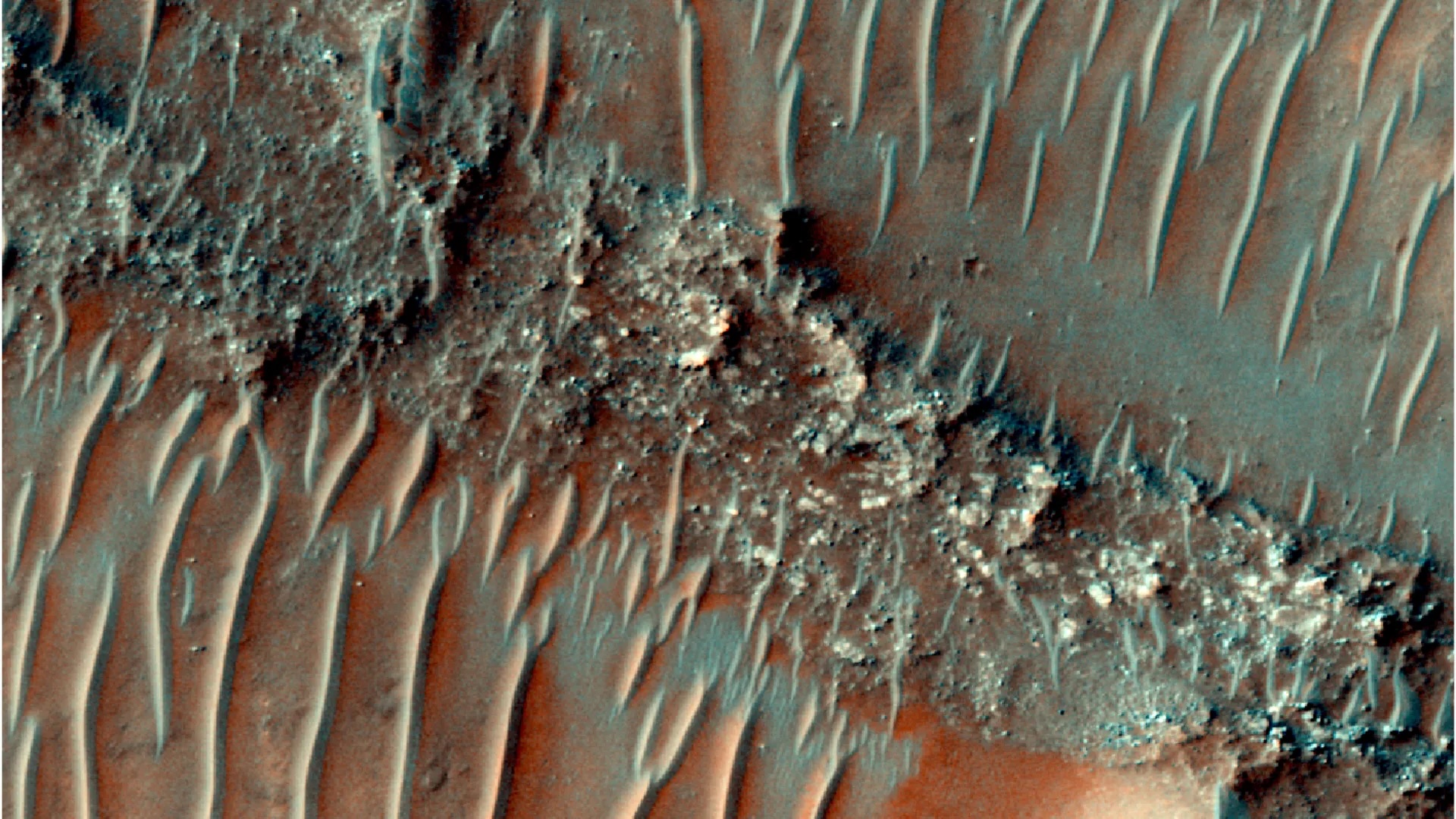
Other times, these sediments were laid down on river beds. Over the eons, the sediments would have hardened, while the river channels and the land around them would have weathered and eroded away. That left the sediments, which are more resistant to erosion, sticking out as tall ridges. Geologists today call them fluvial sinuous ridges, or, more plainly, inverted channels.

Now, Losekoot, who is a Ph.D. student, has led the discovery of a vast network of these channels in Noachis Terra based on images and data taken by the High Resolution Imaging Science Experiment (HiRISE) camera and the Context Camera on NASA’s Mars Reconnaissance Orbiter, and the Mars Orbiter Laser Altimeter (MOLA) on the defunct Mars Global Surveyor mission.

Related: Could signs of Mars life be hidden in its thick layers of clay?

Get the world’s most fascinating discoveries delivered straight to your inbox.

A gray-scale image of Mars' surface shows dried up river beds

(Image credit: NASA/JPL/MSSS/The Murray Lab)

Previously, Noachis Terra had not been given due attention because it lacked the more classical river channels that form more obvious evidence of water. However, by mapping the network of inverted channels, Losekoot realized there was lots of evidence there had once been plentiful water in the region.

“Studying Mars, particularly an under-explored region like Noachis Terra, is really exciting because it’s an environment which has been largely unchanged for billions of years,” said Losekoot. “It’s a time capsule that records fundamental geological processes in a way that just isn’t possible here on Earth.”

Some of the inverted channels appear as isolated segments that have survived the elements for billions of years. Others are more intact, forming systems that run for hundreds of miles and stand tens of yards tall.

A gray-scale photo shows the surface of Mars and its corresponding ancient river beds

This double inverted ridge signifies where an ancient river split into two before reconnecting downstream. Between the two ridges we can see a mesa, which may be the harder material that caused the river to diverge to get around it. (Image credit: NASA/JPL/University of Arizona)

Such a widespread network of inverted channels does not suggest these channels were caused by flash floods, argues Losekoot. Rather, they seem to have formed in stable climatic conditions over a geologically significant period of time during the Noachian–Hesperian transition, which was the shift from one geological era into the next around 3.7 billion years ago.

What’s particularly intriguing is the most likely source of water to have formed these inverted channels is precipitation — be it rain, hail or snow. Indeed, given the size of the inverted channel network in Noachis Terra, this region of Mars may have experienced lots of rainy days in a warm and wet climate.

It’s more evidence that Mars was once more like Earth than the cold and barren desert it is today.

Losekoot presented his findings at the Royal Astronomical Society’s National Astronomy Meeting held at the University of Durham in the U.K., which ran between July 7 and July 11.

This article was originally published on Space.com.

Source link

Share. Facebook Twitter Pinterest LinkedIn Tumblr Email
Previous Article15 gas stations with food worth a detour, according to online reviews
Next Article Pope Leo demands end to Gaza ‘barbarity’ after Israeli strike on Catholic church
Editor
  • Website

Related Posts

Lifestyle

Don Juan Pond: Antarctica’s salty, syrupy lake that never freezes, even when it’s minus 58 F

May 16, 2026
Lifestyle

Withings ScanWatch 2 review: Style meets next-level health monitoring

May 15, 2026
Lifestyle

AI Chatbots are turbo-charging violence against women and girls: We urgently need to regulate them | Yvonne McDermott Rees

May 15, 2026
Add A Comment

Comments are closed.

Categories
  • Entertainment
  • Lifestyle
  • News
  • Sports
  • Tech
  • Travel
Recent Posts
  • Don Juan Pond: Antarctica’s salty, syrupy lake that never freezes, even when it’s minus 58 F
  • Withings ScanWatch 2 review: Style meets next-level health monitoring
  • AI Chatbots are turbo-charging violence against women and girls: We urgently need to regulate them | Yvonne McDermott Rees
  • ‘The biggest El Niño event since the 1870s’: ‘Super’ El Niño is now the most likely scenario by the end of this year ‪—‬ and the humanitarian cost could be huge
  • Antarctica’s sudden sea ice loss is one of the most extreme and confusing events in the modern climate record. Scientists now know why it’s happening.
calendar
May 2026
M T W T F S S
 123
45678910
11121314151617
18192021222324
25262728293031
« Apr    
Recent Posts
  • Don Juan Pond: Antarctica’s salty, syrupy lake that never freezes, even when it’s minus 58 F
  • Withings ScanWatch 2 review: Style meets next-level health monitoring
  • AI Chatbots are turbo-charging violence against women and girls: We urgently need to regulate them | Yvonne McDermott Rees
About

Welcome to Baynard Media, your trusted source for a diverse range of news and insights. We are committed to delivering timely, reliable, and thought-provoking content that keeps you informed
and inspired

Categories
  • Entertainment
  • Lifestyle
  • News
  • Sports
  • Tech
  • Travel
Facebook X (Twitter) Pinterest WhatsApp
  • Contact Us
  • About Us
  • Privacy Policy
  • Disclaimer
  • UNSUBSCRIBE
© 2026 copyrights reserved

Type above and press Enter to search. Press Esc to cancel.