Close Menu
  • Home
  • UNSUBSCRIBE
  • News
  • Lifestyle
  • Tech
  • Entertainment
  • Sports
  • Travel
Facebook X (Twitter) WhatsApp
Trending
  • New AI model spots pancreatic cancer up to 3 years earlier than human doctors in test
  • Watch NASA’s Curiosity rover ‘struggle’ to remove a rock that got stuck on its robotic arm for nearly a week
  • ‘Almost tragicomical’: Coins minted to protect the English from the Vikings ended up as Viking jewelry, experts discover
  • Andes virus — the only hantavirus strain that can spread between people — identified as culprit on cruise ship
  • New water battery could last until the 24th century — and it can be safely discarded in the environment
  • We remember little to nothing of early childhood — and a new mouse study may help explain why
  • The night sky could get three times brighter as new satellites launch — all but ruining the Vera C. Rubin Observatory’s survey of the universe
  • Happy 100th birthday, David Attenborough: 13 surprising facts about the famous naturalist
Facebook X (Twitter) WhatsApp
Baynard Media
  • Home
  • UNSUBSCRIBE
  • News
  • Lifestyle
  • Tech
  • Entertainment
  • Sports
  • Travel
Baynard Media
Home»Lifestyle»‘I was shaking when I first unearthed it’: 11th-century silver coin hoard unearthed in England
Lifestyle

‘I was shaking when I first unearthed it’: 11th-century silver coin hoard unearthed in England

EditorBy EditorJanuary 11, 2025No Comments4 Mins Read
Share Facebook Twitter Pinterest LinkedIn Tumblr Reddit Telegram Email
Share
Facebook Twitter LinkedIn Pinterest Email

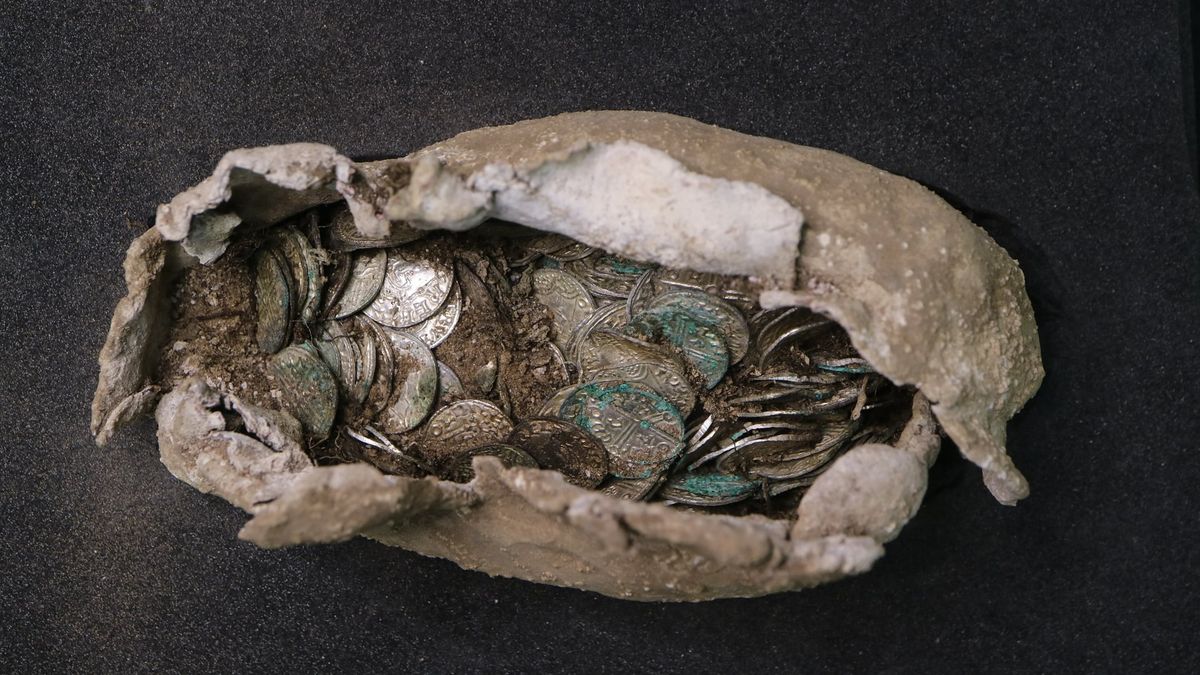
Archaeologists in England have unearthed a hoard of 321 silver coins in mint condition on the construction site of a nuclear power plant. The coins were wrapped in cloth and lead, suggesting their owner may have been trying to protect them while burying them to avoid having them confiscated.

The coins — some of which are from small, rural mints, and therefore quite rare — date to between 1036 and 1044. This means they coincide with the start of the Anglo-Saxon king Edward the Confessor’s reign, a turbulent period of English history during which the king exiled and confiscated the properties of several elites who had fallen out of his favor, according to a statement.

The 11th-century value of the coin hoard, amounting to 320 pence, would have been a sizable sum for most people at the time — enough to buy about 16 cows, said Alexander Bliss, a coin specialist with Oxford Cotswold Archaeology (OCA), the organization that excavated the coins.

“Perhaps the owner of the hoard was concerned about the new regime [or] political situation and wider social instability, taking steps to hide their wealth,” Bliss told Live Science in an email. “There are now three hoards from this period (1042 to 1044) known across England, which strengthens the idea that the first years of Edward’s reign were not calm.”

Related: Anglo-Saxons plagiarized a Roman coin — and it’s full of typos

Anglo-Saxon coin hoards are relatively rare, Bliss said, and the newly discovered treasure stands out because archaeologists excavated it in its original context, with a preserved textile pouch still holding the coins. Many coin hoards lack such context, either because they have been disturbed by agricultural activity or because some metal detectorists don’t immediately recognize the significance of broken casing and leave it behind.

“In this instance, preserving the pouch was very important because it forms part of the overall ‘object’ as one element of containment for the coins,” Bliss said. “We also wanted to understand whether the lead was just a piece of sheet or had been detached from a larger object.”

Get the world’s most fascinating discoveries delivered straight to your inbox.

Archaeologists undid the pouch in a laboratory and determined that the lead wrapping was manufactured from folded sheet, suggesting that the owner of the hoard took care when burying it and used a casing he or she knew to be sturdy.

Close up picture of silver coins minted between 1036 and 1044 in England. Some of the coins are bluish-green due to toning over time.

A close-up of silver coins excavated at the Sizewell C construction site. (Image credit: Oxford Cotswold Archaeology)

Based on the archaeological record, lead sheet was not an uncommon method of storing coins — but the choice of this relatively solid material begs the question of why the owner didn’t use a pot instead, Bliss said. “Perhaps they were unable to access one which was small enough, or alternatively perhaps they wanted to try and disguise the valuable contents,” he said.

The owner of the hoard was likely a person of middling status, rather than an elite or somebody of national importance. They might have had local influence and therefore feared repercussions from the regime change, prompting them to bury a saving pot following the coronation of Edward the Confessor.

Archaeologists discovered the coin hoard while excavating a site on the Suffolk coast in eastern England, where construction for a new nuclear power station called Sizewell C began in 2024.

“I was shaking when I first unearthed it,” Andrew Pegg, an OCA archaeologist, said in the statement. “The information we are learning from it is stunning and I’m so proud to have added to the history of my own part of Suffolk.”

It’s unclear why the owner never came back for the coins, but it’s possible that he or she died before managing to recover it or tell anyone about it. “They might alternatively have been prevented from recovering them due to other means, for example if they left or were exiled from the country and were unable to return,” Bliss said.

Source link

Share. Facebook Twitter Pinterest LinkedIn Tumblr Email
Previous ArticleHow Angelina Jolie and Son Knox Are Helping Family Amid LA Fires
Next Article Eight ways Mark Zuckerberg changed Meta ahead of Trump’s inauguration
Editor
  • Website

Related Posts

Lifestyle

New AI model spots pancreatic cancer up to 3 years earlier than human doctors in test

May 7, 2026
Lifestyle

Watch NASA’s Curiosity rover ‘struggle’ to remove a rock that got stuck on its robotic arm for nearly a week

May 7, 2026
Lifestyle

‘Almost tragicomical’: Coins minted to protect the English from the Vikings ended up as Viking jewelry, experts discover

May 7, 2026
Add A Comment

Comments are closed.

Categories
  • Entertainment
  • Lifestyle
  • News
  • Sports
  • Tech
  • Travel
Recent Posts
  • New AI model spots pancreatic cancer up to 3 years earlier than human doctors in test
  • Watch NASA’s Curiosity rover ‘struggle’ to remove a rock that got stuck on its robotic arm for nearly a week
  • ‘Almost tragicomical’: Coins minted to protect the English from the Vikings ended up as Viking jewelry, experts discover
  • Andes virus — the only hantavirus strain that can spread between people — identified as culprit on cruise ship
  • New water battery could last until the 24th century — and it can be safely discarded in the environment
calendar
May 2026
M T W T F S S
 123
45678910
11121314151617
18192021222324
25262728293031
« Apr    
Recent Posts
  • New AI model spots pancreatic cancer up to 3 years earlier than human doctors in test
  • Watch NASA’s Curiosity rover ‘struggle’ to remove a rock that got stuck on its robotic arm for nearly a week
  • ‘Almost tragicomical’: Coins minted to protect the English from the Vikings ended up as Viking jewelry, experts discover
About

Welcome to Baynard Media, your trusted source for a diverse range of news and insights. We are committed to delivering timely, reliable, and thought-provoking content that keeps you informed
and inspired

Categories
  • Entertainment
  • Lifestyle
  • News
  • Sports
  • Tech
  • Travel
Facebook X (Twitter) Pinterest WhatsApp
  • Contact Us
  • About Us
  • Privacy Policy
  • Disclaimer
  • UNSUBSCRIBE
© 2026 copyrights reserved

Type above and press Enter to search. Press Esc to cancel.