Close Menu
  • Home
  • UNSUBSCRIBE
  • News
  • Lifestyle
  • Tech
  • Entertainment
  • Sports
  • Travel
Facebook X (Twitter) WhatsApp
Trending
  • Why does metal stick together in space?
  • Faster ‘biological aging’ in young adults may help explain rise in early-onset cancers, study hints
  • Computer scientists are rushing to tame tame AI’s voracious appetite for energy
  • Our brains aren’t wired to handle this much bad news. But ‘looking away is not the fix,’ expert says.
  • ‘The fate of Earth depends on a delicate balance’: Our planet may survive the death of the sun after all, new models hint
  • Bullseye! Enormous ‘bow and arrow’ galaxy is unlike anything radio astronomers have ever seen — Space photo of the week
  • IBM creates first sub-1nm computer chip — cramming 100 billion transistors into a tiny fingernail-sized space
  • New chip harnesses quantum computing’s biggest weakness — and tries to turn it into a strength
Facebook X (Twitter) WhatsApp
Baynard Media
  • Home
  • UNSUBSCRIBE
  • News
  • Lifestyle
  • Tech
  • Entertainment
  • Sports
  • Travel
Baynard Media
Home»Lifestyle»Huge magma eruptions may have torn South America and Africa apart during the breakup of supercontinent Pangaea
Lifestyle

Huge magma eruptions may have torn South America and Africa apart during the breakup of supercontinent Pangaea

EditorBy EditorApril 4, 2025No Comments3 Mins Read
Share Facebook Twitter Pinterest LinkedIn Tumblr Reddit Telegram Email
Share
Facebook Twitter LinkedIn Pinterest Email

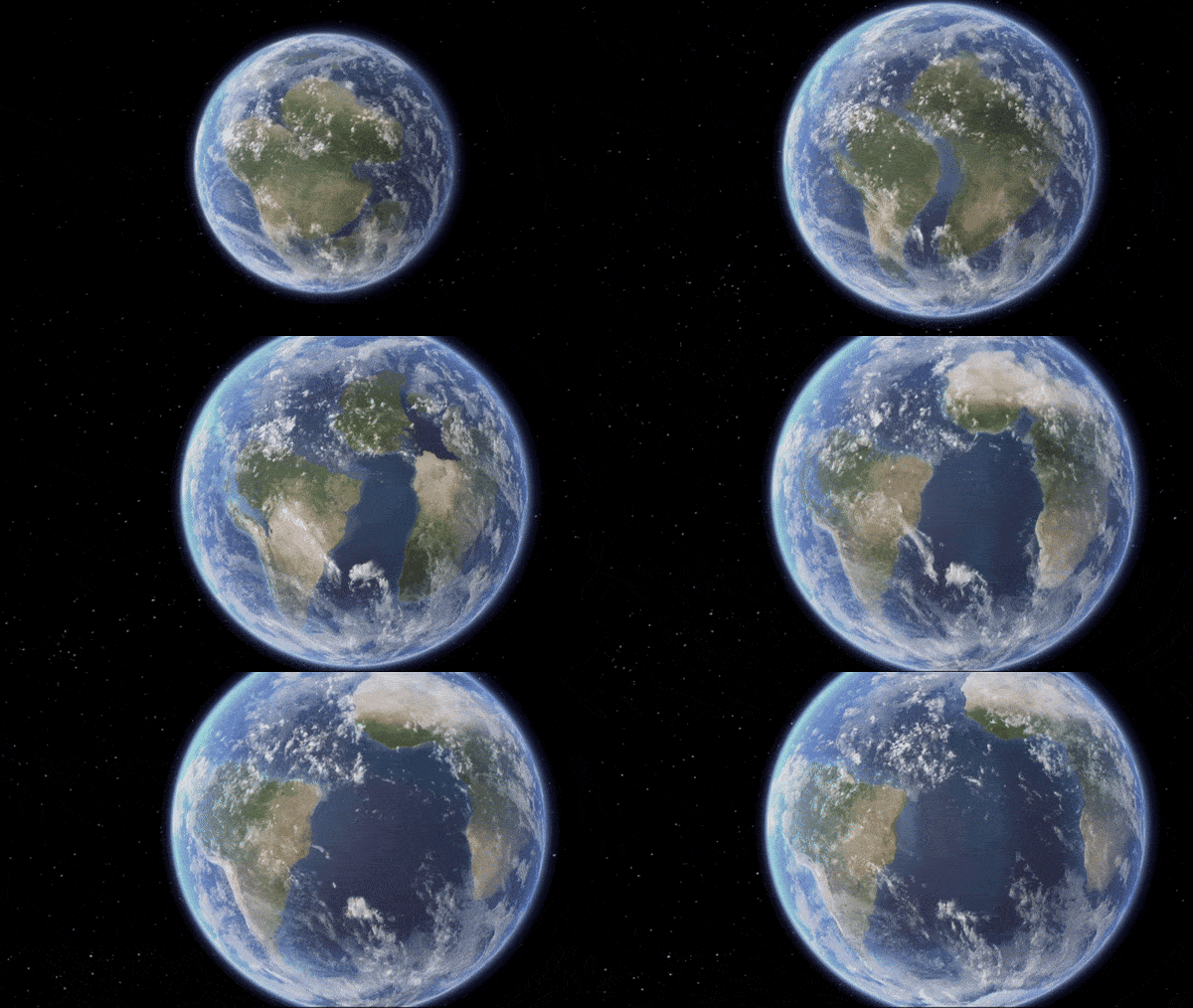
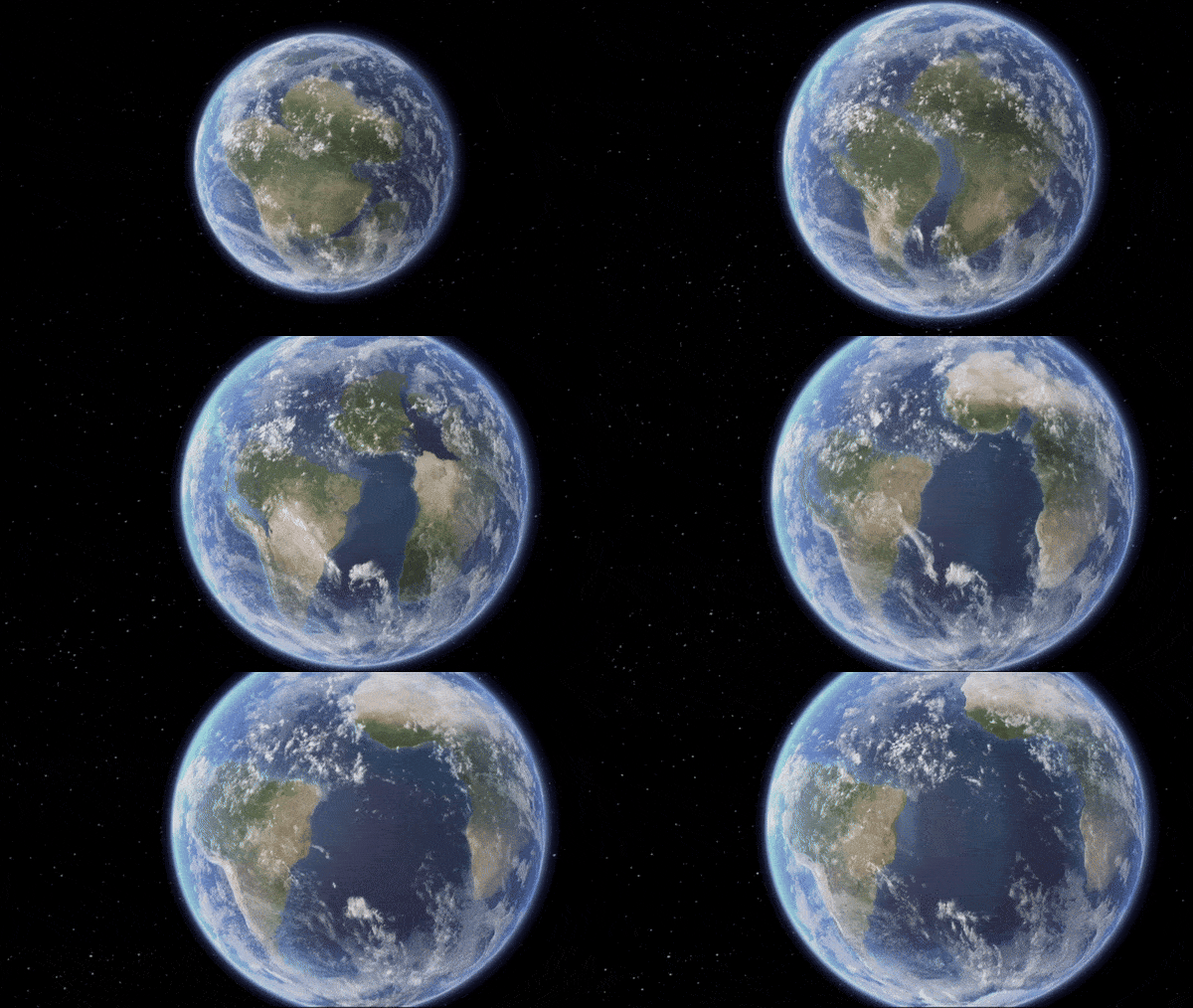
The split between South America and Africa 135 million years ago was a fiery affair, new research finds.

The continental breakup spewed over 3.8 million cubic miles (16 million cubic kilometers) of magma that still persists as volcanic rocks in South America, in Africa, and on the seafloor of the Atlantic Ocean. In some places in Namibia and Angola, these volcanic rock layers are up to 0.6 mile (1 kilometer) thick.

The new study — which combines multiple sources of previously collected data from South America, Africa and the ocean floor — finds that the main magma eruptions occurred between 135 million and 131 million years ago, with a peak around 134.5 million years ago. This improved understanding of the eruption timing could give researchers a better idea of what triggered the breakup as well as its impacts on the climate.

“We get some extinctions and also some perturbations on the climate” around 134.5 million years ago, said study lead author Mohamed Mansour Abdelmalak, a geologist and geophysicist at the University of Oslo in Norway. Knowing the precise age of the magma helps tie the eruptions to these events.

The new research also finds evidence of a “thermal anomaly” beneath what was then southern Pangaea, the supercontinent that began breaking up 200 million years ago into the continents present today. This breakup was slow, with South America and Africa splitting 135 million years ago, and North American not completing its schism with Europe until 55 million years ago. Previous research has suggested that the breakup of southern Pangaea happened, in part, because of what’s known as a mantle plume — a rising column of superhot rock from Earth’s middle layer, the mantle. These plumes melt and thin the continental crust from below.

The new research hints that the thermal anomaly that helped separate South America and Africa may have been caused by that mantle plume, Abdelmalak told Live Science, but the hypothesis is still controversial.

“We don’t have many samples, so we don’t know exactly if this volcanism is related to the mantle plume,” he said. Samples are particularly needed from the rock that now sits under the deep ocean off the coast of Argentina and Uruguay, where very little deep-sea drilling has been done, he said.

Get the world’s most fascinating discoveries delivered straight to your inbox.

There is a modern-day example of a mantle plume leading to outpourings of magma in Iceland, however, Abdelmalak said. There, the Mid-Atlantic Ridge — which is still pulling apart at a rate of 0.8 to 2 inches (2 to 5 centimeters) a year — is on land. This land has been formed by the Iceland hotspot, which studies suggest is driven by a plume reaching deep into the mantle.

Additional deep rock samples from Africa and the deep ocean could help researchers understand how much magma erupted during the split between Africa and South America and how the eruptions affected the climate, Abdelmalak said. In most large eruptions, the climate warms because volcanoes spew huge amounts of greenhouse gases. But there was a period of cooling 134 million years ago, which may have been because the magma that erupted broke down, or weathered, quickly. In weathering, rocks break down and chemically react with the air, pulling carbon dioxide out of the atmosphere.

The findings appear in the May issue of the journal Earth-Science reviews.

Source link

Share. Facebook Twitter Pinterest LinkedIn Tumblr Email
Previous ArticleNASA launches rockets into auroras, creating breathtaking lights in Alaskan skies (photos)
Next Article Thousands of strange, blobby creatures are washing up on California beaches
Editor
  • Website

Related Posts

Lifestyle

Why does metal stick together in space?

June 29, 2026
Lifestyle

Faster ‘biological aging’ in young adults may help explain rise in early-onset cancers, study hints

June 29, 2026
Lifestyle

Computer scientists are rushing to tame tame AI’s voracious appetite for energy

June 28, 2026
Add A Comment

Comments are closed.

Categories
  • Entertainment
  • Lifestyle
  • News
  • Sports
  • Tech
  • Travel
Recent Posts
  • Why does metal stick together in space?
  • Faster ‘biological aging’ in young adults may help explain rise in early-onset cancers, study hints
  • Computer scientists are rushing to tame tame AI’s voracious appetite for energy
  • Our brains aren’t wired to handle this much bad news. But ‘looking away is not the fix,’ expert says.
  • ‘The fate of Earth depends on a delicate balance’: Our planet may survive the death of the sun after all, new models hint
calendar
June 2026
M T W T F S S
1234567
891011121314
15161718192021
22232425262728
2930  
« May    
Recent Posts
  • Why does metal stick together in space?
  • Faster ‘biological aging’ in young adults may help explain rise in early-onset cancers, study hints
  • Computer scientists are rushing to tame tame AI’s voracious appetite for energy
About

Welcome to Baynard Media, your trusted source for a diverse range of news and insights. We are committed to delivering timely, reliable, and thought-provoking content that keeps you informed
and inspired

Categories
  • Entertainment
  • Lifestyle
  • News
  • Sports
  • Tech
  • Travel
Facebook X (Twitter) Pinterest WhatsApp
  • Contact Us
  • About Us
  • Privacy Policy
  • Disclaimer
  • UNSUBSCRIBE
© 2026 copyrights reserved

Type above and press Enter to search. Press Esc to cancel.