
Scientists have discovered a previously-undetected flood under the Greenland ice sheet that spilled out with such force that it burst through nearly 300 feet (91 meters) of solid ice.
The phenomenon occurred in 2014 and caused 24 billion gallons (90 billion liters) of meltwater to punch out from a subglacial lake under the ice sheet. It is the first time such an event has ever been documented in the country.
By studying the sudden cascade, scientists say they will gain vital information about how ice melts in the region and the destructive impacts of this process on the rest of the Greenland sheet. They published their findings Wednesday (July 30) in the journal Nature Geoscience.
“When we first saw this, because it was so unexpected, we thought there was an issue with our data,” study lead author Jade Bowling, a glaciologist at Lancaster University, said in a statement. “However, as we went deeper into our analysis, it became clear that what we were observing was the aftermath of a huge flood of water escaping from underneath the ice.”
“The existence of subglacial lakes beneath the Greenland Ice Sheet is still a relatively recent discovery, and — as our study shows — there is still much we don’t know about how they evolve and how they can impact on the ice sheet system,” Bowling added.
Greenland’s ice sheet is one of only two permanent ice sheets on Earth, the other being the Antarctic ice sheet. It is nearly three times the size of Texas, covering roughly 656,000 square miles (1.7 million square kilometers), according to the US National Snow and Ice Data Center (NSIDC) in Colorado, and loses an estimated 33 million tons (30 million metric tons) of ice every hour.
Related: Scientists record never-before-seen ‘ice quakes’ deep inside Greenland’s frozen rivers
Less is known about the role of meltwater from the ice sheet. Scientists previously thought that it flows from the surface to the base then out into the ocean. The new study looked at subglacial lakes — bodies of liquid water trapped beneath the ice — that tend to be fed by meltwater.
The researchers suggest that these lakes could contribute vast amounts of water to the ocean through drainage events but, as they were only recently discovered, they are still poorly understood.
Using satellite data, the team identified a previously-unknown subglacial lake in the north of Greenland, uncovering a huge flood event that fractured the ice from below.
After poring over data collected by a suite of satellites (NASA’s ICEsat, ICEsat-2 and Landsat-8, along with the European Space Agency’s Sentinel-1, Sentinel-2 and CryoSat-2), the scientists were able to create 3D models of the subglacial flood.
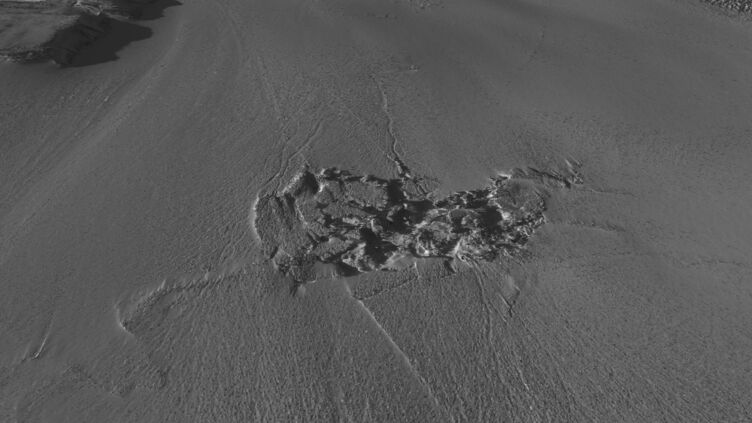
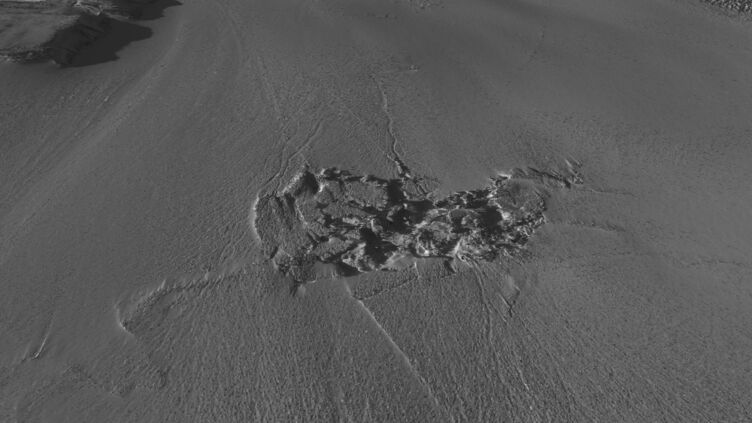
This revealed that, over 10 days between July and August 2014, a 0.77 square-mile (2 square-kilometer) wide, 279 foot (85 m) deep crater was blasted out from the ice sheet as 24 billion gallons of water rushed out to the surface from a meltwater lake uphill. The huge deluge is roughly equivalent to nine hours of Niagara Falls’s peak flow.
Further downstream, the scientists discovered that the surge had fractured a large area of ice, leaving uprooted ice blocks that stood at 82 feet (25 m) high and scouring an ice surface around twice the size of New York’s Central Park.
The findings not only confound past expectations about how meltwater typically flows through an ice sheet before seeping out into the ocean, but also contradicts models predicting that the sheet is frozen solid at its base.
“What we have found in this study surprised us in many ways,” co-author Amber Leeson, a glaciologist at Lancaster University, said in the statement. “It has taught us new and unexpected things about the way that ice sheets can respond to extreme inputs of surface meltwater, and emphasised the need to better understand the ice sheet’s complex hydrological system, both now and in the future.”
