Close Menu
  • Home
  • UNSUBSCRIBE
  • News
  • Lifestyle
  • Tech
  • Entertainment
  • Sports
  • Travel
Facebook X (Twitter) WhatsApp
Trending
  • More young people are getting colorectal cancer — here’s what scientists think might be happening
  • ‘I have no doubt that life is out there’: Why radio astronomers are convinced alien contact is only a matter of time
  • 800-year-old ‘hugging skeletons’ are genetically confirmed as Poland’s only medieval same-sex double burial
  • There’s a new T. rex from the dinosaur age — and it ruled the seas with a skull-crushing bite
  • Great Pyramid of Giza is remarkably resilient to earthquakes —‬ and it’s due to the ancient Egyptians’ ‘extraordinary’ engineering knowledge
  • China’s real-life ‘transformer’ mech is a giant humanoid robot that can switch from bounding on 4 legs to walking on 2
  • How can we prevent AI models from cannibalizing themselves when human-generated data runs out? Scientists say they’ve found the answer.
  • ‘The system is likely to reach a breaking point’: Major Italian volcano is speeding toward a transition, and a major eruption could be on the way
Facebook X (Twitter) WhatsApp
Baynard Media
  • Home
  • UNSUBSCRIBE
  • News
  • Lifestyle
  • Tech
  • Entertainment
  • Sports
  • Travel
Baynard Media
Home»Lifestyle»Hubble revisits stunning Trifid Nebula after 30 years, and spots a growing jet of energy — Space photo of the week
Lifestyle

Hubble revisits stunning Trifid Nebula after 30 years, and spots a growing jet of energy — Space photo of the week

EditorBy EditorApril 26, 2026No Comments4 Mins Read
Share Facebook Twitter Pinterest LinkedIn Tumblr Reddit Telegram Email
Share
Facebook Twitter LinkedIn Pinterest Email

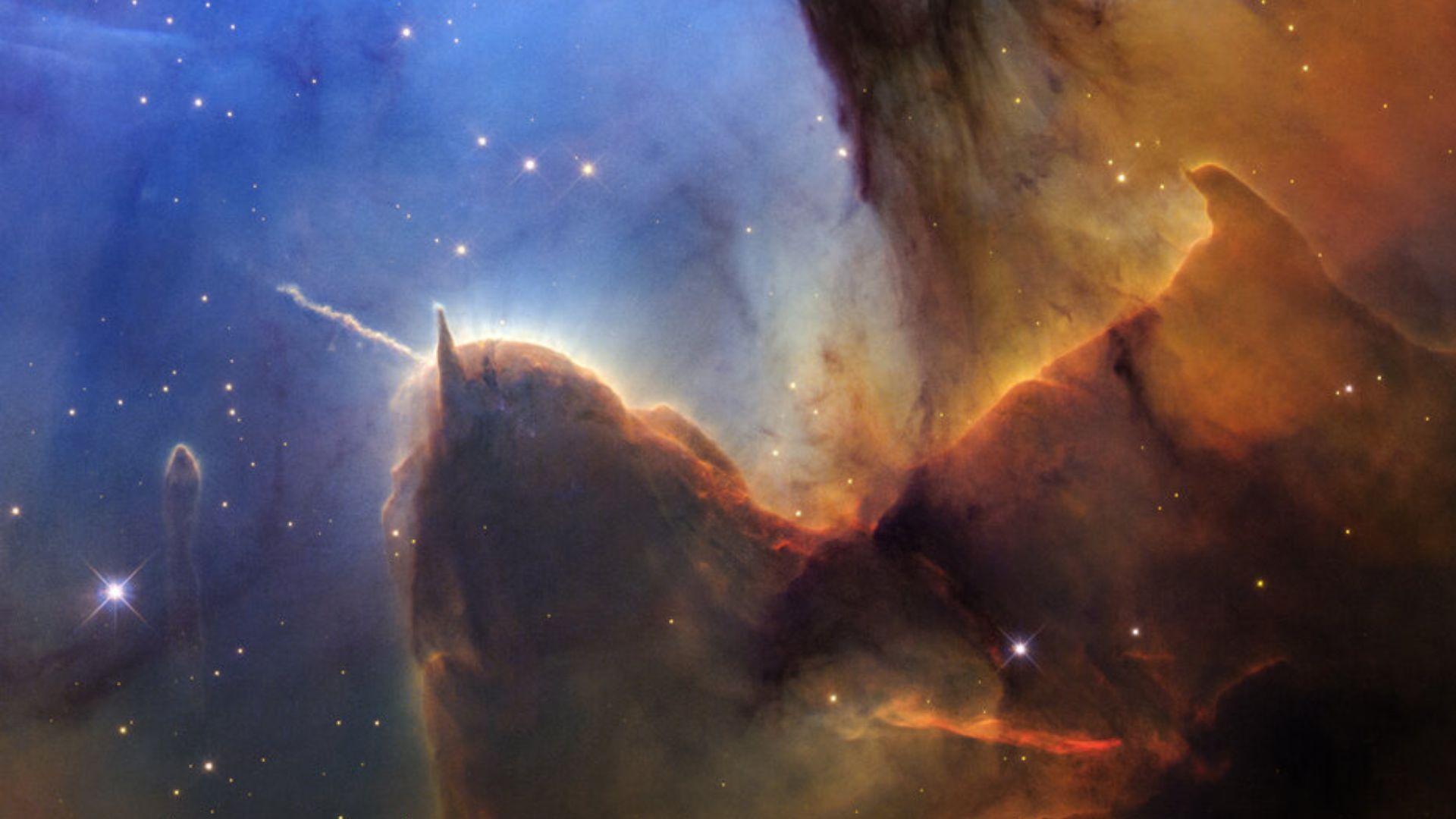
Swirling clouds of brown dust and gas mix in front of a starry blue spacescape

Hubble revisited the aquatic-looking Trifid Nebula 30 years after its original observations. (Image credit: NASA, ESA, STScI. Image processing: J. DePasquale (STScI))

Quick facts

What it is: Trifid Nebula (Messier 20)

Where it is: 5,000 light-years from Earth in the constellation Sagittarius

When it was shared: April 20, 2026
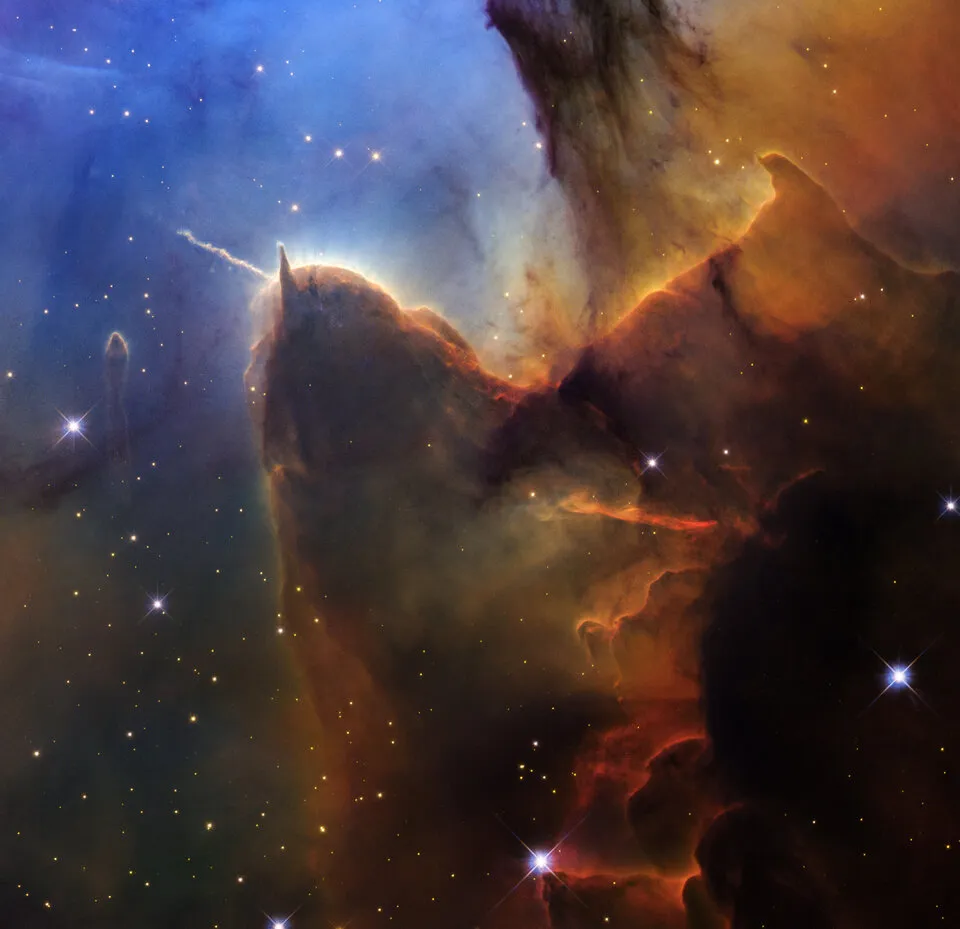
There are speckles, horns, and a series of colorful, glowing ridges. No, it’s not an underwater creature — it’s the latest breathtaking portrait of the Trifid Nebula, captured by the Hubble Space Telescope.

This nebula, also known as Messier 20, is a star-forming region located around 5,000 light-years from Earth in the constellation Sagittarius. Nicknamed the “Cosmic Sea Lemon,” this zoomed-in portion of the nebula tells a story of the tantrums of young, massive stars blowing a giant bubble of gas and dust. This region is home to several stellar giants (not captured in this field of view) that have sculpted this region for at least 300,000 years.

What makes this image even more special is that Hubble first photographed this exact scene back in 1997 using its Wide Field and Planetary Camera 2. Now, 29 years later, Hubble took a second look at this stunning scenery for its 36th anniversary — this time, with its more powerful Wide Field Camera 3.


You may like

Swirling clouds of brown gas and dust mix against a dark blue starry background.

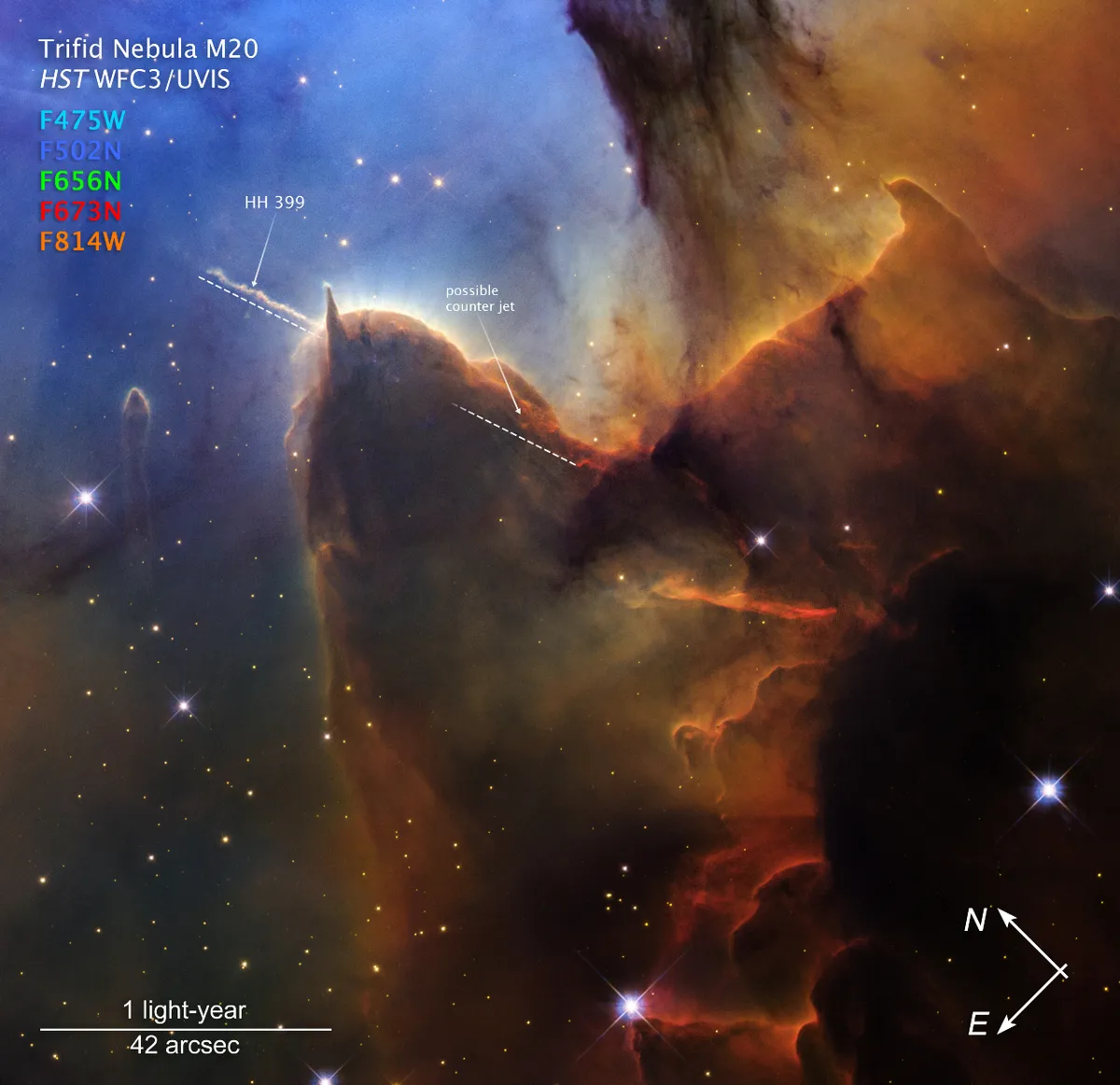
An annotated image of the Trifid Nebula, showing the jet and possible counter-jet being spat out by a young star. (Image credit: NASA, ESA, STScI. Image processing: J. DePasquale (STScI))

In the new image, the mesmerizing orange cloud linings show where powerful ultraviolet radiation from massive stars has stripped electrons from nearby gas, making it glow. Their stellar winds have cleared some surrounding dust, as shown in the bright-blue area where the dust is thinnest. The far-right corner — nearly pitch-black — is where the dust is densest.

The prominent brown-shaped structure in the center left of the image is the “head” of the cosmic sea lemon. Its “body” is a rust-colored cloud of gas. Between two “horns,” yellow gas splashes outward like the glow of a volcano’s lava, almost as if something were being destroyed there. And that is exactly what’s happening; these are regions where the ultraviolet light is eroding gas and dust, according to the European Space Agency.

The main peak, seen left of the sea lemon’s head, is accompanied by a jet of energetic gas. This region is part of the Herbig-Haro (HH) object called HH-399, and the jet is ejected by a baby star located within the sea lemon’s head. (HH objects are bright regions of nebulosity created by the powerful jets of newborn stars.)

Comparing the new observations with the 1997 image, researchers actually watched the jet expand. This change will allow scientists to estimate the jet’s speed, revealing how much energy the young star is injecting into its surroundings. There is also a thick streak of material in bright orange and blazing red that appears to expand to the right — potentially a jet shooting from another newly formed star.

Get the world’s most fascinating discoveries delivered straight to your inbox.

The bright-orange stars scattered across the scene have already won their battle against the nebula. They are fully formed, and their light and stellar winds have cleared the space around them. Over the next few million years, the remaining stars buried in the nebula will do the same. The gas and dust will slowly disappear, and only stars will remain.

With this image, Hubble not only celebrates 36 years of operations but also puts its improved capabilities on full display. The newly operational Vera C. Rubin Observatory, located in Chile’s Atacama Desert, also captured the Trifid Nebula, looking like a giant cloud of cotton candy, in its first batch of images.


Source link

Share. Facebook Twitter Pinterest LinkedIn Tumblr Email
Previous ArticleWhat you’ll need to see May 2026’s night sky
Next Article Astronomers just mapped one of the largest structures in the universe, long hidden behind the Milky Way’s ‘Zone of Avoidance’
Editor
  • Website

Related Posts

Lifestyle

More young people are getting colorectal cancer — here’s what scientists think might be happening

May 22, 2026
Lifestyle

‘I have no doubt that life is out there’: Why radio astronomers are convinced alien contact is only a matter of time

May 22, 2026
Lifestyle

800-year-old ‘hugging skeletons’ are genetically confirmed as Poland’s only medieval same-sex double burial

May 21, 2026
Add A Comment

Comments are closed.

Categories
  • Entertainment
  • Lifestyle
  • News
  • Sports
  • Tech
  • Travel
Recent Posts
  • More young people are getting colorectal cancer — here’s what scientists think might be happening
  • ‘I have no doubt that life is out there’: Why radio astronomers are convinced alien contact is only a matter of time
  • 800-year-old ‘hugging skeletons’ are genetically confirmed as Poland’s only medieval same-sex double burial
  • There’s a new T. rex from the dinosaur age — and it ruled the seas with a skull-crushing bite
  • Great Pyramid of Giza is remarkably resilient to earthquakes —‬ and it’s due to the ancient Egyptians’ ‘extraordinary’ engineering knowledge
calendar
May 2026
M T W T F S S
 123
45678910
11121314151617
18192021222324
25262728293031
« Apr    
Recent Posts
  • More young people are getting colorectal cancer — here’s what scientists think might be happening
  • ‘I have no doubt that life is out there’: Why radio astronomers are convinced alien contact is only a matter of time
  • 800-year-old ‘hugging skeletons’ are genetically confirmed as Poland’s only medieval same-sex double burial
About

Welcome to Baynard Media, your trusted source for a diverse range of news and insights. We are committed to delivering timely, reliable, and thought-provoking content that keeps you informed
and inspired

Categories
  • Entertainment
  • Lifestyle
  • News
  • Sports
  • Tech
  • Travel
Facebook X (Twitter) Pinterest WhatsApp
  • Contact Us
  • About Us
  • Privacy Policy
  • Disclaimer
  • UNSUBSCRIBE
© 2026 copyrights reserved

Type above and press Enter to search. Press Esc to cancel.