Close Menu
  • Home
  • UNSUBSCRIBE
  • News
  • Lifestyle
  • Tech
  • Entertainment
  • Sports
  • Travel
Facebook X (Twitter) WhatsApp
Trending
  • First-of-its-kind map of the mouse nose reveals surprises about the sense of smell
  • Some fungi can influence the weather ‪—‬ and now we know how they do it
  • Neanderthals’ brains weren’t to blame for their demise, new study suggests
  • NASA Curiosity rover uncovers rock with 7 new organic molecules on Mars
  • Mystery of golden orb found in depths of ocean off Alaska finally solved: ‘Everyone was like, What the heck? What is that?’
  • How everything you do is being monitored in an AI-fuelled ‘surveillance capitalism system’ that’s ramping up aggressively
  • Amazfit Active 3 Premium review: A wallet- and beginner-friendly running watch
  • Miniature camelid effigy: A silver llama with a wry smile that the Inca crafted 600 years ago
Facebook X (Twitter) WhatsApp
Baynard Media
  • Home
  • UNSUBSCRIBE
  • News
  • Lifestyle
  • Tech
  • Entertainment
  • Sports
  • Travel
Baynard Media
Home»Lifestyle»Hubble and Euclid capture the final act of a dying star — and it’s glorious: Space photo of the week
Lifestyle

Hubble and Euclid capture the final act of a dying star — and it’s glorious: Space photo of the week

EditorBy EditorMarch 15, 2026No Comments3 Mins Read
Share Facebook Twitter Pinterest LinkedIn Tumblr Reddit Telegram Email
Share
Facebook Twitter LinkedIn Pinterest Email

Quick Facts

What it is: Cat’s Eye Nebula (NGC 6543).

Where it is: 4,300 light-years away from Earth, in the constellation Draco.

When it was shared: Mar. 3, 2026.

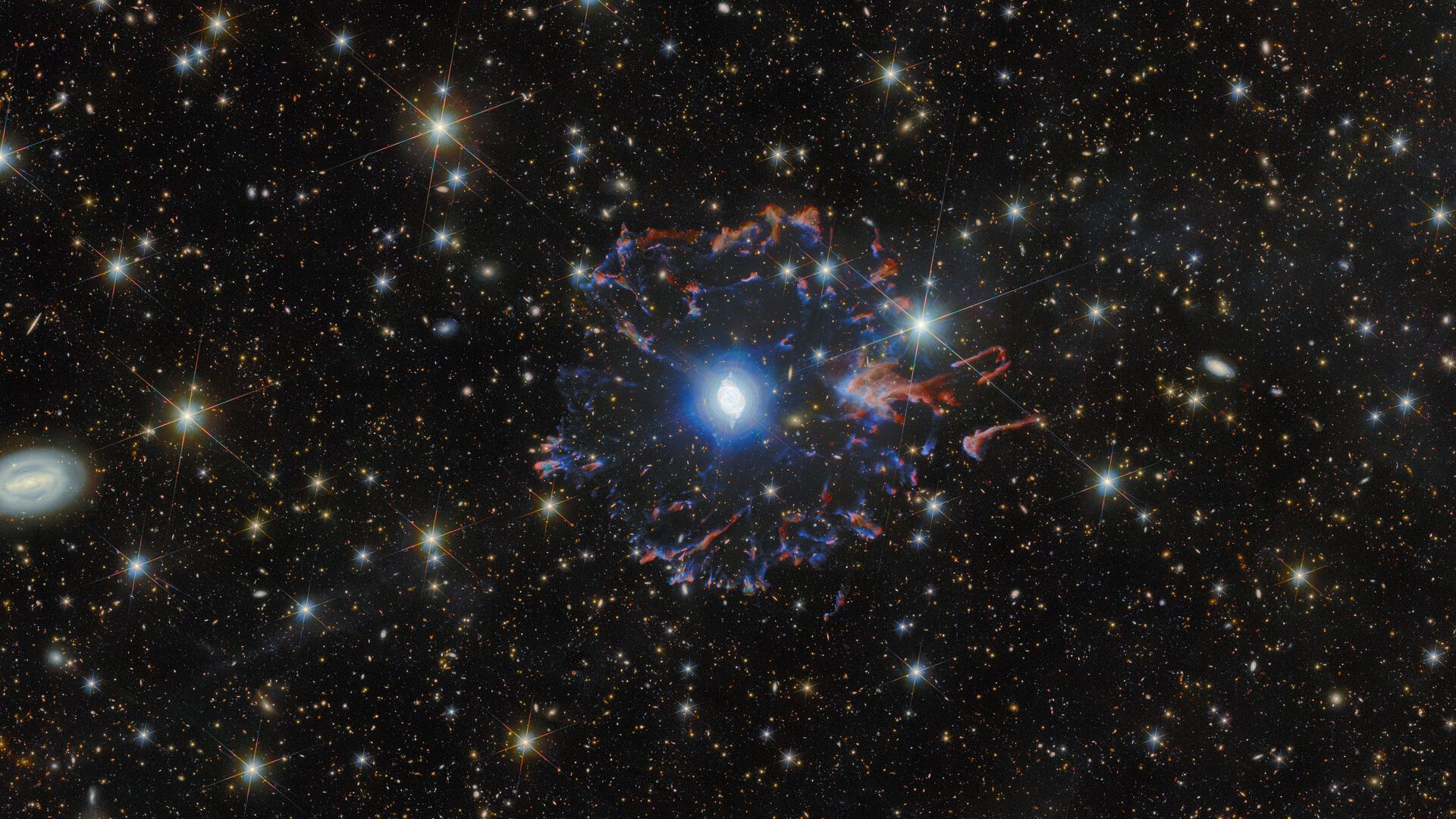
These stunning cosmic snaps show distorted glowing rings of blue, orange and red gas racing away from a dying star. Set against a sea of galaxies and stars, this image showcases the famous Cat’s Eye Nebula, otherwise known as NGC 6543.

As calm and beautiful as it appears, don’t be fooled. This scenic nebula was shaped by the messy interaction between the star’s intense winds, outer layers and powerful jets, thereby creating its intricate, eye-like structure.

Located roughly 4,300 light-years from Earth, the “Cat’s Eye” is a planetary nebula — an expanding cloud of glowing gas expelled by a star of low to medium mass that has reached the final stages of its life. Unlike more massive stars, which die in violent supernova explosions, the central star has gently shed its outer layers into space, creating beautiful and complex shells of discarded material.

Article continues below


You may like

These spectacular images were created using observations from the Hubble Space Telescope and the European Space Agency’s (ESA) Euclid space telescope.

Two images of a planetary nebula in space. The image to the left, labelled “Euclid & Hubble”, shows the whole nebula and its surroundings. A star in the very center is surrounded by white bubbles and loops of gas, all shining with a powerful blue light. Farther away a broken ring of red and blue gas clouds surrounds the nebula. The background shows many stars and distant galaxies. A white box indicates the center of the nebula and this region is the image to the right, labelled “Hubble”. It shows the multi-layered bubbles, pointed jets and circular shells of gas that make up the nebula, as well as the central star, in greater detail.e

A view of the Cat’s Eye Nebula from both the Hubble and Euclid telescopes. (Image credit: ESA/Hubble & NASA, ESA Euclid/Euclid Consortium/NASA/Q1-2025, J.-C. Cuillandre & E. Bertin (CEA Paris-Saclay), Z. Tsvetanov)

Euclid’s wide-field view, captured in visible and near-infrared light, shows faint arcs and delicate filaments of gas surrounding the bright central region. These wispy structures appear to be flying off the scene, into space, and are thought to have been expelled during an earlier stage of the star’s death, before the outer layers were shed that formed the main nebula.

Hubble has captured the fine details of the bright central region of the nebula. This close-up view was taken using visible light and shows a dead yet bright star surrounded by white bubbles and blue loops of gas. Using its Advanced Camera for Surveys, Hubble has revealed even finer, intricate details at the heart of the nebula, including the complexity of gas bubbles and delicate filamentary structures embedded within those bubbles.

These finer details serve as a “fossil record” of the nebula, according to an ESA statement. Each gas bubble corresponds to an episode of mass loss of the dying star. In the image, these bubbles are followed by concentric circles or rings within a brown halo; each ring marks the boundary of the bubbles. Further, the data reveal jets of energetic and high-speed gas, shown in pink, that shoot out from the top and bottom of the nebula. There are also dense knots formed by shock interactions of high-speed jets and slowly-expanding ejected material.

Get the world’s most fascinating discoveries delivered straight to your inbox.

While Hubble captures the unprecedented details of the dying star’s bright nest and its immediate surroundings, Euclid reveals the faint arcs and colorful gas filaments a little farther from the nebula, along with the wider cosmic landscape dotted with distant galaxies. Together, they present an almost cinematic view of the final act of a dying star.


Source link

Share. Facebook Twitter Pinterest LinkedIn Tumblr Email
Previous ArticleScott Pelley slams CBS for settling Trump lawsuit under corporate pressure
Next Article Newport Beach Weighs Sculpture Garden Site for Police
Editor
  • Website

Related Posts

Lifestyle

First-of-its-kind map of the mouse nose reveals surprises about the sense of smell

April 29, 2026
Lifestyle

Some fungi can influence the weather ‪—‬ and now we know how they do it

April 28, 2026
Lifestyle

Neanderthals’ brains weren’t to blame for their demise, new study suggests

April 28, 2026
Add A Comment

Comments are closed.

Categories
  • Entertainment
  • Lifestyle
  • News
  • Sports
  • Tech
  • Travel
Recent Posts
  • First-of-its-kind map of the mouse nose reveals surprises about the sense of smell
  • Some fungi can influence the weather ‪—‬ and now we know how they do it
  • Neanderthals’ brains weren’t to blame for their demise, new study suggests
  • NASA Curiosity rover uncovers rock with 7 new organic molecules on Mars
  • Mystery of golden orb found in depths of ocean off Alaska finally solved: ‘Everyone was like, What the heck? What is that?’
calendar
April 2026
M T W T F S S
 12345
6789101112
13141516171819
20212223242526
27282930  
« Mar    
Recent Posts
  • First-of-its-kind map of the mouse nose reveals surprises about the sense of smell
  • Some fungi can influence the weather ‪—‬ and now we know how they do it
  • Neanderthals’ brains weren’t to blame for their demise, new study suggests
About

Welcome to Baynard Media, your trusted source for a diverse range of news and insights. We are committed to delivering timely, reliable, and thought-provoking content that keeps you informed
and inspired

Categories
  • Entertainment
  • Lifestyle
  • News
  • Sports
  • Tech
  • Travel
Facebook X (Twitter) Pinterest WhatsApp
  • Contact Us
  • About Us
  • Privacy Policy
  • Disclaimer
  • UNSUBSCRIBE
© 2026 copyrights reserved

Type above and press Enter to search. Press Esc to cancel.