Close Menu
  • Home
  • UNSUBSCRIBE
  • News
  • Lifestyle
  • Tech
  • Entertainment
  • Sports
  • Travel
Facebook X (Twitter) WhatsApp
Trending
  • Scientists race to collect the last seeds from a critically endangered tree before it goes extinct
  • What’s the deepest cave in the world?
  • ‘Crystals’ of space-time could be the origins of certain rare black holes, theoretical study hints
  • AI could consume up 3% of world’s electricity the UN warns
  • Kaleidoscopic meteorite could be a piece of a ‘lost world’ from the early solar system — Space photo of the week
  • Some ‘extinct’ volcanoes may just be going through a growth spurt, before they ‘wake up in this catastrophic stage,’ emerging research suggests
  • Jupiter and Venus conjunction 2026: See two bright planets at the same time this weekend
  • Flu drugs might fight cognitive decline seen in HIV, early study hints
Facebook X (Twitter) WhatsApp
Baynard Media
  • Home
  • UNSUBSCRIBE
  • News
  • Lifestyle
  • Tech
  • Entertainment
  • Sports
  • Travel
Baynard Media
Home»Lifestyle»How to watch Saturday’s sunrise ‘devil horn’ solar eclipse online for free
Lifestyle

How to watch Saturday’s sunrise ‘devil horn’ solar eclipse online for free

EditorBy EditorMarch 27, 2025No Comments3 Mins Read
Share Facebook Twitter Pinterest LinkedIn Tumblr Reddit Telegram Email
Share
Facebook Twitter LinkedIn Pinterest Email

The March 29 solar eclipse is almost upon us!

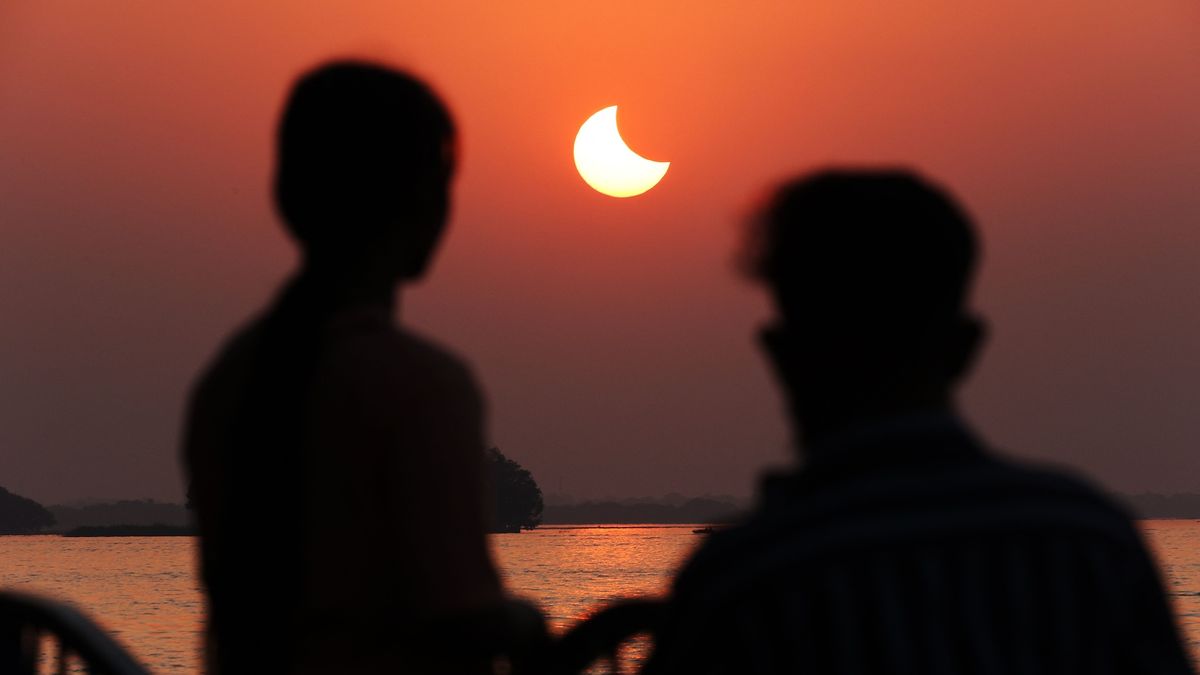
Early on Saturday, the sun will rise partially eclipsed over 13 U.S. states and a broad swath of northeastern Canada. With the new moon covering up to 93% of the sun’s visible surface, millions of people will have the opportunity to watch our star appear to grow a pair of “devil’s horns” in the eerie dawn light.

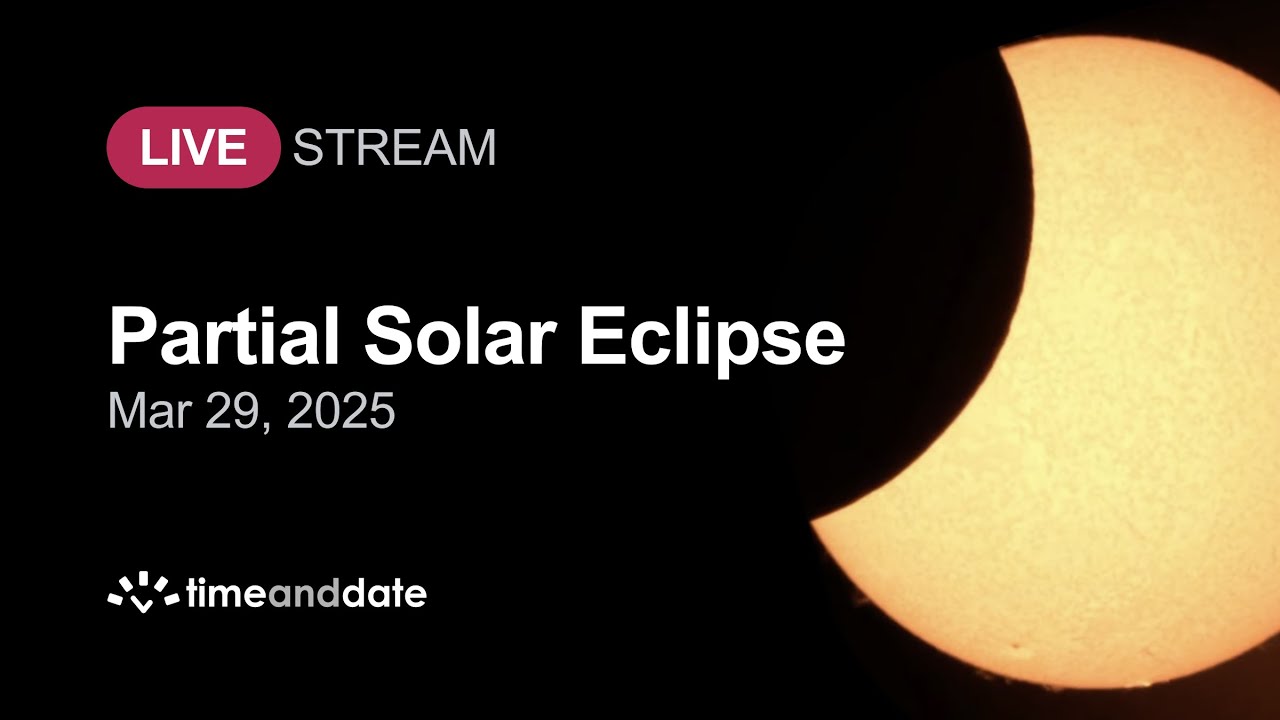
But even if you’re not in the immediate path of the eclipse — or if you don’t have protective eyewear — you can still watch this rare phenomenon unfold in several free online live streams, which you can find right here on this page, courtesy of Timeanddate.com and the Royal Observatory Greenwich.

Watch live: March 29 solar eclipse from North America
LIVE: Partial Solar Eclipse – March 29, 2025 – YouTube
LIVE: Partial Solar Eclipse - March 29, 2025 - YouTube


Watch On

Beginning at 5:30 a.m. EDT, Timeanddate’s stream will show the partial eclipse transpire from a variety of angles and locations around the world. The precise time, duration and extent of the eclipse will be different depending on where in the world it’s being observed from.

Related: What time does the March 29 solar eclipse start?

The live feed will feature images and videos of the eclipse as soon as the sun rises in North America, with prime views coming from St. John’s — the capital city of Newfoundland and Labrador in Canada. If skies are clear, the “devil’s horns” will appear prominently on the sun when the eclipse peaks at around 7:53 a.m. EDT, reaching 82% coverage of the solar disk, according to Timeanddate’s eclipse map. The partial eclipse over Newfoundland will end an hour later.

Watch live: The view from Europe

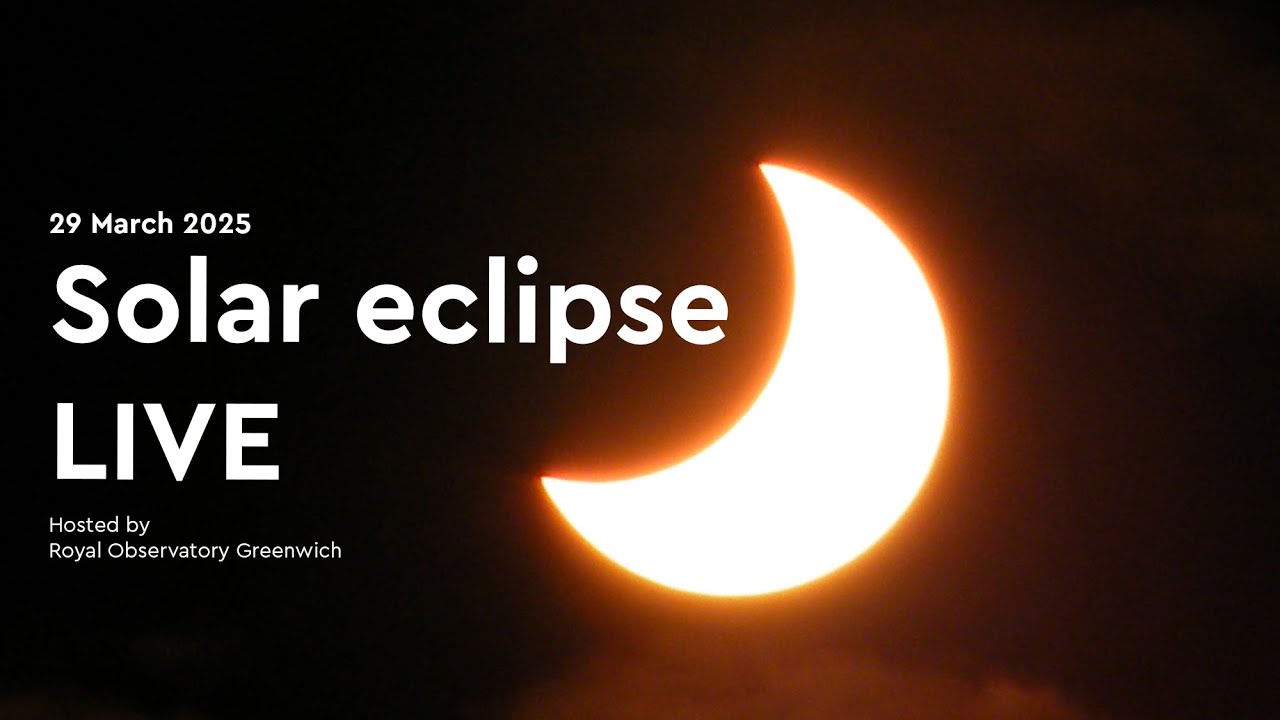
Timeanddate’s stream will also feature several views from across the Atlantic. These will include images from Siena, Italy, which will see a maximum eclipse of about 5% at noon local time; views from the towns of Kristiansand and Skibotn, Norway, where the sun will reach 30% and 37% obscuration, respectively; and a feed from the Royal Observatory Greenwich in London, U.K., where the eclipse will peak at around 11:03 a.m. local time with about 40% coverage.

Get the world’s most fascinating discoveries delivered straight to your inbox.

The Royal Observatory Greenwich will also be hosting its own free live stream of the eclipse, beginning at 10 a.m. local time. For that midmorning view of the eclipse, you can watch the stream below.
Partial Solar Eclipse LIVE | 29 March 2025 – YouTube
Partial Solar Eclipse LIVE | 29 March 2025 - YouTube


Watch On

If you’re watching the live stream, you need nothing but your eyes (and probably a fresh cup of coffee). But if you do manage to see the partial eclipse in person, you MUST wear protective eyewear — such as certified solar eclipse glasses or a backyard telescope with solar filters — at all times, according to NASA. Unlike last year’s total solar eclipse over North America, there will be no moment of totality (when the sun is completely covered by the moon) during Saturday’s partial eclipse, so there is no safe time to remove your eclipse glasses.

After March 29, the next solar eclipse visible from North America will be a partial eclipse on Aug. 12, 2026. This eclipse will appear as a total solar eclipse in Spain, Iceland, Greenland, Russia and a small area of Portugal.


Sun quiz: How well do you know our home star?

Source link

Share. Facebook Twitter Pinterest LinkedIn Tumblr Email
Previous ArticleKansas child said ‘monster’ was under their bed; babysitter finds man hiding there
Next Article Sundance Film Festival moves to Boulder, Colorado, after over 40 years in Park City, Utah
Editor
  • Website

Related Posts

Lifestyle

Scientists race to collect the last seeds from a critically endangered tree before it goes extinct

June 8, 2026
Lifestyle

What’s the deepest cave in the world?

June 7, 2026
Lifestyle

‘Crystals’ of space-time could be the origins of certain rare black holes, theoretical study hints

June 7, 2026
Add A Comment

Comments are closed.

Categories
  • Entertainment
  • Lifestyle
  • News
  • Sports
  • Tech
  • Travel
Recent Posts
  • Scientists race to collect the last seeds from a critically endangered tree before it goes extinct
  • What’s the deepest cave in the world?
  • ‘Crystals’ of space-time could be the origins of certain rare black holes, theoretical study hints
  • AI could consume up 3% of world’s electricity the UN warns
  • Kaleidoscopic meteorite could be a piece of a ‘lost world’ from the early solar system — Space photo of the week
calendar
June 2026
M T W T F S S
1234567
891011121314
15161718192021
22232425262728
2930  
« May    
Recent Posts
  • Scientists race to collect the last seeds from a critically endangered tree before it goes extinct
  • What’s the deepest cave in the world?
  • ‘Crystals’ of space-time could be the origins of certain rare black holes, theoretical study hints
About

Welcome to Baynard Media, your trusted source for a diverse range of news and insights. We are committed to delivering timely, reliable, and thought-provoking content that keeps you informed
and inspired

Categories
  • Entertainment
  • Lifestyle
  • News
  • Sports
  • Tech
  • Travel
Facebook X (Twitter) Pinterest WhatsApp
  • Contact Us
  • About Us
  • Privacy Policy
  • Disclaimer
  • UNSUBSCRIBE
© 2026 copyrights reserved

Type above and press Enter to search. Press Esc to cancel.