
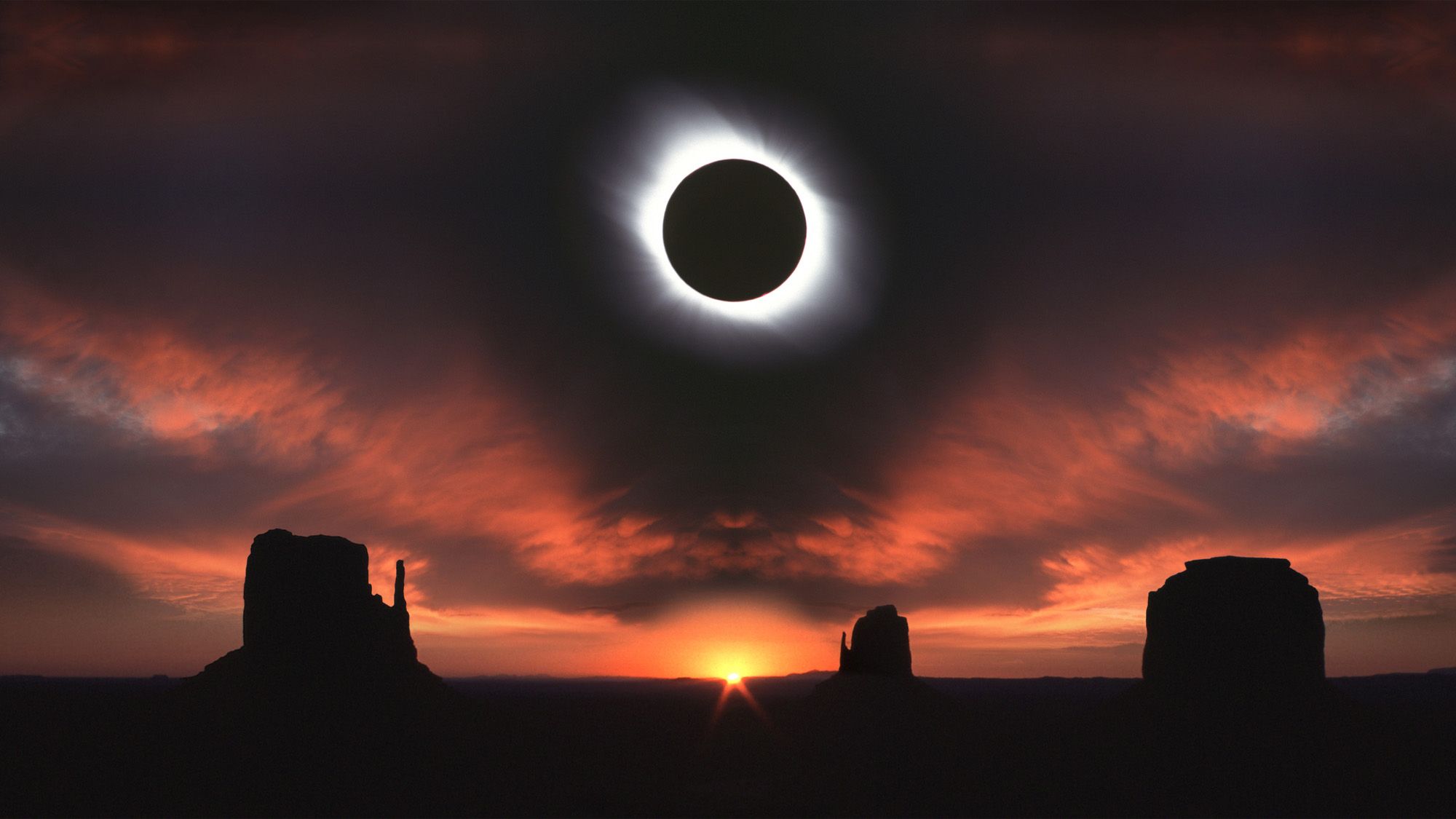
One of the biggest misconceptions about solar eclipses is that enjoying them requires expensive solar gear. Telescopes, tracking mounts, cameras, telephoto lenses and solar filters are all part of the kitbag for serious eclipse photographers, but the reality is that many travel with surprisingly little equipment.
That will be especially true on Aug. 12, 2026. The total solar eclipse crossing Greenland, Iceland and Spain is the headline attraction that day — closely followed by a partial solar eclipse across Europe and in Canada and the U.S. Northeast — but it won’t be the only celestial event worth seeing. Just hours later, the Perseid meteor shower reaches its peak beneath moonless skies. So any eclipse kit built for the Aug. 12 eclipse should therefore be designed with one eye on a night-shoot capturing “shooting stars.”
Here’s what to buy for your eclipse-meets-Perseids double-header, according to your budget.
Under $50: Keep it simple

Solar eclipse glasses should be your first investment.
(Image credit: Getty Images)
If your budget is less than $50, the good news is that you’re not excluded from the eclipse experience. In fact, you can assemble everything necessary for a memorable eclipse day without spending very much at all.
The first purchase should always be certified eclipse glasses. Find some safe suppliers that meet the ISO 12312-2 standard for solar viewers, and consider buying more than you need (somebody nearby will almost certainly forget theirs). A handheld solar viewer is a worthwhile alternative, offering a slightly larger and often more comfortable view than eclipse glasses alone.
With the remaining budget, I’d focus less on astronomy equipment and more on practicality. A compact power bank and a reclining lawn chair (handy for the eclipse and the Perseids) could all be within your budget. Eclipse day involves a great deal of waiting, but if you’re standing in the path of totality — or primed to see a partial eclipse — eclipse glasses and a clear sky are all you really need to experience something extraordinary.
Under $200: The biggest upgrade you can make

A pair of solar binoculars is a fabulous upgrade if you’re observing only a partial solar eclipse.
(Image credit: Jason Parnell-Brookes)
Once your budget reaches around $200, I’d start thinking about binoculars. For many people, the single best upgrade is a pair of dedicated solar binoculars. You can get mini pairs, such as the Celestron EclipSmart 10×25 and Lunt 6×30 Mini Sunoculars, or more substantial pairs like the Celestron Eclipsmart 10×42 and Celestron EclipSmart 20×50. We’ve tried them all, and can tell you that the Lunt 8×32 SUNoculars are the best (and easiest to find the sun with, which beginners always find is surprisingly small in the sky).
Get the world’s most fascinating discoveries delivered straight to your inbox.
Unlike eclipse glasses, which show the sun as a small orange or white disk, solar binoculars reveal sunspots and make the moon’s gradual progress across the solar surface much more engaging. They offer far more detail without introducing the complexity of a telescope. These are the best upgrades you can make if you’re not in the path of totality and want to maximize your view of the partial phases of the eclipse.
If you’re in the path of totality awaiting a total solar eclipse, forgo the solar binoculars and get yourself a good pair of conventional binoculars. The reason is simple: the partial eclipse will be interesting to watch through your eclipse glasses, but it’s the totally eclipsed sun — and the beautiful solar corona that’s revealed when it gets dark — which is the star attraction. You can safely see it with the naked eye or through conventional binoculars (but ONLY when the entire disk of the sun is blocked during totality, which will be for a minute or two).
A good choice would be a pair of 10×42 or 10×50, not only because you’ll get a great view of the solar corona and prominences — loops of plasma from the sun’s surface — but because they’ll double as excellent stargazing binoculars for sweeping across the Milky Way’s rich star fields, bright clusters and countless stars when it gets dark. Using products like DayStar Filters and Baader AstroSolar Safety Film ND 5.0, you can make any pair of conventional binoculars into temporary solar binoculars (use a solar filter for one lens and cap the other).
Under $500: Enter the smart telescope

Smart telescopes will enable easy images of a solar eclipse.
(Image credit: Jamie Carter)
At around $500, a completely different category of equipment becomes available. If we were building an eclipse kit from scratch, this is probably the budget level that would tempt us most because it opens the door to smart telescopes. Devices such as the Seestar S30 and Seestar S30 Pro (as well as the upcoming Seestar S30 Pro Eclipse Edition), DwarfLab Dwarf Mini and Vaonis Vespera Pro are portable and can automatically track the sun. All either have solar filters in the box, or their makers sell them separately (or you can make your own — see above).
The appeal of a smart telescope is that it can track the sun and photograph the eclipse while demanding relatively little attention from the user. With a solar filter fitted, a smart telescope can safely image the partial phases. For those in the path of totality, the totally eclipsed sun can also be imaged — just remember to take the solar filter off, and put it back on again when totality ends. You can then switch to capturing deep-sky objects at night, something you can do without much fuss while you watch the Perseid meteor shower peak with your naked eyes (the only way).
Over $1,000: Getting a close-up

Cameras and telescopes will get you a close-up of the eclipse.
(Image credit: Jamie Carter)
Once you move beyond the $1,000 mark, your options are myriad. Personally, we would go straight for some image-stabilized binoculars. Models such as the Canon 10x42L IS WP, Canon 15×50 IS All Weather or Canon 12×36 IS III are among the most impressive astronomical instruments available to eclipse chasers because they combine premium optics with stabilization technology that effectively removes hand shake.
When you’re standing in the path of totality looking at the sun’s corona in close-up, image stabilization is absolutely what you want. If you chase solar eclipses every few years, they’re worth buying for the few minutes of totality you get to experience. For the partial phases, we use a homemade solar filter on one lens and cap the other lens. Alongside those binoculars, we’d be tempted by a smart telescope for getting basic, but impressive images.
If you like a challenge, you could, of course, go straight for manual photography. Get a mirrorless or DSLR camera and a zoom lens, and you can have a go at imaging the solar corona yourself. You could also consider pairing a camera with a telescope and a star (or solar) tracking mount that can automatically track the sun. You’ll also need to add a quality tripod and solar filters. If you fancy imaging the Perseid meteor shower later that night — or for any landscape astrophotography and the Milky Way — you’ll also need a wide-angle lens.
Research, rehearse, prepare
The danger at this budget level is believing that more equipment automatically produces a better experience. It doesn’t. Every eclipse attracts photographers and observers carrying thousands of dollars’ worth of gear, but many — typically first-timers — spend totality worrying about camera settings instead of looking at the sky.
Whatever gear you buy, the best investment is always time — time to research, rehearse and prepare, and also to arrive early enough to settle into your observing location. That applies to whatever kind of solar eclipse you’re in line for.
Whether your budget is $50 or $5,000, the perfect eclipse kit is the one that allows you to experience a solar eclipse — and if that includes totality, know that it will be a priceless experience.
