
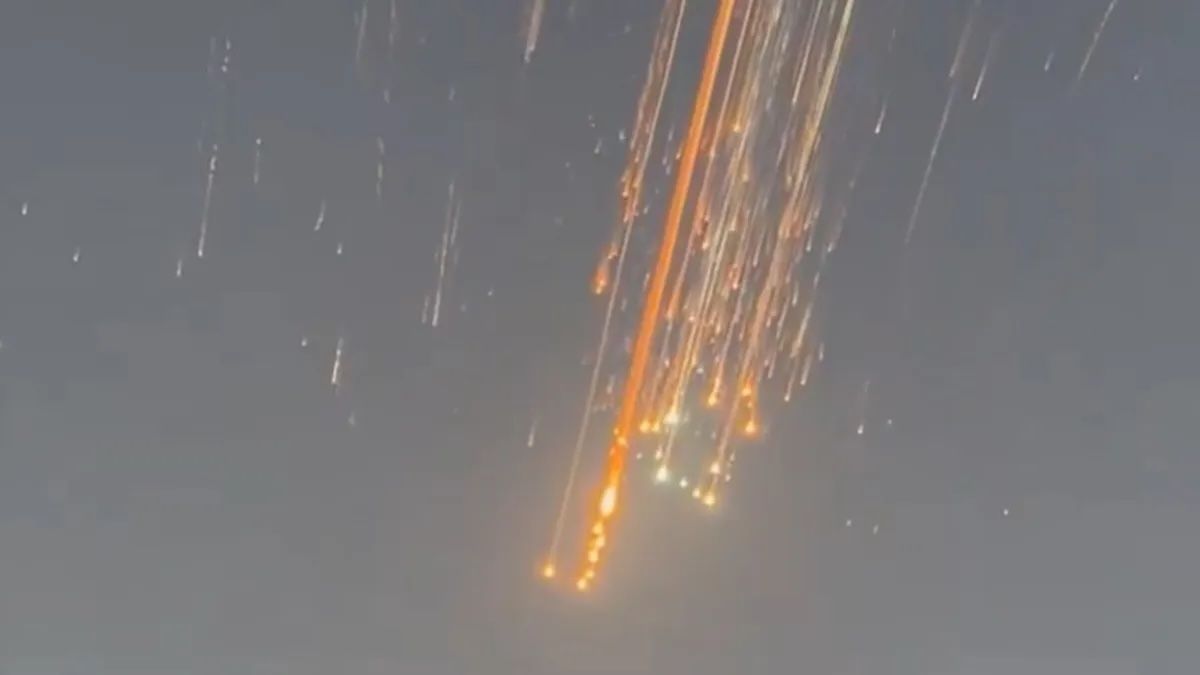
The rapid unscheduled disassembly (aka explosion) of SpaceX’s Starship megarocket that rained scorching fragments of metal across the Caribbean in mid-January may have released significant amounts of harmful air-pollution into the upper layers of Earth’s atmosphere.
The rocket’s upper stage blew up at an altitude of around 90 miles (146 kilometers) according to astronomer and space debris expert Jonathan McDowell, and weighed some 85 tons without propellant. Its plunge back to Earth through the atmosphere may have generated 45.5 metric tons of metal oxides and 40 metric tons of nitrogen oxides, according to University College London atmospheric chemistry researcher Connor Barker. Nitrogen oxides in particular are known for their potential to damage Earth’s protective ozone layer.
Barker, who had recently published an inventory of rocket emissions and pollutants from satellite re-entries in the journal Nature, posted the estimates on his LinkedIn profile shortly after the mishap. He, however, stressed in an email to Space.com that the numbers are a rough, preliminary estimate rather than an accurate calculation of the accident’s environmental impact.
In Barker’s LinkedIn post, however, the scientist said that the amount of metallic air pollution potentially produced in the accident equals that generated by one third of meteorite material that burns up in Earth’s atmosphere every year.
Exactly how much pollution the Starship mishap produced in the higher atmosphere is hard to tell. Scientists, for example, are also not sure how much of the megarocket’s mass burned up and how much of it fell to Earth.
Related: ISS dodges its 39th piece of potentially hazardous space junk. Experts say it won’t be the last.
McDowell told Space.com that “many tons” likely splashed down into the ocean.
Fortunately, the Starship upper stage is made of stainless steel and not aluminum like satellites and upper stages of many other rockets including SpaceX‘s Falcon 9. The incineration of aluminum is what worries many scientists. When aluminum burns at high temperatures during a satellite re-entry, it produces aluminum oxides, or alumina, a white powdery substance known for its potential to damage ozone and change the reflectiveness of Earth’s atmosphere.
In recent years, the number of satellites orbiting Earth and that of subsequent atmospheric re-entries has been rising fast. With that the amount of alumina released into the mesosphere and upper stratosphere — the otherwise pristine middle layers of the atmosphere — has been skyrocketing. Air pollution in the mesosphere and upper stratosphere concerns scientists as the high altitudes at which it arises mean the pollutants remain in the air for a very long time.
Scientists think that the quantity of alumina from incinerated satellites is already approaching the same levels that result from the atmospheric demise of natural space rocks such as asteroids or meteoroids, which contain only trace amounts of aluminum. The amount of nitrogen oxides produced during re-entries is also nearing that generated by natural space rocks.
Nitrogen oxides arise as space rocks or space debris fragments, travelling at hyper-sonic speeds, compress the surrounding air as they fall to Earth. The atoms of nitrogen heat up and react with oxygen, creating the harmful oxides.
With the expected increase in rocket launches and the growth of satellite fleets and the subsequent frequency of re-entries, concentrations of these damaging gases and particles could quickly rise. The pollutants could thwart the recovery of the planet’s ozone layer, worsening the damage caused by ozone-depleting substances used in aerosol sprays and refrigerators in the past. The air pollution from incinerated satellites could also change how much heat the Earth’s atmosphere retains, leading to possibly serious consequences on the planet’s climate.
Originally posted on Space.com.
