
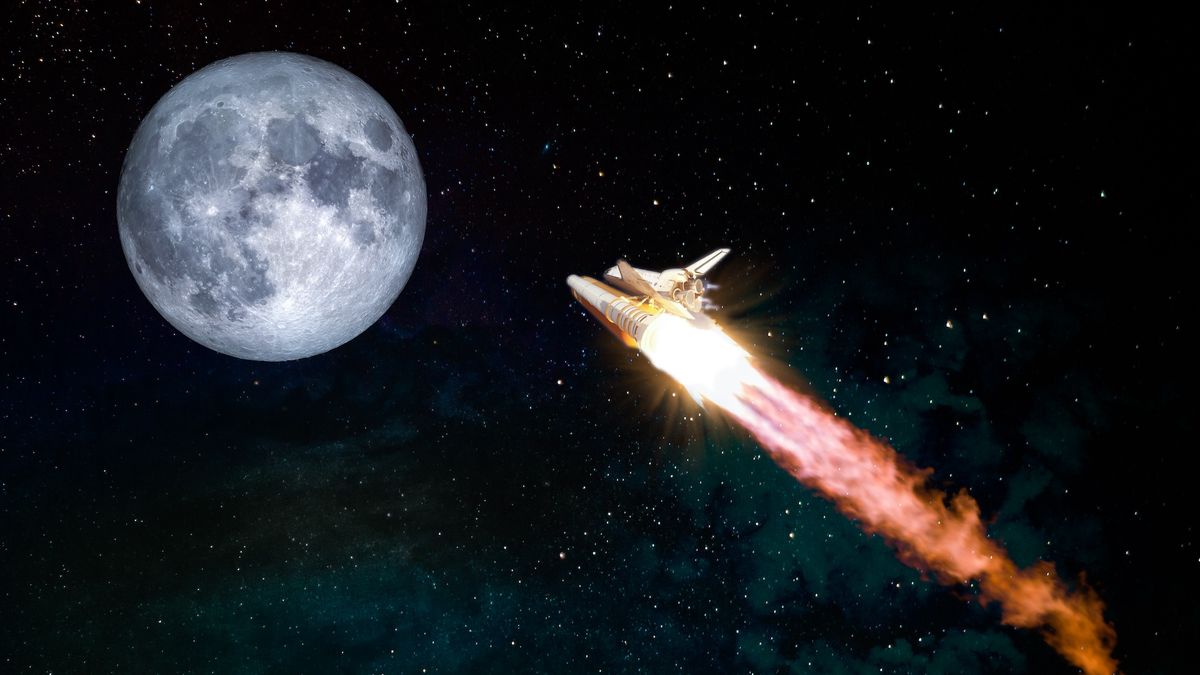
Traveling to the moon is no easy feat. Our natural satellite orbits Earth at an average distance of 238,855 miles (384,400 kilometers). So how long does it take to reach our closest neighbor from the moment a spaceship lifts off?
Based on lunar missions from the past few decades, the answer ranges from about eight hours to 4.5 months. The fastest human-made craft to whiz by the moon — meaning it didn’t stop there — was the New Horizon probe launched by NASA in 2006 to study Pluto; this spacecraft passed by the moon 8 hours and 35 minutes after launch.
But for missions whose destination is the moon, the journey takes a bit longer. In 1959, in humanity’s first ever moon mission, the Soviet Union’s Luna 1 took 34 hours to reach the moon. This uncrewed mission was intended to impact the moon’s surface, but the spacecraft went off course, passing 3,725 miles (5,995 kilometers) away from the moon. It eventually stopped transmitting when its batteries died, and it’s still floating through space to this day.
In 1969, when astronauts actually landed on the moon, it took the Apollo 11 crew 109 hours and 42 minutes from liftoff to Neil Armstrong’s first step on the moon.
The reasons for these variable travel times to the moon depend on many factors, but one of the most important reasons is the amount of fuel used. Engineers have found that using less fuel in a lunar mission can take longer, but it still gets the job done. This can be pulled off by using the natural gravitational forces of celestial bodies, such as Earth and the moon, to help guide the spacecraft along a longer route.
For instance, in 2019, Israel sent an uncrewed spacecraft named Beresheet to land on the moon. After liftoff, Beresheet looped around Earth for about six weeks in ever-widening orbits before gaining enough momentum to zip off toward the moon. It got there, but not the way the Israeli organization SpaceIL wanted: The team lost contact and Beresheet crashed into the lunar surface 48 days after launch, spilling thousands of microscopic tardigrades onto the moon in the process.
Related: Could a spaceship fly through a gas giant like Jupiter?
The spacecraft that holds the record for longest journey to the moon is NASA’s CAPSTONE probe, a 55-pound (25 kilograms) cubesat that took 4.5 months to leave Earth, circle it several times, and finally enter the moon’s orbit in 2022. CAPSTONE (Cislunar Autonomous Positioning System Technology Operations and Navigation Experiment) was sent to the moon to test out an orbit that NASA plans to use for its planned Gateway space outpost.
No matter which route a spacecraft takes, every lunar mission goes through several essential steps. Between 60% and 90% of the launch weight of any space mission is the fuel that enables it to escape Earth’s gravity and enter space. Once the spacecraft arrives in orbit, it needs to use as little fuel as possible to achieve the optimal trajectory to its target, as including more fuel makes the spacecraft heavier and more expensive.
Finally, the craft needs to execute a further fuel burn to escape Earth’s orbit and be on its way. The velocities of spacecraft in transit tend to be similar, but where Luna 1 had a direct trajectory, Apollo 11 needed a more precise lunar orbit trajectory, which accounted for the longer travel time. That meant directing the craft not at the moon but just beside it so it enters orbit, and at a speed safe enough to launch a lander and receive it again.

Apollo 11 took around 4.5 days to reach the moon for other reasons, too. For example, it needed to complete a battery of maneuvers and checks to the guidance and navigation systems before it left Earth’s gravity.
“Once outside of the main Earth gravity influence, only minor orbit corrections are needed, so less fuel is required,” Gretchen Benedix, a founding member and professor at the Space Science and Technology Centre at Curtin University in Australia, told Live Science. “Gravity does all the work — the moon’s gravitation will pull on whatever mass was launched.”
But the travel time also depends on other factors. One of the biggest, according to Mark Blanton, who leads NASA’s Moon to Mars mission analysis and integrated assessments, is the purpose of the mission.
“Missions or agencies will evaluate the type of rockets available and their capabilities to carry spacecraft,” he told Live Science. “The rocket capabilities and mission objectives will set the sizing of the spacecraft — for instance, if it’s a science instrument versus a crewed mission.
“When you put all those constraints together, it will let you design an optimal trajectory, and that will inform on the number of Earth orbits to set up a particular geometry or trajectory,” Blanton said.
That means that, like with everything related to spacecraft and spaceflight, precise calculations about craft size, crew size, fuel allocation and every other possible detail can have an impact on total travel time to the moon.
