Close Menu
  • Home
  • UNSUBSCRIBE
  • News
  • Lifestyle
  • Tech
  • Entertainment
  • Sports
  • Travel
Facebook X (Twitter) WhatsApp
Trending
  • Arthritis drug shows antiviral effects against RSV, the leading cause of infant hospitalization
  • Daddy longlegs may be capturing and devouring frogs in the tropical forests of South America
  • Google wants to release 64 million bacteria-riddled mosquitoes across California and Florida. Here’s why scientists are enthusiastic.
  • ‘In an unrecoverable state’: NASA confirms MAVEN spacecraft is officially dead after loss of signal behind Mars
  • 2 rivers merged to form the Euphrates 3.6 million years ago, eventually leading to the Fertile Crescent
  • NASA confirms fireball meteor exploded over northeastern US with force of 230 tons of TNT
  • Astronauts could use lightning-like plasma jets to kill germs on the moon and Mars, demo hints
  • First whole-genome sequence of a Greenland shark holds clues to their extreme longevity
Facebook X (Twitter) WhatsApp
Baynard Media
  • Home
  • UNSUBSCRIBE
  • News
  • Lifestyle
  • Tech
  • Entertainment
  • Sports
  • Travel
Baynard Media
Home»Lifestyle»Hidden ‘doomed’ star revealed by James Webb Space Telescope could solve decades-old mystery
Lifestyle

Hidden ‘doomed’ star revealed by James Webb Space Telescope could solve decades-old mystery

EditorBy EditorOctober 13, 2025No Comments3 Mins Read
Share Facebook Twitter Pinterest LinkedIn Tumblr Reddit Telegram Email
Share
Facebook Twitter LinkedIn Pinterest Email

The James Webb Space Telescope (JWST) has revealed a hidden “doomed” star that could help solve a giant astrophysical mystery.

The star is a massive red supergiant, which JWST snapped just before the star exploded in a fiery supernova. Massive red supergiants should, in theory, cause most supernovas, but they’re rarely observed. The latest JWST observation, described in a new study published Wednesday (Oct. 8) in The Astrophysical Journal Letters, adds weight to the idea that these giants are often obscured by clouds of dust.

“For multiple decades, we have been trying to determine exactly what the explosions of red supergiant stars look like,” study lead author Charlie Kilpatrick, a research assistant professor studying massive stars at Northwestern University in Illinois, said in a statement. “Only now, with JWST, do we finally have the quality of data and infrared observations that allow us to say precisely the exact type of red supergiant that exploded and what its immediate environment looked like.”


You may like

Stars around the size of our sun swell up near the end of their lifecycles to become red giants before going supernova. Red supergiants are massive stars on the verge of detonating, typically measuring hundreds or thousands of times larger than our sun.

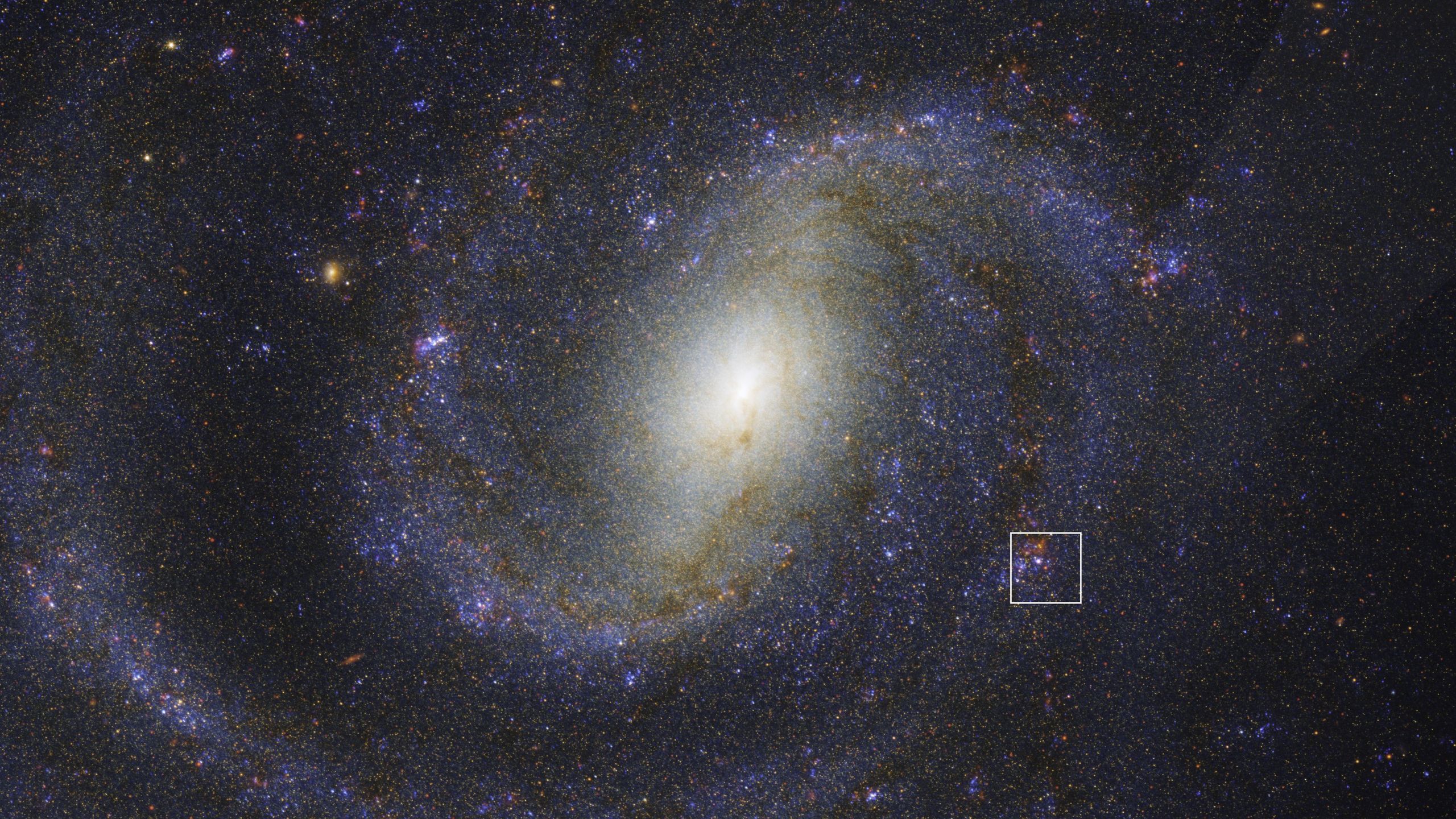
The All-Sky Automated Survey for Supernovae first detected the supernova from the newly imaged supergiant in June. The supernova, officially named SN 2025pht, came from a galaxy called NGC 1637, which is located 38 million light-years from Earth — pretty close for something in space. The authors of the new study identified the supergiant’s source star (its progenitor) by comparing historical Hubble Space Telescope data to new JWST images of NGC 1637 taken before and after the explosion.

An image of the spiral galaxy NGC 1637 with additional detailed images of the red supergiant before and after it went supernova, combining JWST and Hubble observations.

Researchers combined observations from JWST and Hubble to make this image of spiral galaxy NGC 1637, with additional images of the massive red supergiant before and after it went supernova. (Image credit: NASA, ESA, CSA, STScI, Charles Kilpatrick (Northwestern), Aswin Suresh (Northwestern))

Researchers like Kilpatrick have suggested that the most massive aging stars might also be the dustiest, so their light is blocked. This possible explanation tracks with the new JWST observation. The star shone about 100,000 times brighter than our sun, but the team estimated that its dust was so thick that this light was made more than 100 times dimmer, according to the statement.

The dust was also particularly effective at blocking shorter, blue wavelengths of light. Fortunately, JWST’s powerful infrared detection could see the longer red wavelengths, providing an unprecedented detailed look at a supergiant on the brink of going supernova.

Get the world’s most fascinating discoveries delivered straight to your inbox.

“SN2025pht is surprising because it appeared much redder than almost any other red supergiant we’ve seen explode as a supernova,” Kilpatrick said. “That tells us that previous explosions might have been much more luminous than we thought because we didn’t have the same quality of infrared data that JWST can now provide.”

Source link

Share. Facebook Twitter Pinterest LinkedIn Tumblr Email
Previous ArticleLions’ Brian Branch faces criticism for postgame punch
Next Article Hostage Bar Kupershtein speaks to family on phone
Editor
  • Website

Related Posts

Lifestyle

Arthritis drug shows antiviral effects against RSV, the leading cause of infant hospitalization

June 4, 2026
Lifestyle

Daddy longlegs may be capturing and devouring frogs in the tropical forests of South America

June 3, 2026
Lifestyle

Google wants to release 64 million bacteria-riddled mosquitoes across California and Florida. Here’s why scientists are enthusiastic.

June 3, 2026
Add A Comment

Comments are closed.

Categories
  • Entertainment
  • Lifestyle
  • News
  • Sports
  • Tech
  • Travel
Recent Posts
  • Arthritis drug shows antiviral effects against RSV, the leading cause of infant hospitalization
  • Daddy longlegs may be capturing and devouring frogs in the tropical forests of South America
  • Google wants to release 64 million bacteria-riddled mosquitoes across California and Florida. Here’s why scientists are enthusiastic.
  • ‘In an unrecoverable state’: NASA confirms MAVEN spacecraft is officially dead after loss of signal behind Mars
  • 2 rivers merged to form the Euphrates 3.6 million years ago, eventually leading to the Fertile Crescent
calendar
June 2026
M T W T F S S
1234567
891011121314
15161718192021
22232425262728
2930  
« May    
Recent Posts
  • Arthritis drug shows antiviral effects against RSV, the leading cause of infant hospitalization
  • Daddy longlegs may be capturing and devouring frogs in the tropical forests of South America
  • Google wants to release 64 million bacteria-riddled mosquitoes across California and Florida. Here’s why scientists are enthusiastic.
About

Welcome to Baynard Media, your trusted source for a diverse range of news and insights. We are committed to delivering timely, reliable, and thought-provoking content that keeps you informed
and inspired

Categories
  • Entertainment
  • Lifestyle
  • News
  • Sports
  • Tech
  • Travel
Facebook X (Twitter) Pinterest WhatsApp
  • Contact Us
  • About Us
  • Privacy Policy
  • Disclaimer
  • UNSUBSCRIBE
© 2026 copyrights reserved

Type above and press Enter to search. Press Esc to cancel.