Close Menu
  • Home
  • UNSUBSCRIBE
  • News
  • Lifestyle
  • Tech
  • Entertainment
  • Sports
  • Travel
Facebook X (Twitter) WhatsApp
Trending
  • Arthritis drug shows antiviral effects against RSV, the leading cause of infant hospitalization
  • Daddy longlegs may be capturing and devouring frogs in the tropical forests of South America
  • Google wants to release 64 million bacteria-riddled mosquitoes across California and Florida. Here’s why scientists are enthusiastic.
  • ‘In an unrecoverable state’: NASA confirms MAVEN spacecraft is officially dead after loss of signal behind Mars
  • 2 rivers merged to form the Euphrates 3.6 million years ago, eventually leading to the Fertile Crescent
  • NASA confirms fireball meteor exploded over northeastern US with force of 230 tons of TNT
  • Astronauts could use lightning-like plasma jets to kill germs on the moon and Mars, demo hints
  • First whole-genome sequence of a Greenland shark holds clues to their extreme longevity
Facebook X (Twitter) WhatsApp
Baynard Media
  • Home
  • UNSUBSCRIBE
  • News
  • Lifestyle
  • Tech
  • Entertainment
  • Sports
  • Travel
Baynard Media
Home»Lifestyle»Giant sandy ‘slug’ crawls through floodplains in Kazakhstan, but it could soon be frozen in place — Earth from space
Lifestyle

Giant sandy ‘slug’ crawls through floodplains in Kazakhstan, but it could soon be frozen in place — Earth from space

EditorBy EditorSeptember 2, 2025No Comments3 Mins Read
Share Facebook Twitter Pinterest LinkedIn Tumblr Reddit Telegram Email
Share
Facebook Twitter LinkedIn Pinterest Email

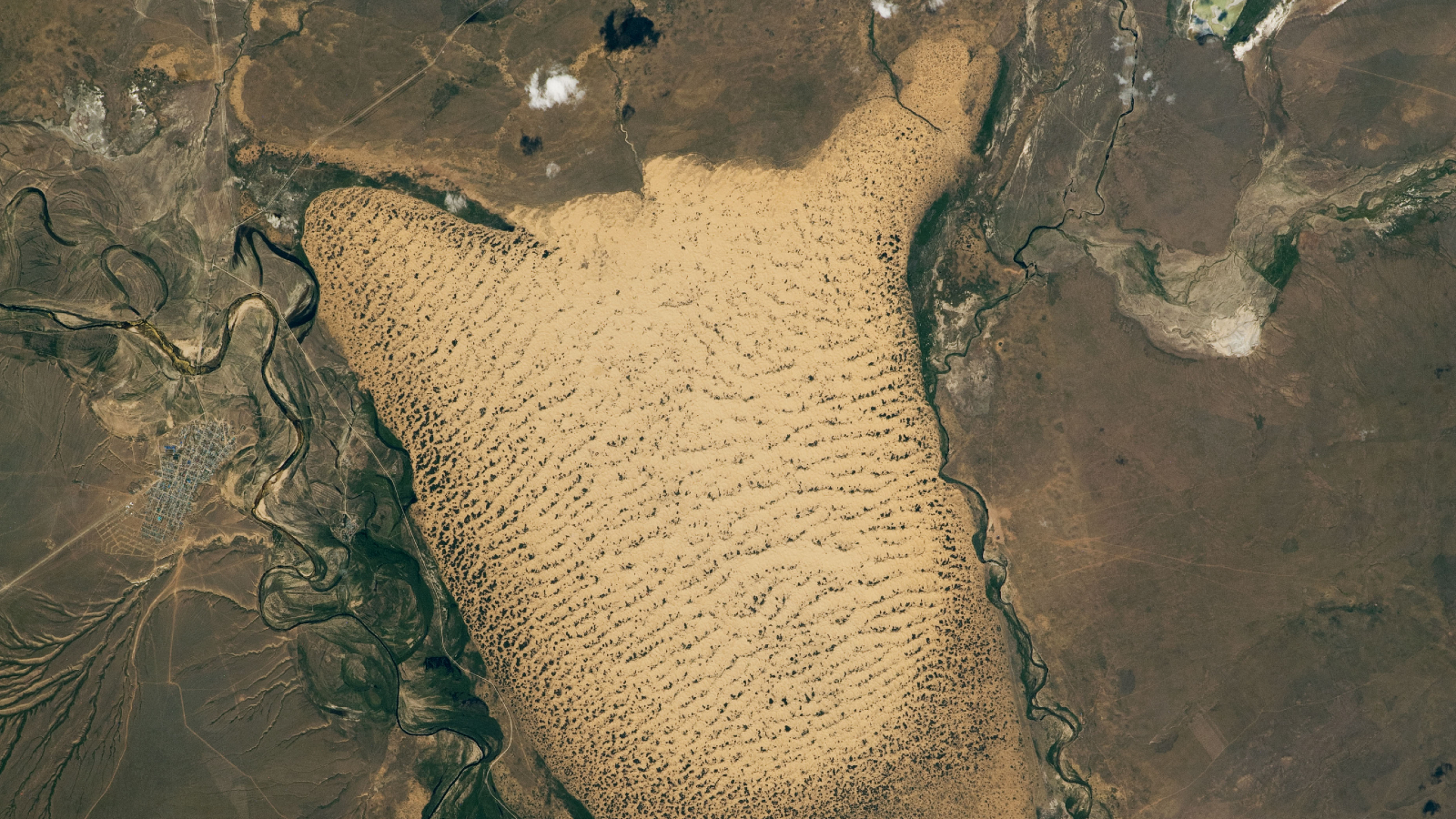
A satellite image of a giant slug-shaped field of sand dunes in Kazakhstan

A large field of sand dunes located alongside the village of Oyyl in the Kazakh Steppe bears a striking resemblance to a giant slug. (Image credit: NASA/ISS program)

QUICK FACTS

Where is it? Oyyl dune field, Kazakhstan [49.0485097, 54.776320616]

What’s in the photo? A large field of sand dunes in the shape of a slug

Who took the photo? An unnamed astronaut on board the International Space Station

When was it taken? June 15, 2022

This intriguing astronaut photo shows off an oddly shaped field of dunes in Kazakhstan that strongly resembles a giant slug meandering across the landscape. The mollusk mimic is covered with clusters of vegetation, suggesting its sands are slowly being frozen in place.

The dune field is located around 175 miles (280 kilometers) northeast of the Caspian Sea in the western reaches of the Kazakh Steppe — a vast region of open grassland covering north Kazakhstan and parts of Russia. It is sandwiched between the village of Oyyl to the west (left in the image) and a large floodplain to the east (right in the image).

It covers an area of around 75 square miles (190 square kilometers), around three times the size of Manhattan, and measures approximately 13 miles (21 km) across at its widest point, according to NASA’s Earth Observatory.


You may like

Dune fields form in natural depressions, or sinks, within the surrounding landscape, normally in regions with high winds capable of depositing sand in these holes. In this case, the slug-shaped sink sits approximately 300 feet (90 meters) below the elevation of the surrounding landscape.

Most of the sand within this sink originates from the adjacent floodplain, as well as another floodplain located to the south (not shown in the image). Floodplains generate lots of sand when they dry out, as previously trapped coarse sediments get scattered across the land and blown away by the wind, according to National Geographic.

Related: See all the best images of Earth from space

A photo of several sand dunes with rows of vegetation growing along their ridges

Vegetation growing along the dunes’ ridges is slowly fixing them in place, similar to these dunes (pictured) in Niger. (Image credit: ISSOUF SANOGO/AFP via Getty Images)

The parallel lines visible across the dunes are ridges of sand built up as the prevailing wind pushes the sand northward. Over time, the positions of these ridges subtly shift in the same direction.

Get the world’s most fascinating discoveries delivered straight to your inbox.

The dark patches littered across the dune field are plants that have taken root in the ridges. If the concentration of this vegetation gets high enough, it can fix a ridge into place and prevent it from moving, similar to some of the dunes frozen in place along various coastlines across the globe.

Most of the vegetation is concentrated along the southern and western edges of the dune field, likely due to water coming from the Uil River, which snakes around the outskirts of Oyyl, according to the Earth Observatory.

Scientists are currently uncertain if the rest of the dune field will follow suit and become overrun by plant life in the future.

Source link

Share. Facebook Twitter Pinterest LinkedIn Tumblr Email
Previous ArticleSudan landslide kills at least 1,000 people in Central Darfur village
Next Article China to stage military parade attended by Putin and Kim Jong Un
Editor
  • Website

Related Posts

Lifestyle

Arthritis drug shows antiviral effects against RSV, the leading cause of infant hospitalization

June 4, 2026
Lifestyle

Daddy longlegs may be capturing and devouring frogs in the tropical forests of South America

June 3, 2026
Lifestyle

Google wants to release 64 million bacteria-riddled mosquitoes across California and Florida. Here’s why scientists are enthusiastic.

June 3, 2026
Add A Comment

Comments are closed.

Categories
  • Entertainment
  • Lifestyle
  • News
  • Sports
  • Tech
  • Travel
Recent Posts
  • Arthritis drug shows antiviral effects against RSV, the leading cause of infant hospitalization
  • Daddy longlegs may be capturing and devouring frogs in the tropical forests of South America
  • Google wants to release 64 million bacteria-riddled mosquitoes across California and Florida. Here’s why scientists are enthusiastic.
  • ‘In an unrecoverable state’: NASA confirms MAVEN spacecraft is officially dead after loss of signal behind Mars
  • 2 rivers merged to form the Euphrates 3.6 million years ago, eventually leading to the Fertile Crescent
calendar
June 2026
M T W T F S S
1234567
891011121314
15161718192021
22232425262728
2930  
« May    
Recent Posts
  • Arthritis drug shows antiviral effects against RSV, the leading cause of infant hospitalization
  • Daddy longlegs may be capturing and devouring frogs in the tropical forests of South America
  • Google wants to release 64 million bacteria-riddled mosquitoes across California and Florida. Here’s why scientists are enthusiastic.
About

Welcome to Baynard Media, your trusted source for a diverse range of news and insights. We are committed to delivering timely, reliable, and thought-provoking content that keeps you informed
and inspired

Categories
  • Entertainment
  • Lifestyle
  • News
  • Sports
  • Tech
  • Travel
Facebook X (Twitter) Pinterest WhatsApp
  • Contact Us
  • About Us
  • Privacy Policy
  • Disclaimer
  • UNSUBSCRIBE
© 2026 copyrights reserved

Type above and press Enter to search. Press Esc to cancel.