
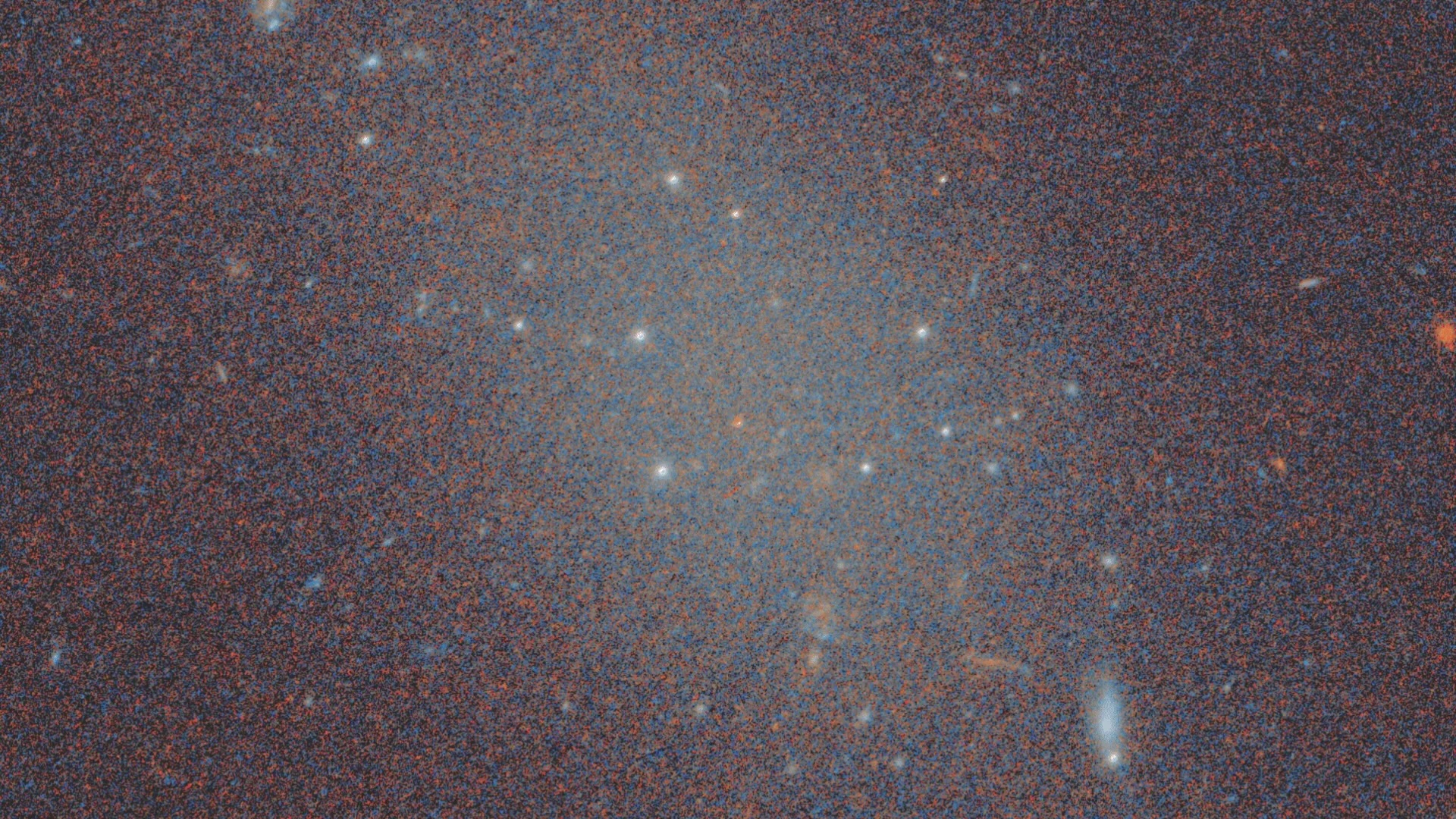
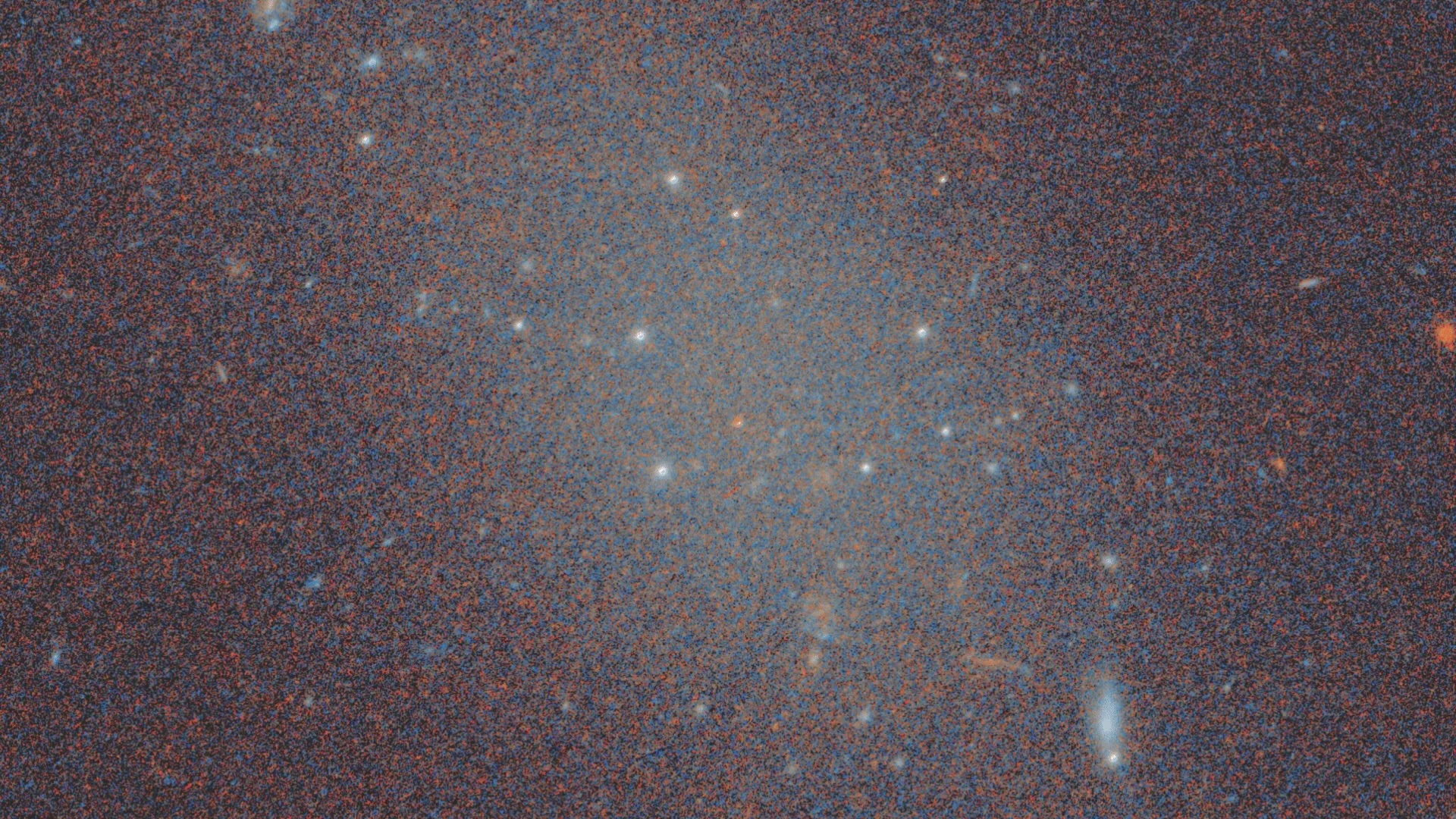
Astronomers have stumbled upon yet another ghostly galaxy that appears to be devoid of dark matter.
Dark matter, the invisible substance astronomers believe dominates the universe, provides the gravitational scaffolding for galaxies to assemble and grow. Discovering a galaxy without dark matter is indeed perplexing, like finding a shadow without a source.
Yet, over the past decade, several such sightings have been reported — all of them so-called “ultradiffuse galaxies,” which are about the size of our own Milky Way but remarkably sparse in stars.
The latest member of this puzzling collection, known as FCC 224, resides on the fringes of the Fornax Cluster, a collection of galaxies that lies roughly 65 million light-years from Earth.
Related: Scientists may have finally found where the ‘missing half’ of the universe’s matter is hiding
First spotted in 2024, FCC 224 is a dwarf galaxy that boasts a dozen luminous, tightly bound clusters of stars — an unusually rich population for its size, typically seen in larger, dark-matter rich galaxies — yet appears to lack the mysterious substance. It also occupies a distinctly different cosmic neighborhood than other galaxies that are deficient in dark matter, suggesting such objects might not be isolated flukes but rather represent a more common, previously unrecognized class of dwarf galaxies, according to two complementary papers published last month.
“No existing galaxy formation model within our standard cosmological paradigm can currently explain how this galaxy came to be,” Maria Buzzo, a doctoral candidate in astrophysics at the Swinburne University of Technology in Australia who led one of the new studies, said in a statement.
Using data from the Keck Observatory in Hawaii, Buzzo and her team tracked the movement of a dozen star clusters within FCC 224. These measurements revealed a slow speed among the clusters, a key indicator that the galaxy lacks the strong gravitational pull expected from dark matter, the new study reports. No known scenario can fully explain FCC 224’s properties, the researchers say.
Another team, led by astronomer Yimeng Tang at the University of California, Santa Cruz, compared FCC 224’s properties to other galaxies that seemingly lack dark matter, focusing on two ghostly objects within the NGC 1052 group about 65 million light-years away in the constellation Cetus.
Tang and his colleagues propose that FCC 224, like those NGC 1052 dwarf galaxies, formed from a high-velocity collision of gas-rich galaxies. In such an event, the gas separates from the dark matter, and subsequent star formation in the expelled gas forms one or more dark-matter-free galaxies.
Previous research found that the two galaxies in the NGC 1052 group, DF2 and DF4, belong to a trail of seven to 11 dark-matter-deficient galaxies that formed in the same ancient collision. FCC 224 likely has a twin galaxy, too, Tang and his team suggest in their study.
One candidate is the nearby galaxy FCC 240, which appears to have the same size, shape and orientation as FCC 224. If forthcoming observations confirm the shared properties, it would provide crucial evidence supporting the collision scenario for the formation of FCC 224, the researchers say.
Alternatively, FCC 224 could be the result of a chaotic, high-energy environment where intense star formation from overmassive star clusters expelled dark matter from the galaxy, the team suggests.
“FCC 224 serves as a crucial data point in our effort to identify and study other dark-matter-deficient galaxies,” Buzzo said in the statement. “By expanding the sample size, we can refine our understanding of these rare galaxies and of the role of dark matter in dwarf galaxy formation.”
Originally posted on Space.com.
