Close Menu
  • Home
  • UNSUBSCRIBE
  • News
  • Lifestyle
  • Tech
  • Entertainment
  • Sports
  • Travel
Facebook X (Twitter) WhatsApp
Trending
  • Shadowy tendrils of ancient lava have scarred a dark volcano next to a ‘skull’ in the Sahara — Earth from space
  • 2,000-year-old scrolls buried by Mount Vesuvius eruption finally deciphered with help from AI
  • Japan’s bold experiment to curb antibiotic misuse has been a huge success. Could it work in the US?
  • Chinese supercomputer leapfrogs best US machines to be ranked world’s fastest
  • Strawberry moon 2026: Tonight’s full moon is the lowest, and one of the smallest ‘micromoons’ all year
  • Sleep and Death cista handle: A 2,400-year-old sculpture depicting gods carrying away Zeus’ son during the Trojan War
  • Why does metal stick together in space?
  • Faster ‘biological aging’ in young adults may help explain rise in early-onset cancers, study hints
Facebook X (Twitter) WhatsApp
Baynard Media
  • Home
  • UNSUBSCRIBE
  • News
  • Lifestyle
  • Tech
  • Entertainment
  • Sports
  • Travel
Baynard Media
Home»Lifestyle»Fossil discovery in Australia reveals ‘upside down’ dinosaur ecosystem with 2 giant predators
Lifestyle

Fossil discovery in Australia reveals ‘upside down’ dinosaur ecosystem with 2 giant predators

EditorBy EditorFebruary 27, 2025No Comments4 Mins Read
Share Facebook Twitter Pinterest LinkedIn Tumblr Reddit Telegram Email
Share
Facebook Twitter LinkedIn Pinterest Email

Researchers in Australia have discovered fossils of two enormous predators that lived alongside one another, upending ideas about how the ancient ecosystem operated down under 120 million years ago. This cache of fossils included the oldest large megaraptor ever found.

Megaraptorids were a group of fearsome predators in the Cretaceous period (145 million to 66 million years ago). They lived in the ecosystems of Australia and South America, which were joined together via Antarctica as part of a massive southern landmass called Gondwana.

Study lead-author Jake Kotevski, a paleontology doctoral candidate at the Museums Victoria Research Institute and Monash University in Australia, described megaraptorids as a “hands first predator” with muscular forearms and long, curved claws for catching prey — they effectively bring their prey in for a “hug of death,” he said in a video released by Museums Victoria.
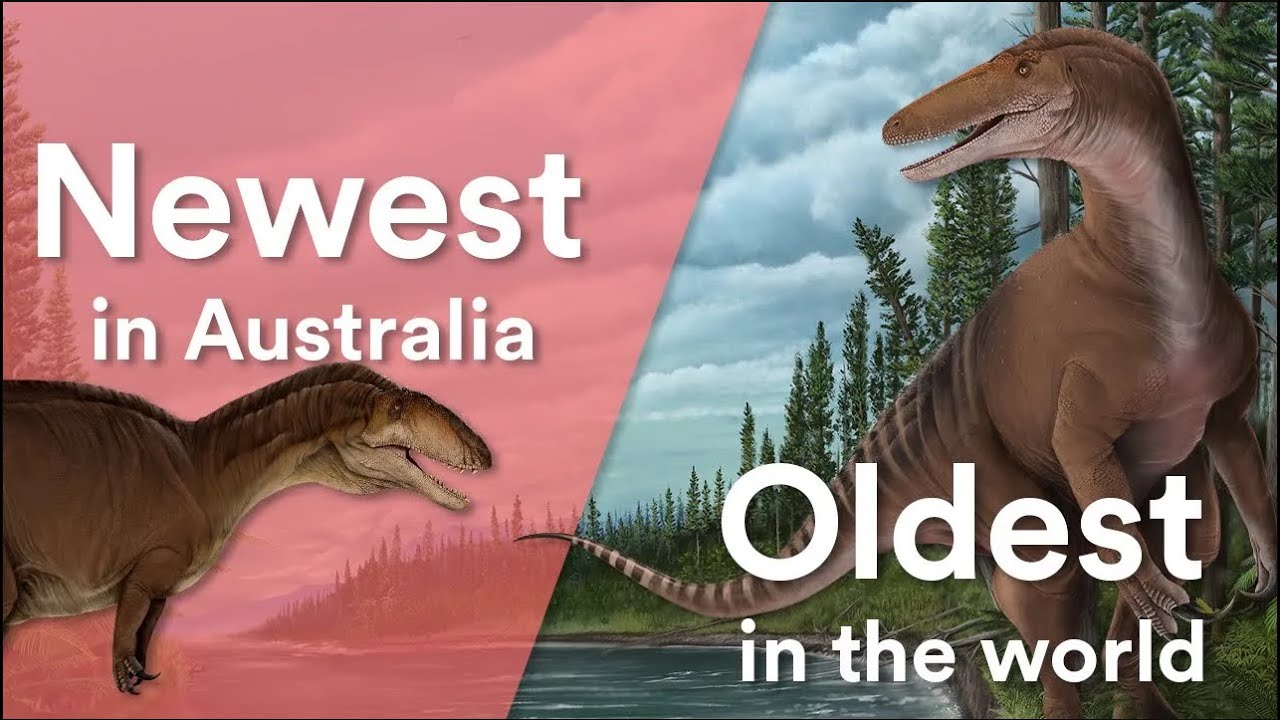
New Australian dinosaurs, and the oldest megaraptorid fossils in the world – YouTube
New Australian dinosaurs, and the oldest megaraptorid fossils in the world - YouTube


Watch On

The fossils discovered by Kotevski and his colleagues belonged to an unspecified 120 million-year-old megaraptorid that was 20 to 23 feet (6 to 7 meters) long — making it one of the largest theropods (a bipedal group of mostly meat-eating dinosaurs) ever discovered in Australia. It also predates megaraptorids in South America by around 30 million years.

In the new study, published Feb. 19 in the Journal of Vertebrate Paleontology, researchers also identified fossils from another group of large, predatory dinosaurs called Carcharodontosauria, which are also found in South America but have never been identified in Australia before.

The carcharodontosaur fossils suggest that in Australia, these dinosaurs grew up to 13 feet (4 m) long, which is significantly shorter than their counterparts in South America, which grew up to 43 feet (13 m).

In other words, the roles of the two predatory dinosaurs seem to have been reversed in Victoria, with megaraptorids acting as the larger apex predators and carcharodontosaurs acting as smaller, secondary predators. Australia’s unique Cretaceous ecosystem therefore had an “upside-down” dynamic, according to a statement released by Museums Victoria.

Get the world’s most fascinating discoveries delivered straight to your inbox.

Related: What if a giant asteroid had not wiped out the dinosaurs?

The newly identified fossils were found in what were the banks of a large river, like the modern-day Ganges or Amazon, Kotevski told Live Science in an email. Southern Australia was close enough to the South Pole that it was within the Antarctic Circle during the Cretaceous, although the region was much warmer then than it is today.

The team identified the fossils, collected from the upper Strzelecki rock formation on the coastline of Victoria in southern Australia between 1988 and 2022, with modern 3D imaging techniques, including micro-computed tomography. The technique involves taking X-rays of an object as it rotates 360 degrees so that it can be studied in greater detail.
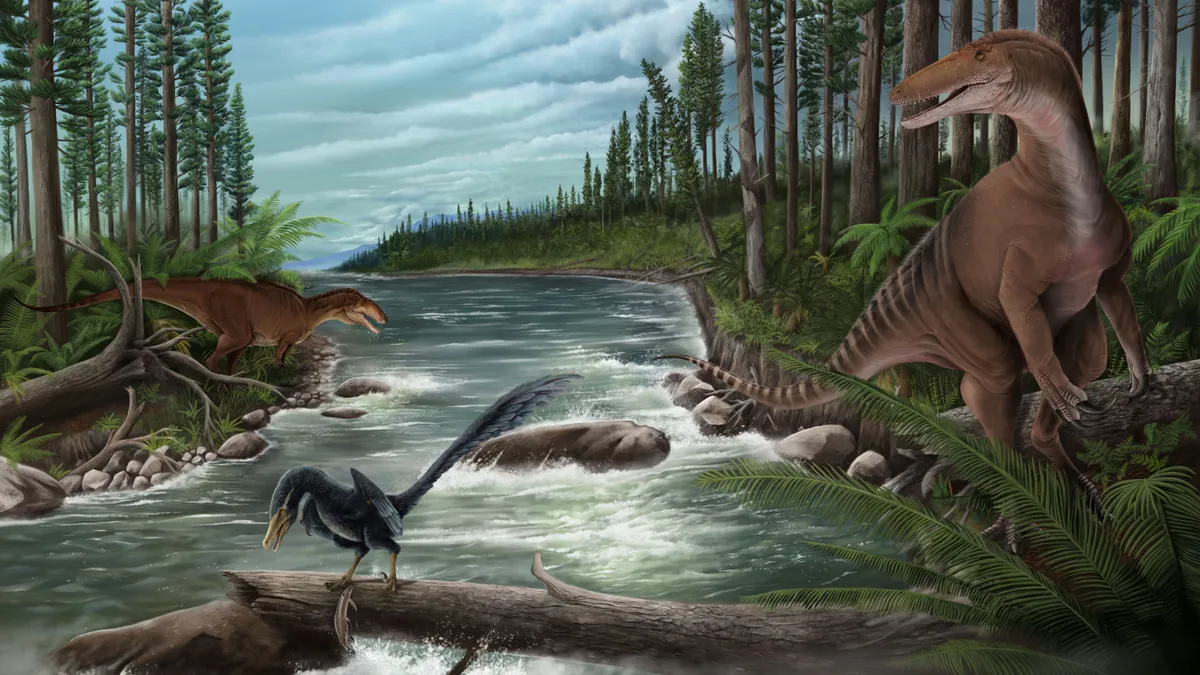
An illustration of a megaraptorid, carcharodontosaur and unwillingne sharing an ancient river ecosystem in what is now Australia.

The megaraptorid (right), carcharodontosaur (left) and unwillingne (bottom) depicted here shared an ancient ecosystem in what is now Australia. (Image credit: Artwork by Jonathan Metzger. Source: Museums Victoria)

The fossils revealed that giant megaraptorids and carcharodontosaurs were living near the river, which Kotevski said was situated within a vast rift valley created as Australia pulled away from Tasmania and Antarctica.

“In the Antarctic circle, it has been proposed that Cretaceous [Victoria] experienced long periods of dark/light that the poles experience today,” Kotevski said. “Thick forests lined this fast flowing river, where [a] myriad [of] small dinosaurs thrived, seemingly dominated by our … apex predator megaraptorid.”

The discoveries add to evidence that dinosaurs were traveling across Antarctica to move between South America and Australia during the middle of the Cretaceous, according to the study. However, Kotevski noted that researchers still have a lot more to learn about the Australian dinosaur ecosystem.

“More discovery, collection and research is fundamental to further unlocking these secrets and building a picture of how these animals looked, differed, and behaved within their environment,” Kotevski said.

Source link

Share. Facebook Twitter Pinterest LinkedIn Tumblr Email
Previous ArticleWhat to know on Alex Cooper, Alix Earle after ‘Hot Mess’ reportedly podcast dropped by Unwell Network
Next Article Racketeering charges against New Jersey Democratic power broker George Norcross dismissed by judge
Editor
  • Website

Related Posts

Lifestyle

Shadowy tendrils of ancient lava have scarred a dark volcano next to a ‘skull’ in the Sahara — Earth from space

June 30, 2026
Lifestyle

2,000-year-old scrolls buried by Mount Vesuvius eruption finally deciphered with help from AI

June 30, 2026
Lifestyle

Japan’s bold experiment to curb antibiotic misuse has been a huge success. Could it work in the US?

June 29, 2026
Add A Comment

Comments are closed.

Categories
  • Entertainment
  • Lifestyle
  • News
  • Sports
  • Tech
  • Travel
Recent Posts
  • Shadowy tendrils of ancient lava have scarred a dark volcano next to a ‘skull’ in the Sahara — Earth from space
  • 2,000-year-old scrolls buried by Mount Vesuvius eruption finally deciphered with help from AI
  • Japan’s bold experiment to curb antibiotic misuse has been a huge success. Could it work in the US?
  • Chinese supercomputer leapfrogs best US machines to be ranked world’s fastest
  • Strawberry moon 2026: Tonight’s full moon is the lowest, and one of the smallest ‘micromoons’ all year
calendar
June 2026
M T W T F S S
1234567
891011121314
15161718192021
22232425262728
2930  
« May    
Recent Posts
  • Shadowy tendrils of ancient lava have scarred a dark volcano next to a ‘skull’ in the Sahara — Earth from space
  • 2,000-year-old scrolls buried by Mount Vesuvius eruption finally deciphered with help from AI
  • Japan’s bold experiment to curb antibiotic misuse has been a huge success. Could it work in the US?
About

Welcome to Baynard Media, your trusted source for a diverse range of news and insights. We are committed to delivering timely, reliable, and thought-provoking content that keeps you informed
and inspired

Categories
  • Entertainment
  • Lifestyle
  • News
  • Sports
  • Tech
  • Travel
Facebook X (Twitter) Pinterest WhatsApp
  • Contact Us
  • About Us
  • Privacy Policy
  • Disclaimer
  • UNSUBSCRIBE
© 2026 copyrights reserved

Type above and press Enter to search. Press Esc to cancel.