Close Menu
  • Home
  • UNSUBSCRIBE
  • News
  • Lifestyle
  • Tech
  • Entertainment
  • Sports
  • Travel
Facebook X (Twitter) WhatsApp
Trending
  • 800-year-old ‘hugging skeletons’ are genetically confirmed as Poland’s only medieval same-sex double burial
  • There’s a new T. rex from the dinosaur age — and it ruled the seas with a skull-crushing bite
  • Great Pyramid of Giza is remarkably resilient to earthquakes —‬ and it’s due to the ancient Egyptians’ ‘extraordinary’ engineering knowledge
  • China’s real-life ‘transformer’ mech is a giant humanoid robot that can switch from bounding on 4 legs to walking on 2
  • How can we prevent AI models from cannibalizing themselves when human-generated data runs out? Scientists say they’ve found the answer.
  • ‘The system is likely to reach a breaking point’: Major Italian volcano is speeding toward a transition, and a major eruption could be on the way
  • China installs world’s largest floating wind turbine in deep water test — it generates enough energy to power 4,200 homes annually
  • Diagnostic dilemma: A biopsy of a woman’s cancerous tumor caused it to vanish
Facebook X (Twitter) WhatsApp
Baynard Media
  • Home
  • UNSUBSCRIBE
  • News
  • Lifestyle
  • Tech
  • Entertainment
  • Sports
  • Travel
Baynard Media
Home»Lifestyle»For the first time, James Webb telescope detects 5 ‘building blocks of life’ in ice outside the Milky Way
Lifestyle

For the first time, James Webb telescope detects 5 ‘building blocks of life’ in ice outside the Milky Way

EditorBy EditorOctober 28, 2025No Comments3 Mins Read
Share Facebook Twitter Pinterest LinkedIn Tumblr Reddit Telegram Email
Share
Facebook Twitter LinkedIn Pinterest Email

For the first time, scientists have spotted multiple complex building blocks of life in the ice around a star outside the Milky Way.

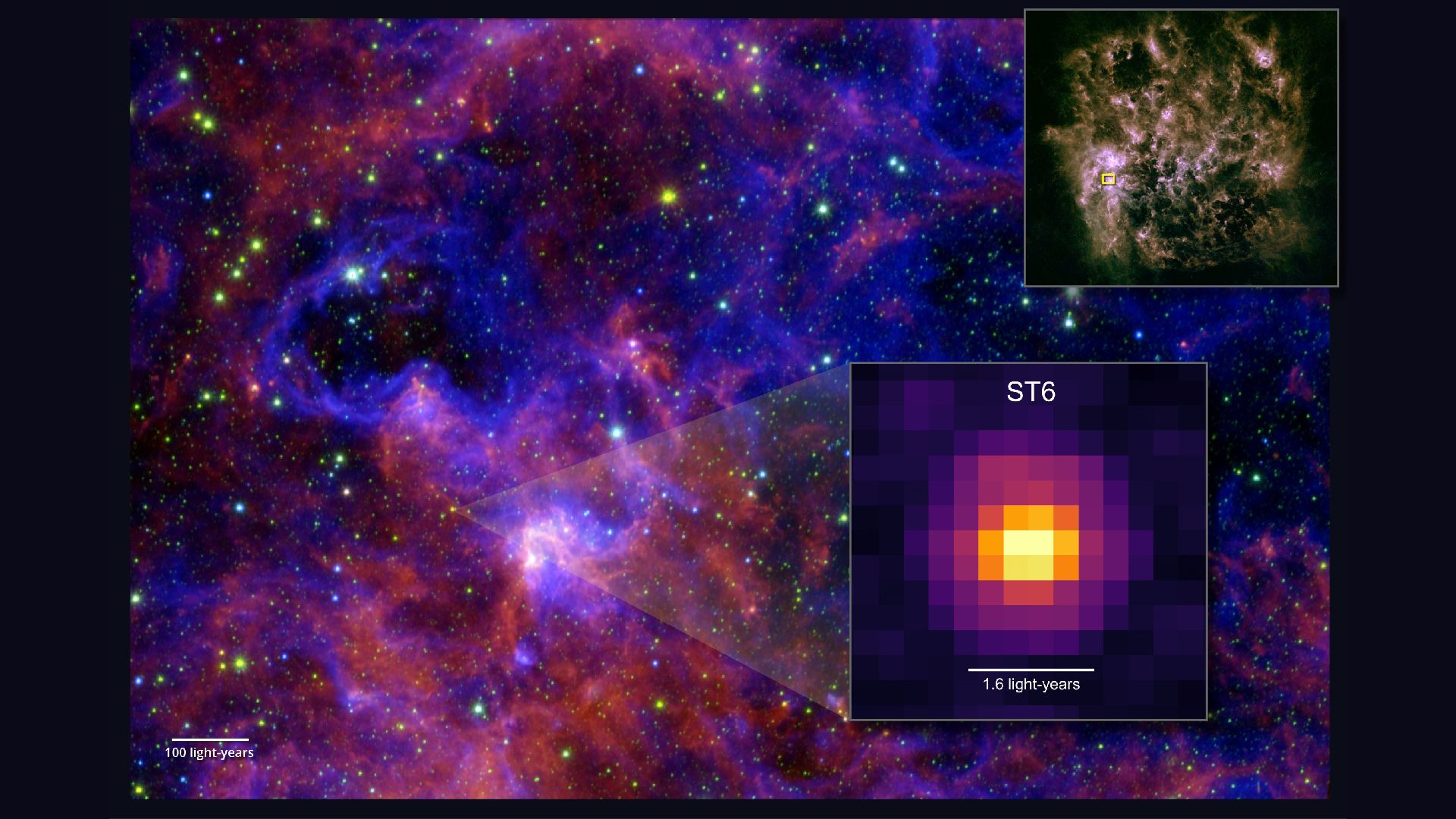
Using the James Webb Space Telescope (JWST), researchers detected five large, carbon-based compounds around a protostar in the Large Magellanic Cloud, a small galaxy that orbits closely to the Milky Way. The findings could help scientists learn how complex molecules formed in the early universe, according to a study published Oct. 20 in the Astrophysical Journal Letters.

The Large Magellanic Cloud is a dwarf galaxy 160,000 light-years from Earth in the Local Group, a collection of gravitationally bound galaxies that includes the Milky Way. The Large Magellanic Cloud is filled with hot, luminous stars that flood it with ultraviolet radiation. It also has fewer elements heavier than helium than the Milky Way does. These conditions make it similar to those expected in galaxies in the early universe.


You may like

“What we learn in the Large Magellanic Cloud, we can apply to understanding these more distant galaxies from when the universe was much younger,” study co-author Marta Sewilo, an astronomer at the University of Maryland and NASA’s Goddard Space Flight Center, said in a statement. “The harsh conditions tell us more about how complex organic chemistry can occur in these primitive environments where much fewer heavy elements like carbon, nitrogen and oxygen are available for chemical reactions.”

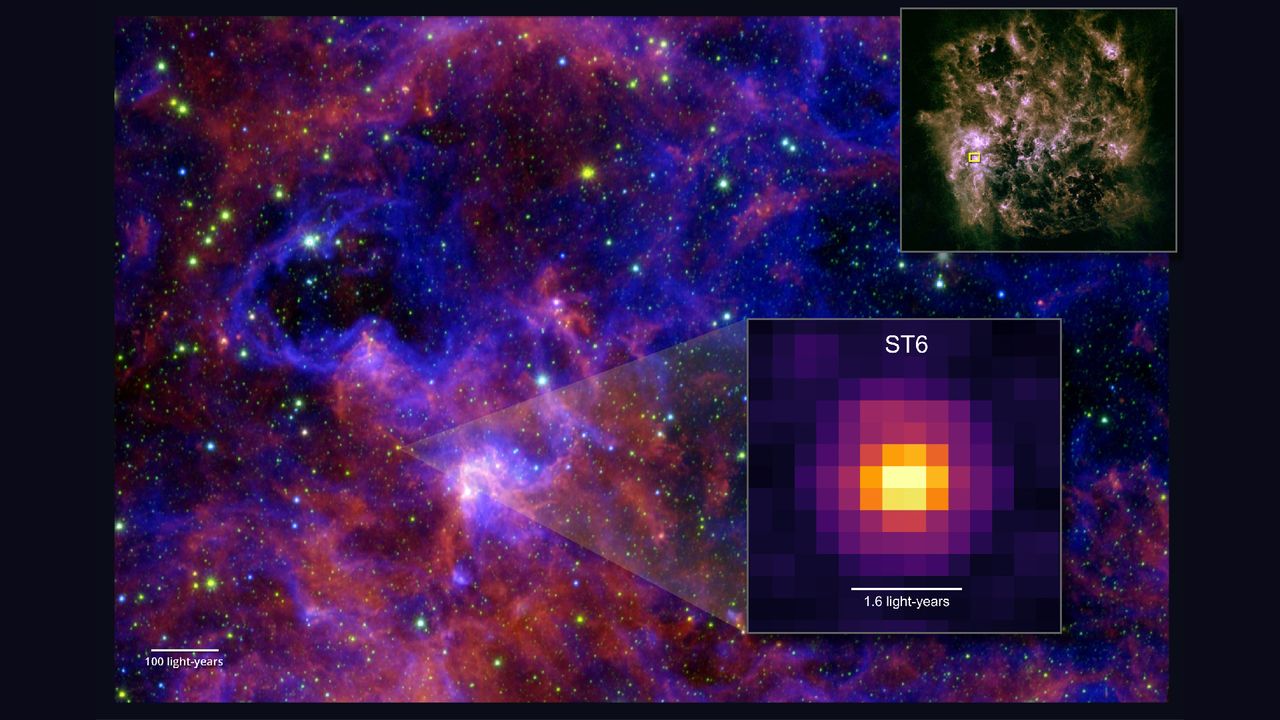
In March 2024, the researchers pointed the JWST at a developing star, dubbed ST6, in the Large Magellanic Cloud. Using instruments that measure infrared light, they discovered five complex carbon-based molecules in the ice around the star: methanol, acetaldehyde, ethanol, methyl formate and acetic acid.

Of the five molecules, only methanol has been previously detected in protostars outside the Milky Way. Acetic acid, the main component in vinegar, had never even been conclusively found in space ice before.

“Before Webb, methanol had been the only complex organic molecule conclusively detected in ice around protostars, even in our own galaxy,” Sewilo said. “The exceptional quality of our new observations helped us gather an immense amount of information from a single spectrum, more than we’ve ever had before.”

Get the world’s most fascinating discoveries delivered straight to your inbox.

The researchers also found signals that might be caused by a chemical called glycolaldehyde, although further study will be needed to confirm its presence. Glycolaldehyde can react with other molecules to form a type of sugar called ribose, an important component of ribonucleic acid (RNA), which is essential for life.

Finding such complex molecules in the Large Magellanic Cloud suggests that chemical reactions on the surfaces of dust grains can produce complex molecules even under harsh conditions, the researchers said. In future studies, the team plans to look for these and similar molecules around other protostars, both in the Milky Way and in nearby galaxies.

“With this discovery, we’ve made significant advancements in understanding how complex chemistry emerges in the universe and opening new possibilities for research into how life came to be,” Sewilo said in the statement.

Source link

Share. Facebook Twitter Pinterest LinkedIn Tumblr Email
Previous ArticleRepublicans rebuke Trump’s 50% emergency tariffs on Brazil in Senate vote
Next Article Discovered! Uncovered! Dr. Seuss book to be released
Editor
  • Website

Related Posts

Lifestyle

800-year-old ‘hugging skeletons’ are genetically confirmed as Poland’s only medieval same-sex double burial

May 21, 2026
Lifestyle

There’s a new T. rex from the dinosaur age — and it ruled the seas with a skull-crushing bite

May 21, 2026
Lifestyle

Great Pyramid of Giza is remarkably resilient to earthquakes —‬ and it’s due to the ancient Egyptians’ ‘extraordinary’ engineering knowledge

May 21, 2026
Add A Comment

Comments are closed.

Categories
  • Entertainment
  • Lifestyle
  • News
  • Sports
  • Tech
  • Travel
Recent Posts
  • 800-year-old ‘hugging skeletons’ are genetically confirmed as Poland’s only medieval same-sex double burial
  • There’s a new T. rex from the dinosaur age — and it ruled the seas with a skull-crushing bite
  • Great Pyramid of Giza is remarkably resilient to earthquakes —‬ and it’s due to the ancient Egyptians’ ‘extraordinary’ engineering knowledge
  • China’s real-life ‘transformer’ mech is a giant humanoid robot that can switch from bounding on 4 legs to walking on 2
  • How can we prevent AI models from cannibalizing themselves when human-generated data runs out? Scientists say they’ve found the answer.
calendar
May 2026
M T W T F S S
 123
45678910
11121314151617
18192021222324
25262728293031
« Apr    
Recent Posts
  • 800-year-old ‘hugging skeletons’ are genetically confirmed as Poland’s only medieval same-sex double burial
  • There’s a new T. rex from the dinosaur age — and it ruled the seas with a skull-crushing bite
  • Great Pyramid of Giza is remarkably resilient to earthquakes —‬ and it’s due to the ancient Egyptians’ ‘extraordinary’ engineering knowledge
About

Welcome to Baynard Media, your trusted source for a diverse range of news and insights. We are committed to delivering timely, reliable, and thought-provoking content that keeps you informed
and inspired

Categories
  • Entertainment
  • Lifestyle
  • News
  • Sports
  • Tech
  • Travel
Facebook X (Twitter) Pinterest WhatsApp
  • Contact Us
  • About Us
  • Privacy Policy
  • Disclaimer
  • UNSUBSCRIBE
© 2026 copyrights reserved

Type above and press Enter to search. Press Esc to cancel.