
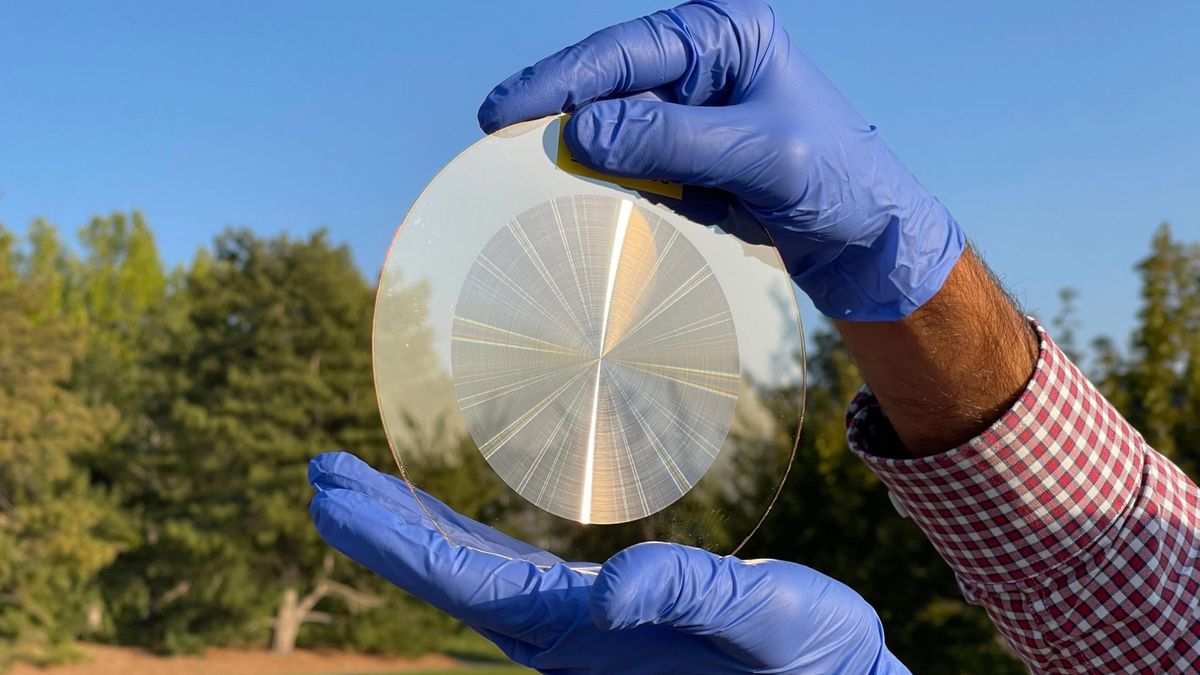
A new type of flat, razor-thin telescope lens could transform deep-space stargazing by making it possible to mount lightweight but powerful telescopes onto aircraft and satellites, scientists say.
Refractor telescopes normally use curved lenses to magnify distant objects through a process called refraction. Similar to a magnifying glass, the curved lens of a telescope bends light and directs it to a focal point, making objects appear larger.
However, traditional lenses quickly become impractical for space telescopes studying stars or galaxies millions of light years away. This is because the further away an object is, the more magnification is required to bring it into focus, and therefore the thicker and heavier the lens needs to be.
That’s why scientists have explored flat lenses, which should in theory be lighter and less bulky. The challenge with them, however, is that light interacts with them differently than with curved lenses.
Visible light is a type of electromagnetic radiation, which is transmitted in waves or particles at different wavelengths and frequencies. When light passes through a flat lens, it diffracts, scattering wavelengths in multiple directions and resulting in a blurry, unfocused image.
But a new “multilevel diffractive lens” (MDL) developed by scientists features a multi-level structure consisting of “microscopically small concentric rings.” These effectively channel different wavelengths of light towards the same focal point to create a sharp, color-accurate image.
Related: Could we turn the sun into a gigantic telescope?
The new 100-millimeter (3.9-inch) diameter lens, which has a 200 mm (7.8 in) focal length, is just 2.4 micrometers thick. Optimized for the 400 to 800 nm wavelength range for visible light, this lens is much lighter than a conventional curved lens and eliminates color distortions.
The scientists published their findings Feb. 3 in the journal Applied Physics Letters. The study was funded by the Defense Advanced Research Projects Agency (DARPA), NASA and the Office of Naval Research.
“Our demonstration is a stepping stone towards creating very large aperture lightweight flat lenses with the capability of capturing full-color images for use in air- and space-based telescopes,” lead study author Apratim Majumder, assistant professor in electrical and computer engineering at the University of Utah, said in a statement.

Ahead of the curve
Scientists have designed flat lenses in the past, most notably the fresnel zone plate (FZP), which features concentric ridges etched across the surface. However, the ridges of FZPs break light into separate wavelengths and diffract them at different angles, resulting in color distortions.
The MDL is unique in that its concentric rings exist at varying depths within the lens itself. As light passes through, the microscopic indentations adjust how different wavelengths diffract, preventing them from spreading apart as they normally would. This controlled diffraction brings all wavelengths of light into focus at the same time, resulting in a sharper, color-accurate image.
As well as avoiding the color distortions of FZPs, the researchers said the new flat lens offered the same light-bending power as traditional curved lenses. In the study, they used the MDL to capture images of the sun and moon. Lunar images they took revealed key geological features, while they also used it in solar imaging to capture visible sunspots.
“Simulating the performance of these lenses over a very large bandwidth, from visible to near-infrared, involved solving complex computational problems involving very large datasets,” Majumder said in the statement. “Once we optimized the design of the lens’ microstructures, the manufacturing process required very stringent process control and environmental stability.”
The researchers said the technology had applications in astronomy, astrophotography and other “long-range imaging tasks” including “airborne and space-based imaging applications.” What’s more, production may not be far off.
“Our computational techniques suggested we could design multi-level diffractive flat lenses with large apertures that could focus light across the visible spectrum and we have the resources in the Utah Nanofab to actually make them,” study co-author Rajesh Menon, professor of electrical and computer engineering at University of Utah, said in the statement.
