Close Menu
  • Home
  • UNSUBSCRIBE
  • News
  • Lifestyle
  • Tech
  • Entertainment
  • Sports
  • Travel
Facebook X (Twitter) WhatsApp
Trending
  • How did animals survive the asteroid that killed the dinosaurs?
  • ‘We can identify these really early, before the clinical diagnosis’: Epigenetic markers may help explain why Native Hawaiians are aging faster
  • Catapult the cow: 6 medieval castles that were never conquered
  • China launches ‘human artificial embryos’ to space for the first time
  • NASA’s Psyche spacecraft beams back blue images of Mars on its way to a metal asteroid
  • Science news this week: Laotian ‘death jar’, climate change threatens rice crops, and an asthma drug treats tough cancer
  • DNA sequencing is rewriting our understanding of historic outbreaks, but it can’t tell the whole story
  • AI-generated images are making it impossible to distinguish truth from fiction. We need laws and AI watermarks to protect our shared reality.
Facebook X (Twitter) WhatsApp
Baynard Media
  • Home
  • UNSUBSCRIBE
  • News
  • Lifestyle
  • Tech
  • Entertainment
  • Sports
  • Travel
Baynard Media
Home»Lifestyle»Fishers discover first-of-its-kind bright orange shark with two rare conditions in Caribbean
Lifestyle

Fishers discover first-of-its-kind bright orange shark with two rare conditions in Caribbean

EditorBy EditorSeptember 5, 2025No Comments4 Mins Read
Share Facebook Twitter Pinterest LinkedIn Tumblr Reddit Telegram Email
Share
Facebook Twitter LinkedIn Pinterest Email

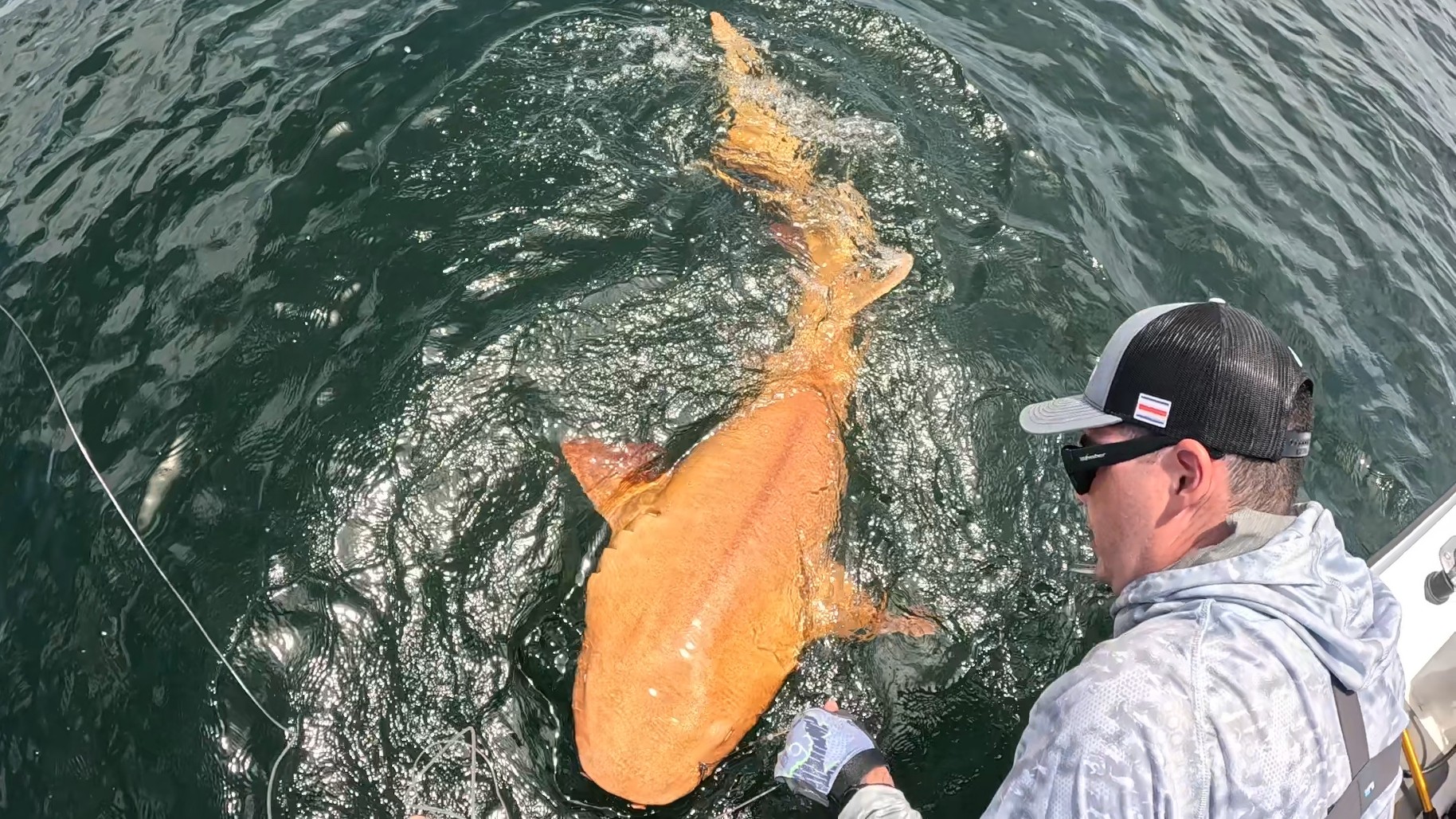
A first-of-its-kind bright orange shark with white eyes has been caught and released in the Caribbean, a new study reveals.

The nurse shark (Ginglymostoma cirratum) had a mysterious condition called xanthism, or xanthochroism, which increases yellow pigmentation in the skin. Researchers have recorded xanthism in several animals, but this is the first definitive case of a nurse shark with the trait. The shark also appears to have albinism, making it even more unusual.

Sports fishers discovered the shark by chance off the east coast of Costa Rica in 2024. Garvin Watson, owner of the Parismina Domus Dei hotel in the village of Parismina, reeled in the shark, which was around 6.6 feet (2 meters) long and swimming 120 feet (37 m) below the surface.


You may like

“We could not believe what we had in front of our eyes,” Watson told Live Science in an email.

“That orange shark shining with the sunlight was something out of the ordinary,” he said. “We did not know that it was going to be a discovery worldwide, recognized by all the biologists of the world.”

The fishers photographed the shark, then removed the hook from its mouth and released it back into the Caribbean Sea. Researchers described the event and its significance in a new study published Aug. 1 in the journal Marine Biodiversity.

Related: Do sharks make noises? An accidental discovery might just answer that question

Get the world’s most fascinating discoveries delivered straight to your inbox.

Scientists have documented xanthism in a variety of species, including frogs, birds and fish. While some animals are normally yellow and orange, these colors are more prominent in xanthic individuals of these species.

Nurse sharks are typically yellow to gray-brown. There have been occasional reports of unusual coloring in this species, including albinism — characterized by a complete lack of melanin pigmentation in the skin and iris — and potential xanthism, but a xanthic nurse shark had never been scientifically documented before now, according to the study.

“We were very surprised and excited when we saw the [xanthism] in the photos,” study lead author Marioxis Macías-Cuyare, a doctoral candidate in biological oceanography at the Federal University of Rio Grande in Brazil, told Live Science in an email.

Image 1 of 2

A photograph of the bright orange nurse shark being reeled in by a boat.
The shark had total xanthism, with the anomalous pigmentation covering its whole body. (Image credit: Garvin Watson and Parismina Domus Dei. Parismina Limón Bar, Costa Rica.)

A photograph of the orange shark being released.
Fishers released the shark after it was photographed. (Image credit: Garvin Watson and Parismina Domus Dei. Parismina Limón Bar, Costa Rica.)

The researchers spoke with Watson and studied photos of the shark. They noted that the shark lacked the black irises typically seen in shark eyes, and concluded that it was likely albino as well as xanthic. A 2018 study documented this combined condition, known as albino-xanthochromism, in a ray species (Raja montagui) found in the Irish Sea.

Researchers are still studying the causes of abnormal pigmentation in sharks. Such conditions are typically associated with genetics, but factors such as environmental stress, elevated temperatures and hormonal imbalances may also contribute to different colors, according to the study.

Macías-Cuyare said that xanthism is usually genetic, but more research was needed to understand the conditions influencing the shark’s anomalous pigmentation.

The shark’s survival is also curious. Animals evolve to be specific colors to better survive in their environments, so being bright orange when the species isn’t meant to be would normally be a hindrance. In this case, the shark has made it to adulthood and doesn’t appear to have been held back by its unusual color.

“Many factors influence this, such as the environment, but everything remains speculative until the variables that could influence this genetic condition are tested,” Macías-Cuyare said.

Source link

Share. Facebook Twitter Pinterest LinkedIn Tumblr Email
Previous ArticleFlorida opens new ‘Deportation Depot’ migrant detention facility
Next Article Tesla could make Elon Musk world’s first trillionaire
Editor
  • Website

Related Posts

Lifestyle

How did animals survive the asteroid that killed the dinosaurs?

May 24, 2026
Lifestyle

‘We can identify these really early, before the clinical diagnosis’: Epigenetic markers may help explain why Native Hawaiians are aging faster

May 24, 2026
Lifestyle

Catapult the cow: 6 medieval castles that were never conquered

May 24, 2026
Add A Comment

Comments are closed.

Categories
  • Entertainment
  • Lifestyle
  • News
  • Sports
  • Tech
  • Travel
Recent Posts
  • How did animals survive the asteroid that killed the dinosaurs?
  • ‘We can identify these really early, before the clinical diagnosis’: Epigenetic markers may help explain why Native Hawaiians are aging faster
  • Catapult the cow: 6 medieval castles that were never conquered
  • China launches ‘human artificial embryos’ to space for the first time
  • NASA’s Psyche spacecraft beams back blue images of Mars on its way to a metal asteroid
calendar
May 2026
M T W T F S S
 123
45678910
11121314151617
18192021222324
25262728293031
« Apr    
Recent Posts
  • How did animals survive the asteroid that killed the dinosaurs?
  • ‘We can identify these really early, before the clinical diagnosis’: Epigenetic markers may help explain why Native Hawaiians are aging faster
  • Catapult the cow: 6 medieval castles that were never conquered
About

Welcome to Baynard Media, your trusted source for a diverse range of news and insights. We are committed to delivering timely, reliable, and thought-provoking content that keeps you informed
and inspired

Categories
  • Entertainment
  • Lifestyle
  • News
  • Sports
  • Tech
  • Travel
Facebook X (Twitter) Pinterest WhatsApp
  • Contact Us
  • About Us
  • Privacy Policy
  • Disclaimer
  • UNSUBSCRIBE
© 2026 copyrights reserved

Type above and press Enter to search. Press Esc to cancel.