Close Menu
  • Home
  • UNSUBSCRIBE
  • News
  • Lifestyle
  • Tech
  • Entertainment
  • Sports
  • Travel
Facebook X (Twitter) WhatsApp
Trending
  • Faster ‘biological aging’ in young adults may help explain rise in early-onset cancers, study hints
  • Computer scientists are rushing to tame tame AI’s voracious appetite for energy
  • Our brains aren’t wired to handle this much bad news. But ‘looking away is not the fix,’ expert says.
  • ‘The fate of Earth depends on a delicate balance’: Our planet may survive the death of the sun after all, new models hint
  • Bullseye! Enormous ‘bow and arrow’ galaxy is unlike anything radio astronomers have ever seen — Space photo of the week
  • IBM creates first sub-1nm computer chip — cramming 100 billion transistors into a tiny fingernail-sized space
  • New chip harnesses quantum computing’s biggest weakness — and tries to turn it into a strength
  • How did the Romans build such straight roads?
Facebook X (Twitter) WhatsApp
Baynard Media
  • Home
  • UNSUBSCRIBE
  • News
  • Lifestyle
  • Tech
  • Entertainment
  • Sports
  • Travel
Baynard Media
Home»Lifestyle»‘Fascinating’ Viking Age inscription reveals who owned immensely valuable ‘Galloway Hoard’
Lifestyle

‘Fascinating’ Viking Age inscription reveals who owned immensely valuable ‘Galloway Hoard’

EditorBy EditorFebruary 10, 2025No Comments4 Mins Read
Share Facebook Twitter Pinterest LinkedIn Tumblr Reddit Telegram Email
Share
Facebook Twitter LinkedIn Pinterest Email

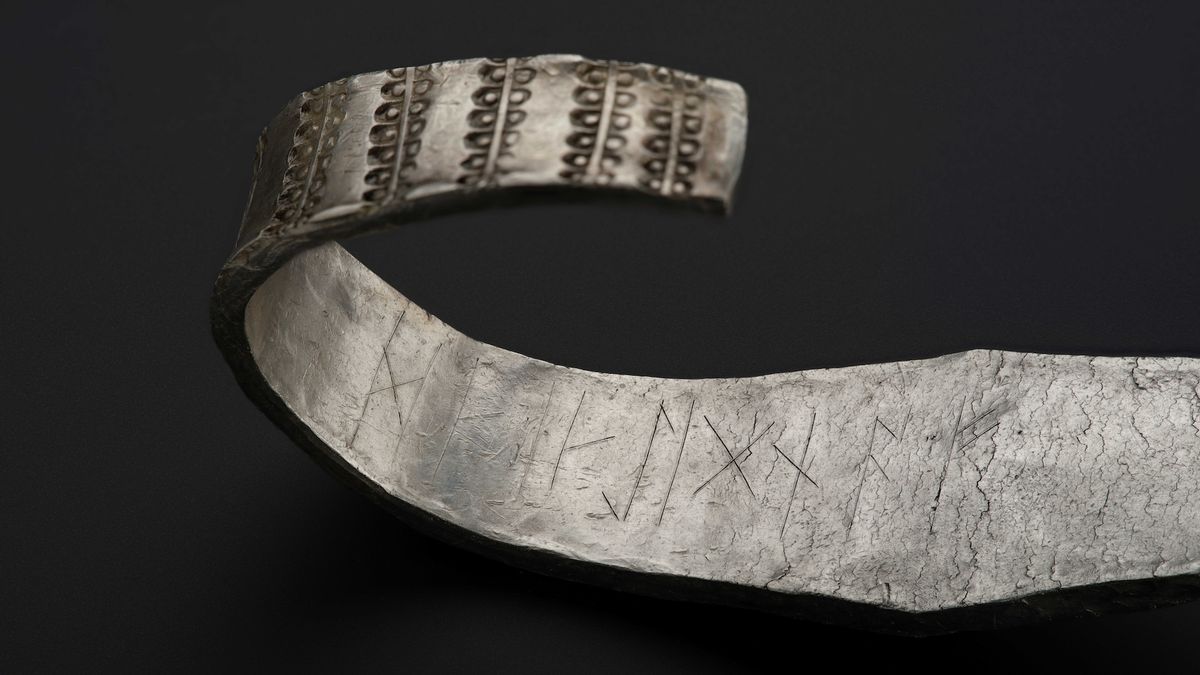
Newly deciphered Viking Age runes carved inside a 1,100-year-old silver arm ring from Scotland suggest that the ornament and the hoard it was buried with were owned by a community, rather than by an individual.

The discovery provides important insight into the immensely valuable “Galloway Hoard” that contains the arm ring, experts said.

Researchers identified the language of the runic inscription as a type of Old English (a form of the ancient Germanic language). The proposed translation reads, “This is the community’s wealth,” although the translators noted that the word “wealth” could also be interpreted as “property.”

They said the inscription implies that the entire Galloway Hoard, which contains more than 11 pounds (5 kilograms) of silver and gold, was held in common by an early medieval community.

“The idea that the wealth this hoard represents would be communally held is fascinating,” Martin Goldberg, an archaeologist with National Museums Scotland involved in recent research into the hoard, said in a statement. But “it does still leave us with unanswered questions around the circumstances in which a community’s wealth would come to be buried, and also which particular community.”

Related: Massive medieval coin hoard worth ‘about 150 sheep’ discovered in Germany’s Black Forest

Medieval treasure

Metal detectorists found the Galloway Hoard in 2014 near the village of Balmaghie in the Galloway region of southwest Scotland — hence its name.

Get the world’s most fascinating discoveries delivered straight to your inbox.

Experts have determined that the hoard dates to about the year 900 and that it seems to have been buried in four distinct parcels, according to National Museums Scotland, which acquired the hoard in 2017.

The top layer of the buried hoard contained silver bullion and a rare Anglo-Saxon silver crucifix, and four silver arm rings were buried beneath it. Below that was a wooden box containing pieces of gold, and beneath that was a trove of carefully wrapped relics, beads, pendants, brooches and bracelets.

Experts think the careful burial helped preserve several rare organic artifacts, including pieces of silk and other textiles that had been used to wrap some of the items. And they also determined that some of the objects originated from far away, including a silver gilt vessel made with metal that seems to have come from a mine in Iran, possibly when it was part of the Sasanian Empire (A.D. 224 to 651).

Image 1 of 3

a picture of the Galloway hoard
(Image credit: National Museums Scotland)

The Galloway Hoard was found by metal detectorists in 2014. It comprises more than 11 pounds (5 kilograms) of mostly silver and gold artifacts.

a silver armband with geometric designs
(Image credit: National Museums Scotland)

The translated inscription is on the inside of one of four silver arm rings discovered in the Galloway Hoard.

a close-up of multiple silver armbands with runic inscriptions
(Image credit: National Museums Scotland)

Each of the silver arm rings in the Galloway Hoard bears an inscription in runes, but these have been undeciphered until now.


Viking Age silver

Many of the objects in the hoard have religious connections, including the silver crucifix, which was probably a bishop’s “pectoral cross.” The cross, along with the name “Bishop Hyguald” inscribed on a gilded rock crystal jar, suggests the hoard may have been owned by a religious community, Goldberg said. These findings support a theory that Christian clergy buried the hoard to dupe the Vikings.

Each of the four silver arm rings had runic inscriptions cut into their inside faces, but their meanings had confounded experts until now, the statement said.

David Parsons, a runologist at the University of Wales who studied the inscriptions, said the runic spelling used for some words seemed not to correspond to any known languages in use in early-medieval Britain or Ireland.

“However, if we think about both spoken and written English today, there are a huge range of original and idiomatic variations,” he said in the statement — and so the translation of the inscription on the silver arm ring seems to have affirmed that the object had been owned in common by a community.

Source link

Share. Facebook Twitter Pinterest LinkedIn Tumblr Email
Previous ArticleGet a 1-year BJ’s membership for just $20
Next Article Nicole Kidman, Kylie Jenner and More Who Brought Their Kids to Fashion Week
Editor
  • Website

Related Posts

Lifestyle

Faster ‘biological aging’ in young adults may help explain rise in early-onset cancers, study hints

June 29, 2026
Lifestyle

Computer scientists are rushing to tame tame AI’s voracious appetite for energy

June 28, 2026
Lifestyle

Our brains aren’t wired to handle this much bad news. But ‘looking away is not the fix,’ expert says.

June 28, 2026
Add A Comment

Comments are closed.

Categories
  • Entertainment
  • Lifestyle
  • News
  • Sports
  • Tech
  • Travel
Recent Posts
  • Faster ‘biological aging’ in young adults may help explain rise in early-onset cancers, study hints
  • Computer scientists are rushing to tame tame AI’s voracious appetite for energy
  • Our brains aren’t wired to handle this much bad news. But ‘looking away is not the fix,’ expert says.
  • ‘The fate of Earth depends on a delicate balance’: Our planet may survive the death of the sun after all, new models hint
  • Bullseye! Enormous ‘bow and arrow’ galaxy is unlike anything radio astronomers have ever seen — Space photo of the week
calendar
June 2026
M T W T F S S
1234567
891011121314
15161718192021
22232425262728
2930  
« May    
Recent Posts
  • Faster ‘biological aging’ in young adults may help explain rise in early-onset cancers, study hints
  • Computer scientists are rushing to tame tame AI’s voracious appetite for energy
  • Our brains aren’t wired to handle this much bad news. But ‘looking away is not the fix,’ expert says.
About

Welcome to Baynard Media, your trusted source for a diverse range of news and insights. We are committed to delivering timely, reliable, and thought-provoking content that keeps you informed
and inspired

Categories
  • Entertainment
  • Lifestyle
  • News
  • Sports
  • Tech
  • Travel
Facebook X (Twitter) Pinterest WhatsApp
  • Contact Us
  • About Us
  • Privacy Policy
  • Disclaimer
  • UNSUBSCRIBE
© 2026 copyrights reserved

Type above and press Enter to search. Press Esc to cancel.