Close Menu
  • Home
  • UNSUBSCRIBE
  • News
  • Lifestyle
  • Tech
  • Entertainment
  • Sports
  • Travel
Facebook X (Twitter) WhatsApp
Trending
  • There’s a new T. rex from the dinosaur age — and it ruled the seas with a skull-crushing bite
  • Great Pyramid of Giza is remarkably resilient to earthquakes —‬ and it’s due to the ancient Egyptians’ ‘extraordinary’ engineering knowledge
  • China’s real-life ‘transformer’ mech is a giant humanoid robot that can switch from bounding on 4 legs to walking on 2
  • How can we prevent AI models from cannibalizing themselves when human-generated data runs out? Scientists say they’ve found the answer.
  • ‘The system is likely to reach a breaking point’: Major Italian volcano is speeding toward a transition, and a major eruption could be on the way
  • China installs world’s largest floating wind turbine in deep water test — it generates enough energy to power 4,200 homes annually
  • Diagnostic dilemma: A biopsy of a woman’s cancerous tumor caused it to vanish
  • Physicists confirm ‘negative time’ is real in mind-bending quantum experiment
Facebook X (Twitter) WhatsApp
Baynard Media
  • Home
  • UNSUBSCRIBE
  • News
  • Lifestyle
  • Tech
  • Entertainment
  • Sports
  • Travel
Baynard Media
Home»Lifestyle»Farewell to the computer mouse? Bizarre new designs could reduce wrist injuries, scientists say.
Lifestyle

Farewell to the computer mouse? Bizarre new designs could reduce wrist injuries, scientists say.

EditorBy EditorSeptember 20, 2025No Comments4 Mins Read
Share Facebook Twitter Pinterest LinkedIn Tumblr Reddit Telegram Email
Share
Facebook Twitter LinkedIn Pinterest Email

Few gadgets are as iconic as the computer mouse, which has been a staple of the desktop PC since it emerged some 60 years ago.

The design has gone through various evolutions in the decades since, from trackball to laser and wired to wireless, as well as a variety of ergonomic redesigns to improve comfort and reduce the risk of wrist strain. Even so, the fundamental form-factor has remained largely recognizable — until now.

In a new study, researchers developed two prototype mouse designs that mark a more radical departure from the norm: one with a squeezable mesh body, and another with a hinged A-frame design that stands vertically.


You may like

Both are designed to reduce the wrist movements associated with repetitive strain injuries (RSI), which the researchers argued had not been solved by existing ergonomic designs such as slanted grips or trackballs that sit under the fingers.

“The main reason for this propagation of strain from the mouse hand to other parts of the body is that users frequently need to reposition (lift) the mouse several hundred times per hour, such as when trying to reach corners of the screen. As every mouse user is familiar with, lifting the mouse requires moving the wrist and sometimes even the forearm,” the researchers wrote in a study published in the Sept.–Oct. 2025 issue of the journal ACM Interactions.

Related: History of computers: A brief timeline

The researchers said that the prevailing cause of injury and discomfort when using mice is the fact that most designs still feature rigid outer shells.

Get the world’s most fascinating discoveries delivered straight to your inbox.

Even in the 1970s, when softer materials like rubber and silicone started appearing in the grips of tools like hammers and screwdrivers, mice continued to be made with hard casings, largely because they were cheaper and easier to manufacture.

“In our opinion, the effectiveness of ergonomic devices could improve significantly if mouse design took into consideration that users’ hands are not rigid solids. The overwhelming majority of hand tools humans use — keyboards, pencils, hammers, screwdrivers, mice — are rigid for reasons of economy and necessity,” the researchers wrote in the study.

“Advances in 3D printing, the popularity of soft robotics [and] other trends, such as flexible electronics … allow us to build consumer electronic devices that are compliant with our bodies.”


You may like

Fleximouse and A-frame

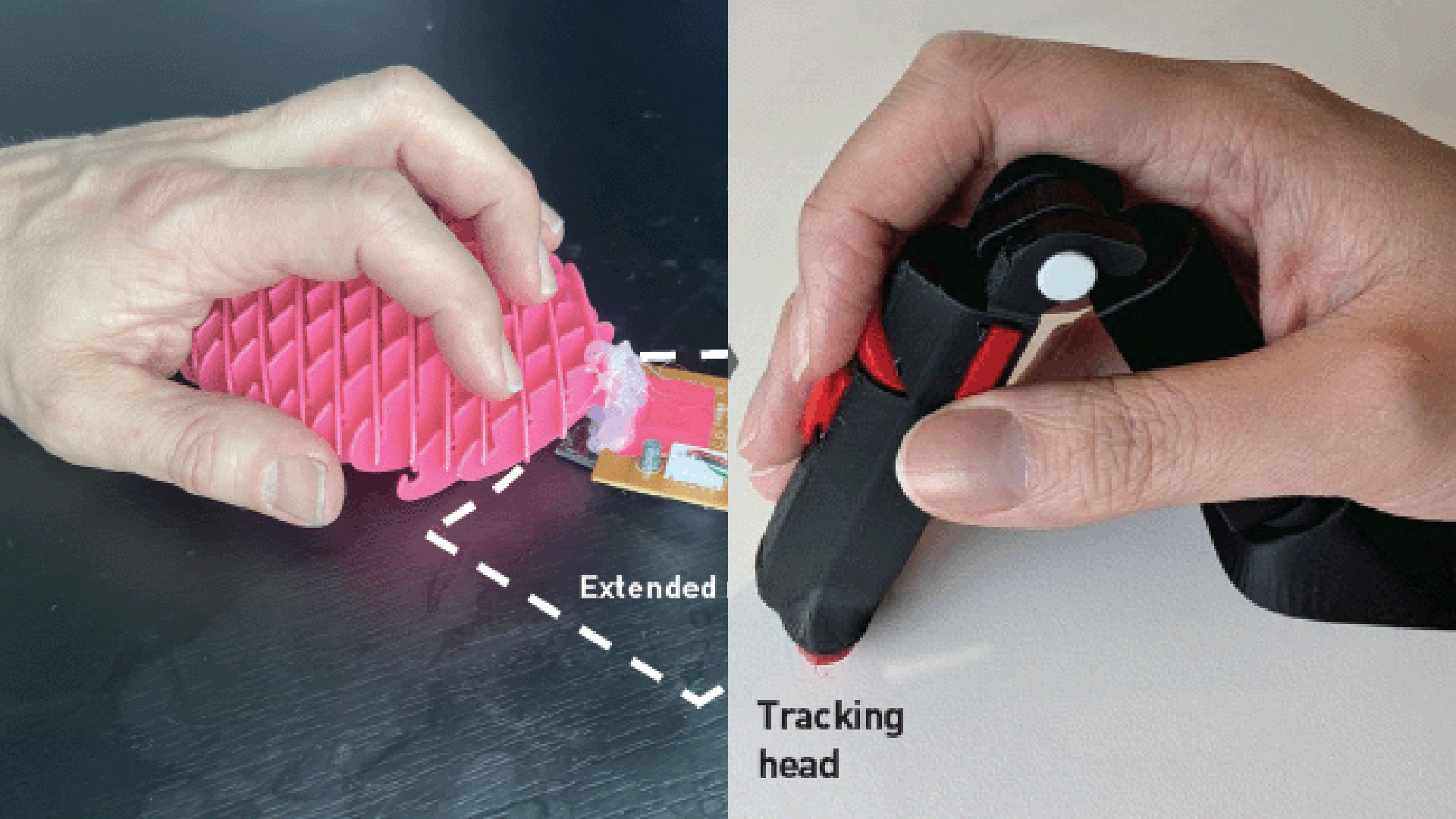
The researchers’ first prototype, dubbed the Fleximouse, features a pliable mesh body that responds to being squeezed, meaning users can move the cursor by changing their grip instead of moving the device over a surface.

The A-frame design, meanwhile, was developed in collaboration with the Melbourne School of Design in Australia. It offers a more natural grip and is built with fewer moving parts — meaning it is less prone to wear. It also keeps the two bones in the forearm — the radius and the ulna — from being crossed all the time, as they are when the hand is lying flat, which the researchers identified as a leading cause of wrist strain.

Image 1 of 2

a prototype of a dome-shaped computer mouse with an extended front end
(Image credit: Jose Berengueres and Tony Yu, CC BY-NC-ND 4.0, Nazarbayev University.)

The Fleximouse design allows users to move the cursor by changing their grip.

a two-paneled image showing a prototype and design of an A-frame shaped computer mouse
(Image credit: Jose Berengueres and Tony Yu, CC BY-NC-ND 4.0, Nazarbayev University.)

The A-frame mouse provides a more ergonomic grip shape.

The two designs were tested out by 28 students at KTH Royal Institute of Technology — many of whom were gamers and frequent mouse users. Of these users, 11 had previously reported chronic discomfort as a result of extended mouse use, while four had clinically diagnosed RSIs.

Feedback was mixed. Some participants described the Fleximouse as playful and appreciated not having to reposition their wrist as often, but others missed familiar features like the scroll wheel. The A-frame mouse also raised issues around fit, with the researchers finding that even small differences in hand size affected how comfortable or natural the grip felt. That said, both prototypes “significantly reduced wrist repositioning”, which was noted as a key contributor to discomfort.

The researchers said future work will explore how to fine-tune flexible designs, including ways to make them adjustable or more easily tailored to users’ hands — potentially offering “the same granularity as glove or shoe sizes.”

“The idea of customizing and personalizing the computer mouse — much like clothing — now seems closer to reality,” they said in the study.

Source link

Share. Facebook Twitter Pinterest LinkedIn Tumblr Email
Previous ArticleKimmel’s ‘face of the brand’ status hangs in balance amid indefinite benching
Next Article Federal prosecutor tasked with investigating Trump adversary Letitia James resigns under pressure
Editor
  • Website

Related Posts

Lifestyle

There’s a new T. rex from the dinosaur age — and it ruled the seas with a skull-crushing bite

May 21, 2026
Lifestyle

Great Pyramid of Giza is remarkably resilient to earthquakes —‬ and it’s due to the ancient Egyptians’ ‘extraordinary’ engineering knowledge

May 21, 2026
Lifestyle

China’s real-life ‘transformer’ mech is a giant humanoid robot that can switch from bounding on 4 legs to walking on 2

May 21, 2026
Add A Comment

Comments are closed.

Categories
  • Entertainment
  • Lifestyle
  • News
  • Sports
  • Tech
  • Travel
Recent Posts
  • There’s a new T. rex from the dinosaur age — and it ruled the seas with a skull-crushing bite
  • Great Pyramid of Giza is remarkably resilient to earthquakes —‬ and it’s due to the ancient Egyptians’ ‘extraordinary’ engineering knowledge
  • China’s real-life ‘transformer’ mech is a giant humanoid robot that can switch from bounding on 4 legs to walking on 2
  • How can we prevent AI models from cannibalizing themselves when human-generated data runs out? Scientists say they’ve found the answer.
  • ‘The system is likely to reach a breaking point’: Major Italian volcano is speeding toward a transition, and a major eruption could be on the way
calendar
May 2026
M T W T F S S
 123
45678910
11121314151617
18192021222324
25262728293031
« Apr    
Recent Posts
  • There’s a new T. rex from the dinosaur age — and it ruled the seas with a skull-crushing bite
  • Great Pyramid of Giza is remarkably resilient to earthquakes —‬ and it’s due to the ancient Egyptians’ ‘extraordinary’ engineering knowledge
  • China’s real-life ‘transformer’ mech is a giant humanoid robot that can switch from bounding on 4 legs to walking on 2
About

Welcome to Baynard Media, your trusted source for a diverse range of news and insights. We are committed to delivering timely, reliable, and thought-provoking content that keeps you informed
and inspired

Categories
  • Entertainment
  • Lifestyle
  • News
  • Sports
  • Tech
  • Travel
Facebook X (Twitter) Pinterest WhatsApp
  • Contact Us
  • About Us
  • Privacy Policy
  • Disclaimer
  • UNSUBSCRIBE
© 2026 copyrights reserved

Type above and press Enter to search. Press Esc to cancel.