
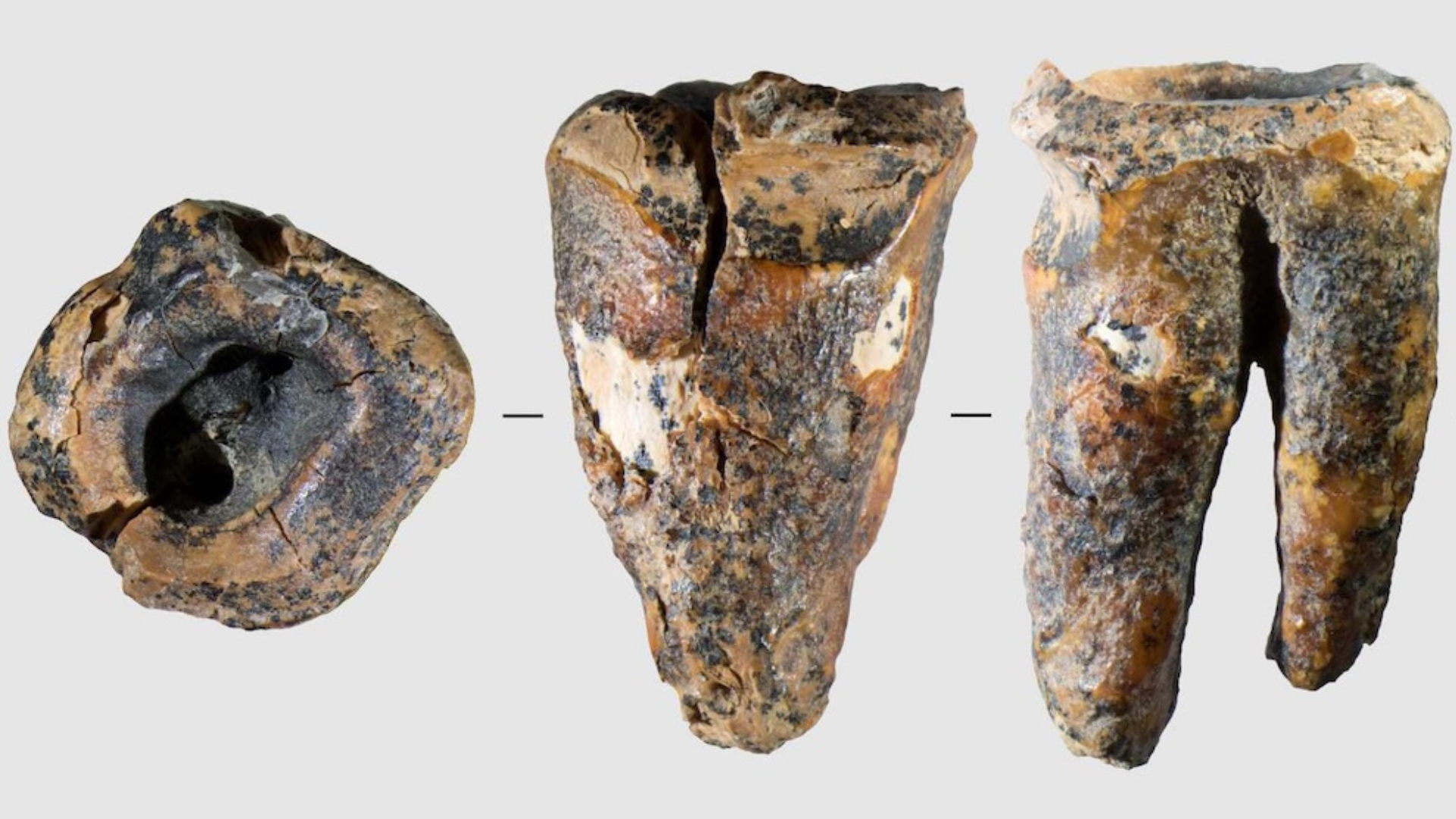
Around 60,000 years ago in Siberia, a Neanderthal opened their mouth so that a rotten tooth could be drilled — and the case is the oldest evidence of an intentional dental treatment to date, a new study finds.
A lower molar tooth belonging to a Neanderthal adult was originally unearthed in 2016, but it was not clear what had caused the deep hole in its surface. Now, experimental evidence indicates the hole was made with a small stone drill used to clean out bits of severely rotten tooth tissue, according to a study published Wednesday (May 13) in the journal PLOS One.
This intricate procedure shows Neanderthals — our closest human relatives who lived from around 400,000 to 40,000 years ago — had the brains to recognize this painful tooth cavity could be treated and possessed the fine motor skills to successfully execute the procedure.
“The fact that this invasive treatment took place and the person survived lends me to believe that this is another example of the really very sophisticated Neanderthal understanding of human biology and when you need to intervene,” study co-author John W. Olsen, a professor emeritus of anthropology at the University of Arizona, told Live Science.
It’s unclear whether this was self-treatment or dentistry performed by another individual. Even so, “it suggests that the roots of invasive medicine and surgery do not belong exclusively to Homo sapiens, but are part of a broader legacy shared with our closest relatives,” Gregorio Oxilia, a dental anthropologist at the Free Mediterranean University in Italy who was not involved in the research, told Live Science in an email.
The oldest evidence of our own species, Homo sapiens, treating tooth decay dates to roughly 14,000 years ago in what is now Italy. By pushing back the date of intentional dentistry by roughly 45,000 years, this new finding “fundamentally reshapes our understanding of the evolution of human healthcare,” said Oxilia, who was the first author on the study detailing the 14,000-year-old finding.
Prehistoric healthcare
There are now multiple known cases of Neanderthal healthcare. For example, different sites in Spain show that Neanderthals seem to have cared for a child with Down syndrome and ate medicinal plants.
However, in part because their generally low-carbohydrate diets kept the rates of tooth decay low, evidence of dental interventions in Neanderthals has been limited.
So, to determine whether the unusual hole in the roughly 59,000-year-old Neanderthal molar found in Chagyrskaya Cave was deliberately human-made, the researchers inspected the tooth and ran experiments using three modern human teeth.
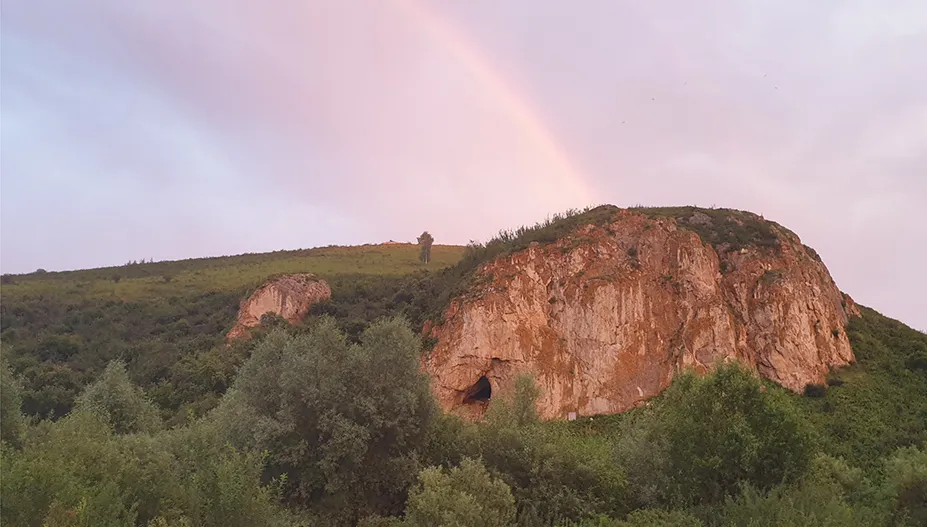
Chagyrskaya Cave is located in southwestern Siberia, Russia.
Microscopic analyses of the Neanderthal molar revealed two patches of deep demineralization, indicative of severe tooth decay. One area of tooth decay was located where the tooth would have met the gumline. Here, the researchers identified straight grooves characteristic of tooth picking.
The other decayed patch overlapped with the 0.17 inch long, 0.11 inch wide and 0.10 inch deep (4.2 mm long, 2.8 mm wide and 2.6 mm deep) cavity on the tooth’s surface. There were tiny markings along the top edge of this hole.
The team then ran experiments on three modern human teeth to see which tools and motions were required to replicate these markings. This revealed the grooves could be made by the twisting motion of small stone tools made from locally available jasper. Multiple examples of tools with long, thin, pointed tips that could have served this purpose have previously been found in Chagyrskaya Cave.
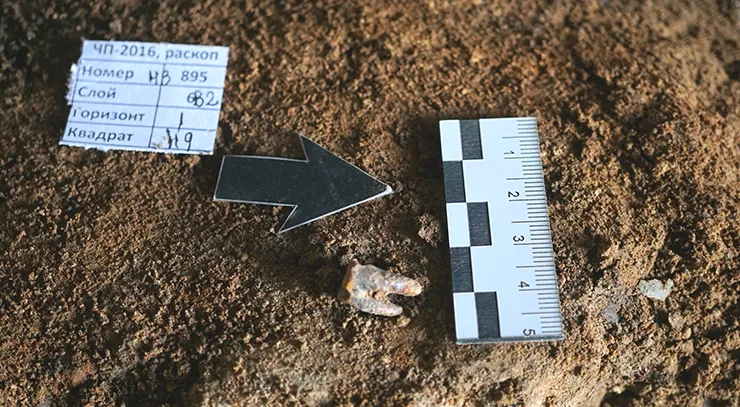
The tooth was originally discovered in 2016.
Evidence of chew marks overlaying the grooves around the cavity indicates this individual “not only survived the operation,” Olsen said, “but that they lived for some significant period of time, allowing their normal chewing activities to begin to erase the evidence of the original drilling.”
While scientists cannot be certain the hole was made using a stone dental drill, the very localized markings make this conclusion more likely than other possible explanations, such as the hole being the result of damage after the individual died, said Marina Lozano Ruiz, a bioarchaeologist who researches Neanderthal teeth at the University of Rovira i Virgili in Catalonia, who was not involved in the study.
The case is “exceptional precisely because it shows that they were able to react to an uncommon pathology with a highly targeted and technically complex response,” Oxilia said.
Rebecca Wragg Sykes, an archaeologist at the University of Cambridge and author of “Kindred: Neanderthal Life, Love, Death and Art” (Bloomsbury Sigma, 2020), thinks the procedure was likely self-treatment. “Digging into this rotten tooth probably didn’t need anyone to help,” Sykes, who was not involved in the study, told Live Science in an email.
Although group members may have provided emotional support during the painful procedure, “we’ve learned from other primates that they can actually survive really serious conditions without any help from their group,” she said.
Zubova AV, Zotkina LV, Olsen JW, Kulkov AM, Moiseyev VG, Malyutina AA, et al. (2026) Earliest evidence for invasive mitigation of dental caries by Neanderthals. PLoS One 21(5): e0347662. https://doi.org/10.1371/journal.pone.0347662
How much do you know about our closest relatives? Find out with our Neanderthal quiz!
