
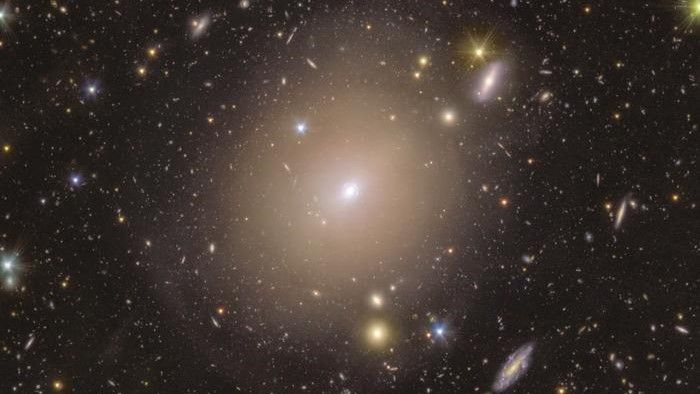
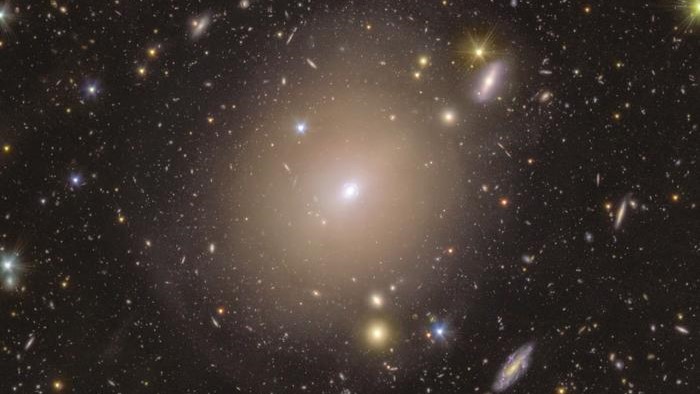
The Euclid space telescope has captured a stunning and rare “Einstein ring” magnifying light from the depths of the universe.
The image shows a faint halo surrounding the nearby galaxy NGC 6505, created as the galaxy warps and magnifies light from an even more distant galaxy behind it.
This type of magnification is called gravitational lensing and was first predicted by Albert Einstein in 1915. The powerful magnification means that the resulting image shows us light from an unnamed and undiscovered galaxy 4.42 billion light-years into the universe’s past — even though NGC 6505 is only 590 million light-years away, in Earth’s “cosmic backyard.” The researchers published their findings Feb. 10 in the journal Astronomy and Astrophysics.
“An Einstein ring is an example of strong gravitational lensing,” study lead author Conor O’Riordan, a researcher at the Max Planck Institute for Astrophysics in Germany, said in a statement. “All strong lenses are special, because they’re so rare, and they’re incredibly useful scientifically. This one is particularly special, because it’s so close to Earth and the alignment makes it very beautiful.”
Magnifying the stars
Einstein’s theory of general relativity describes the way massive objects warp the fabric of the universe, called space-time. Gravity, Einstein discovered, isn’t produced by an unseen force but by space-time curving and distorting in the presence of matter and energy.
Related: Mysterious ‘Green Monster’ lurking in James Webb photo of supernova remnant is finally explained
This curved space, in turn, sets the rules for how energy and matter move. Even though light travels in a straight line, light traveling through a highly curved region of space-time, such as the region around a massive galaxy, also travels in a curve — bending around the galaxy and splaying out into a halo.
The new image was retrieved from data collected by the Euclid space telescope during its early testing phase in September 2023. Launched on July 1, 2023, Euclid was designed to compile wide-lens images to help scientists hunt for two of the universe’s most mysterious components: dark matter and dark energy.Researchers think dark matter and dark energy together make up about 95% of the universe, but they do not interact with light so can’t be detected directly.
Instead, scientists study these mysterious components by observing the way they interact with the visible universe around them: Dark matter can be seen by observing its gravitational warping effects on galaxies; and dark energy can be spotted in the force propelling the universe’s runaway expansion.
Astronomers have identified hundreds of Einstein rings. But these phenomena aren’t sought after just because they make pretty pictures. Because the rings magnify light, scientists can reconstruct this light into its original, pre-bent, form, which can enhance the details astronomers are able to spot in very distant galaxies.
Also, because the extent to which light bends depends on the strength of the gravitational field of the object that bends it, Einstein rings can act as a cosmic scale for gauging the masses of galaxies and black holes, including how much dark matter they contain.
“I find it very intriguing that this ring was observed within a well-known galaxy, which was first discovered in 1884,” study co-author Valeria Pettorino, a project scientist working on Euclid, said in the statement. “The galaxy has been known to astronomers for a very long time. And yet this ring was never observed before. This demonstrates how powerful Euclid is, finding new things even in places we thought we knew well. This discovery is very encouraging for the future of the Euclid mission and demonstrates its fantastic capabilities.”
Euclid is partway through its six-year mission to catalog a third of the entire night sky by capturing thousands of wide-angle images. All told, Euclid will capture light from more than a billion galaxies that are up to 10 billion years old, according to the European Space Agency.
Once this is done, astronomers will use Euclid’s images to create two maps: one of the gravitational lensing of galaxies that should reveal concentrations of dark matter, and the other of shock waves called baryon acoustic oscillations that can trace dark energy.
