Close Menu
  • Home
  • UNSUBSCRIBE
  • News
  • Lifestyle
  • Tech
  • Entertainment
  • Sports
  • Travel
Facebook X (Twitter) WhatsApp
Trending
  • ‘Unequivocal evidence’ of the age of Earth’s oldest impact crater turns out to be off by half a billion years
  • Something is interfering with alien radio signals in space, new paper claims — and there’s an easy way to fix it
  • NASA satellite captures wave of warm water hundreds of miles long that signals a devastatingly strong El Niño
  • 9 of the best technology conspiracy theories
  • Bizarre ‘bull’s-eye’ cloud rings appear above erupting volcano on Atlantic island — Earth from space
  • IBD is caused by a broken ‘inflammation brake’ in some patients
  • Hanging lamp in the form of a sandaled right foot: A 1,600-year-old bronze lamp with multilayered Christian symbolism
  • Never-before-seen shark that ‘walks’ on land discovered off Papua New Guinea
Facebook X (Twitter) WhatsApp
Baynard Media
  • Home
  • UNSUBSCRIBE
  • News
  • Lifestyle
  • Tech
  • Entertainment
  • Sports
  • Travel
Baynard Media
Home»Lifestyle»Enormous, mountain-size asteroid will be visible from Earth this weekend in rare ‘once in a decade’ event
Lifestyle

Enormous, mountain-size asteroid will be visible from Earth this weekend in rare ‘once in a decade’ event

EditorBy EditorJanuary 10, 2025No Comments3 Mins Read
Share Facebook Twitter Pinterest LinkedIn Tumblr Reddit Telegram Email
Share
Facebook Twitter LinkedIn Pinterest Email

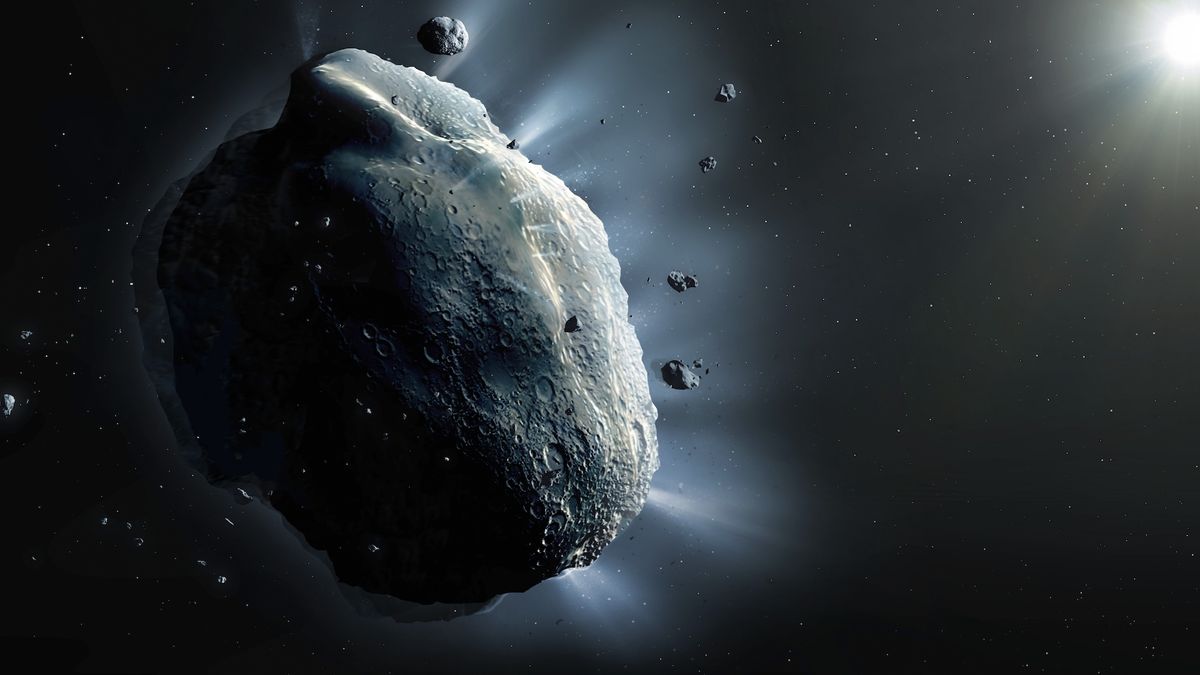
An enormous asteroid has just zoomed safely past Earth, but it isn’t done with our planet yet.

This weekend, the mountain-size space rock will peak in brightness in a rare once-in-a-decade event that you can observe from home with basic stargazing binoculars — or in a free livestream.

Named (887) Alinda, the near-Earth asteroid measures an estimated 2.6 miles (4.2 kilometers) wide — roughly the width of Manhattan — according to NASA’s Jet Propulsion Laboratory. On Wednesday (Jan. 8), the chunky space rock made its closest approach to Earth in decades, swooping to within 7.6 million miles (12.3 million km) of our planet, or about 32 times the average distance between Earth and the moon. Alinda isn’t predicted to make another close approach to Earth until 2087.

While an asteroid this big could trigger a mass extinction event if it were to collide with Earth, its large size also makes it a great target for curious stargazers. On Sunday (Jan. 12), Alinda will peak in brightness at a magnitude of 9.4. That isn’t bright enough to be seen with the naked eye, but it’s bright enough to be visible through entry-level stargazing binoculars or a good backyard telescope, according to astronomer Gianluca Masi, who runs the Virtual Telescope Project in Italy.

The asteroid will be visible moving through the constellation Gemini, which appears in the Northern Hemisphere just after dark and remains visible all night long, according to skywatching reporter Jamie Carter.

Related: NASA’s most wanted: The 5 most dangerous asteroids to Earth

If you don’t have the gear, don’t fret; Masi and the Virtual Telescope Project are hosting a free livestream of asteroid Alinda’s bright flyby on Jan. 12 at 12:30 p.m. EST. You can watch it on the project’s official YouTube page or in the video embedded below.

Get the world’s most fascinating discoveries delivered straight to your inbox.

Near-Earth Asteroid (887) Alinda close encounter: online observation – 12 Jan. 2025 – YouTube
Near-Earth Asteroid (887) Alinda close encounter: online observation – 12 Jan. 2025 - YouTube


Watch On

It’s rare to see such a large object pass this close to Earth. According to Masi, events like this happen just once a decade, and Alinda is one of the five largest asteroids that will pass within 9.3 million miles (15 million km) of our planet from now until the year 2200.

Luckily, neither Alinda nor any other known asteroid poses a threat to Earth for at least the next century, according to NASA. However, space agencies take the threat of “planet killer” asteroids very seriously and are currently testing various planetary defense plans. NASA’s recent Double Asteroid Redirection Test (DART) mission proved that it is possible to divert a large asteroid by crashing a spacecraft into it. However, the logistics of actually protecting Earth from a threatening asteroid would likely involve firing hundreds of rockets simultaneously, which would require years to decades of advance notice, Live Science previously reported. In the meantime, China plans to launch its own asteroid deflection mission by 2030.

If bright asteroids are not your space jam, then stay tuned for plenty of other exciting stargazing opportunities this month. On Monday (Jan. 13), the full Wolf Moon will rise next to Mars and appear to gobble up the Red Planet as Mars slips behind the moon for about four hours, before reemerging on the other side. Later, starting Jan. 21, a parade of six planets will be visible in Earth’s skies, with Venus, Mars, Jupiter and Saturn all visible to the naked eye after dark and Uranus and Neptune visible with stargazing equipment. The planets will linger in the sky through February, with Mercury also joining the planetary procession in early March.

Source link

Share. Facebook Twitter Pinterest LinkedIn Tumblr Email
Previous ArticleTwidget for $39 | Mashable
Next Article This encrypted 64GB flash drive is just $59.99
Editor
  • Website

Related Posts

Lifestyle

‘Unequivocal evidence’ of the age of Earth’s oldest impact crater turns out to be off by half a billion years

June 24, 2026
Lifestyle

Something is interfering with alien radio signals in space, new paper claims — and there’s an easy way to fix it

June 23, 2026
Lifestyle

NASA satellite captures wave of warm water hundreds of miles long that signals a devastatingly strong El Niño

June 23, 2026
Add A Comment

Comments are closed.

Categories
  • Entertainment
  • Lifestyle
  • News
  • Sports
  • Tech
  • Travel
Recent Posts
  • ‘Unequivocal evidence’ of the age of Earth’s oldest impact crater turns out to be off by half a billion years
  • Something is interfering with alien radio signals in space, new paper claims — and there’s an easy way to fix it
  • NASA satellite captures wave of warm water hundreds of miles long that signals a devastatingly strong El Niño
  • 9 of the best technology conspiracy theories
  • Bizarre ‘bull’s-eye’ cloud rings appear above erupting volcano on Atlantic island — Earth from space
calendar
June 2026
M T W T F S S
1234567
891011121314
15161718192021
22232425262728
2930  
« May    
Recent Posts
  • ‘Unequivocal evidence’ of the age of Earth’s oldest impact crater turns out to be off by half a billion years
  • Something is interfering with alien radio signals in space, new paper claims — and there’s an easy way to fix it
  • NASA satellite captures wave of warm water hundreds of miles long that signals a devastatingly strong El Niño
About

Welcome to Baynard Media, your trusted source for a diverse range of news and insights. We are committed to delivering timely, reliable, and thought-provoking content that keeps you informed
and inspired

Categories
  • Entertainment
  • Lifestyle
  • News
  • Sports
  • Tech
  • Travel
Facebook X (Twitter) Pinterest WhatsApp
  • Contact Us
  • About Us
  • Privacy Policy
  • Disclaimer
  • UNSUBSCRIBE
© 2026 copyrights reserved

Type above and press Enter to search. Press Esc to cancel.