Close Menu
  • Home
  • UNSUBSCRIBE
  • News
  • Lifestyle
  • Tech
  • Entertainment
  • Sports
  • Travel
Facebook X (Twitter) WhatsApp
Trending
  • Scientists propose launching a giant ‘airbag’ into space to protect us from solar superstorms ‪— and experts say it’s ‘quite feasible’
  • Dead-end bitcoin mining wastes as much energy as Switzerland’s entire hydropower generation capacity
  • 66 billion trees have been planted in China’s Great Green Wall — and they appear to be growing faster than natural forests
  • 500-year-old freeze-dried potato snacks discovered in Inca storage room in Peru
  • CERN shuts down Large Hadron Collider until 2030, upgrading the atom smasher to its most powerful form yet
  • Scientists figured out how to shrink huge ultrafast lasers so they fit on a tiny chip ‪‪—‬ the ‘holy grail’ of the field
  • Shadowy tendrils of ancient lava have scarred a dark volcano next to a ‘skull’ in the Sahara — Earth from space
  • 2,000-year-old scrolls buried by Mount Vesuvius eruption finally deciphered with help from AI
Facebook X (Twitter) WhatsApp
Baynard Media
  • Home
  • UNSUBSCRIBE
  • News
  • Lifestyle
  • Tech
  • Entertainment
  • Sports
  • Travel
Baynard Media
Home»Lifestyle»Earth from space: ‘Lake of clouds’ appears between volcanic nesting dolls in Russia via rare mirror-like phenomenon
Lifestyle

Earth from space: ‘Lake of clouds’ appears between volcanic nesting dolls in Russia via rare mirror-like phenomenon

EditorBy EditorDecember 31, 2024No Comments3 Mins Read
Share Facebook Twitter Pinterest LinkedIn Tumblr Reddit Telegram Email
Share
Facebook Twitter LinkedIn Pinterest Email

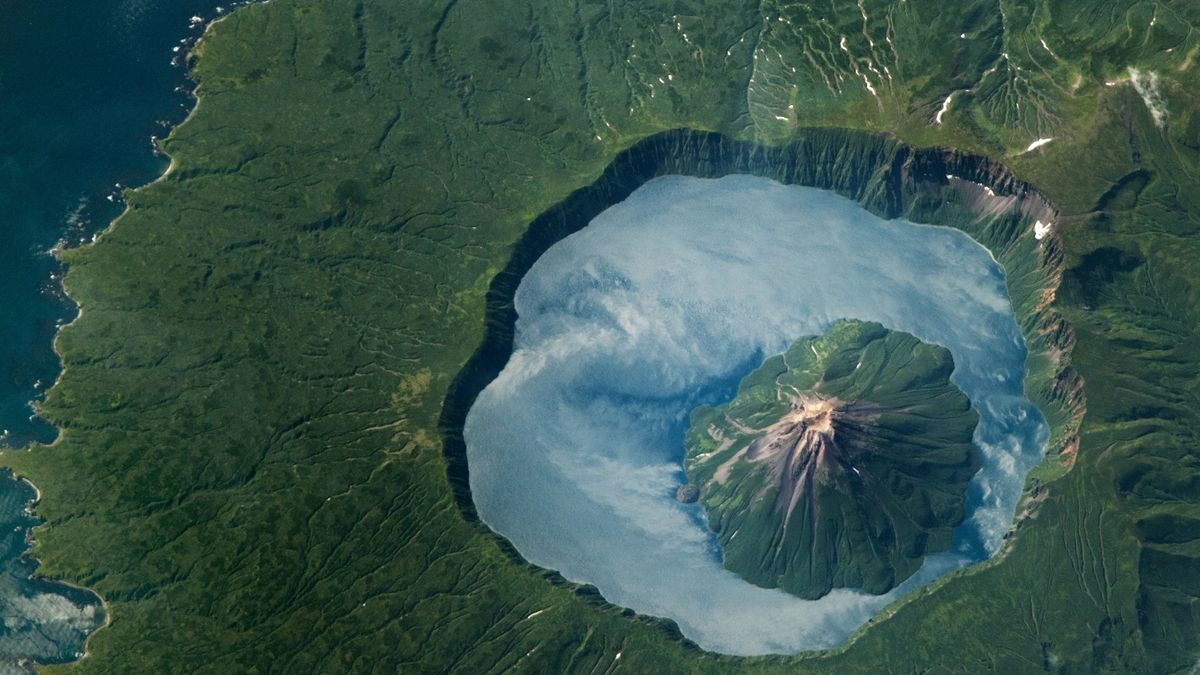
QUICK FACTS

Where is it? Onekotan Island, northwest Pacific Ocean [49.35544352, 154.7164388]

What’s in the photo? Clouds reflecting off the mirror-like surface of a crater lake between two halves of a volcano

Who took the photo? An unnamed astronaut on the International Space Station (ISS)

When was it taken? Aug. 19, 2023

This striking astronaut photo shows one of Russia’s deepest lakes sandwiched between two halves of a volcano as its surface was transformed into a reflective sea of swirling clouds thanks to a rare mirror-like phenomenon, known as “sunglint.”

The volcanic “nesting dolls,” collectively known as the Krenitsyna Volcano, are located on the southern tip of Onekotan Island in the Kuril Islands — a Russian archipelago located in the Pacific Ocean between the Kamchatka Peninsula and Hokkaido, the second-largest and northernmost island in Japan.

The volcano has two main parts: The large lake-filled, crater-like depression, known as the Tsar-Rusyr caldera, which spans up to 5 miles (8 kilometers) across; and the cone-shape mountain that rises out of the water, known as the Krenitsyna Peak, which reaches approximately 4,200 feet (1,300 meters) above sea level. This unusual configuration is the result of the volcano collapsing in on itself, before a new peak grew up out of the active remnant.

The crater lake that sits within the Tsar-Rusyr caldera and surrounds Krenitsyna Peak is known as Kol’tsevoye Lake. It is 1,200 feet (370 m) deep, making it one of the deepest lakes in Russia, according to NASA’s Earth Observatory.

Related: See all the best images of Earth from space

A photo of Krenitsyna Volcano and its crater lake taken from the crater's ridge

The Krenitsyna Peak rises out of the deep waters of Kol’tsevoye Lake, which in turn sits in the much larger Tsar-Rusyr caldera. (Image credit: Getty Images)

Sunglint effect

In the astronaut photo, Kol’tsevoye Lake looks as if it has been covered by low-lying clouds sitting at the bottom of the caldera. However, there are no clouds in this image. Instead, what you can see is clouds passing high over the island that have been reflected off the water’s surface.

Normally, a standard reflection would not be strong enough to make the clouds look so real. But in this case, the orientation of the sun relative to the ISS means that the sun’s full beam is being reflected straight back at the astronaut taking the photo, creating an effect known as sunglint, which transforms a large body of water into a giant silver mirror. The caldera’s rim stands roughly 1,000 feet (300 m) above the lake’s surface, creating shadows that help to accentuate the cloudy illusion.

Get the world’s most fascinating discoveries delivered straight to your inbox.

An aerial photo on Onekotan Island showing the Krenitsyna Volcano and Nemo Volcano at either ends of the land mass

Onekotan Island is home to two nesting volcanos: Krenitsyns Volcano in the south (bottom of image) and Nemo Volcano in the north (top of image). (Image credit: NASA Space Shuttle Program)

However, the clouds are still only visible because the astronaut is positioned above the volcano at an angle that allows them to see the sunglint without being right on top of the island, which would mean the clouds would block their view of the lake.

The Krenitsyna Volcano is still active and last erupted in 1952 with a “moderate” outburst that lasted for around a week, according to the Smithsonian Institute’s Global Volcanism Program. But its last major eruption was likely around 7,600 years ago.

Interestingly, another set of volcanic nesting dolls with its own crater lake, collectively known as the Nemo Volcano, is positioned on the northern end of Onekotan Island. However, in this case, the lake does not surround the peak that has grown out of this collapsed caldera.

Source link

Share. Facebook Twitter Pinterest LinkedIn Tumblr Email
Previous ArticleNYC congestion pricing set to start as planned Sunday after ruling in final lawsuit
Next Article MVG hits back at 'nonsense' Wright claim: 'No one takes him seriously!'
Editor
  • Website

Related Posts

Lifestyle

Scientists propose launching a giant ‘airbag’ into space to protect us from solar superstorms ‪— and experts say it’s ‘quite feasible’

July 1, 2026
Lifestyle

Dead-end bitcoin mining wastes as much energy as Switzerland’s entire hydropower generation capacity

July 1, 2026
Lifestyle

66 billion trees have been planted in China’s Great Green Wall — and they appear to be growing faster than natural forests

July 1, 2026
Add A Comment

Comments are closed.

Categories
  • Entertainment
  • Lifestyle
  • News
  • Sports
  • Tech
  • Travel
Recent Posts
  • Scientists propose launching a giant ‘airbag’ into space to protect us from solar superstorms ‪— and experts say it’s ‘quite feasible’
  • Dead-end bitcoin mining wastes as much energy as Switzerland’s entire hydropower generation capacity
  • 66 billion trees have been planted in China’s Great Green Wall — and they appear to be growing faster than natural forests
  • 500-year-old freeze-dried potato snacks discovered in Inca storage room in Peru
  • CERN shuts down Large Hadron Collider until 2030, upgrading the atom smasher to its most powerful form yet
calendar
July 2026
M T W T F S S
 12345
6789101112
13141516171819
20212223242526
2728293031  
« Jun    
Recent Posts
  • Scientists propose launching a giant ‘airbag’ into space to protect us from solar superstorms ‪— and experts say it’s ‘quite feasible’
  • Dead-end bitcoin mining wastes as much energy as Switzerland’s entire hydropower generation capacity
  • 66 billion trees have been planted in China’s Great Green Wall — and they appear to be growing faster than natural forests
About

Welcome to Baynard Media, your trusted source for a diverse range of news and insights. We are committed to delivering timely, reliable, and thought-provoking content that keeps you informed
and inspired

Categories
  • Entertainment
  • Lifestyle
  • News
  • Sports
  • Tech
  • Travel
Facebook X (Twitter) Pinterest WhatsApp
  • Contact Us
  • About Us
  • Privacy Policy
  • Disclaimer
  • UNSUBSCRIBE
© 2026 copyrights reserved

Type above and press Enter to search. Press Esc to cancel.