Close Menu
  • Home
  • UNSUBSCRIBE
  • News
  • Lifestyle
  • Tech
  • Entertainment
  • Sports
  • Travel
Facebook X (Twitter) WhatsApp
Trending
  • Why does metal stick together in space?
  • Faster ‘biological aging’ in young adults may help explain rise in early-onset cancers, study hints
  • Computer scientists are rushing to tame tame AI’s voracious appetite for energy
  • Our brains aren’t wired to handle this much bad news. But ‘looking away is not the fix,’ expert says.
  • ‘The fate of Earth depends on a delicate balance’: Our planet may survive the death of the sun after all, new models hint
  • Bullseye! Enormous ‘bow and arrow’ galaxy is unlike anything radio astronomers have ever seen — Space photo of the week
  • IBM creates first sub-1nm computer chip — cramming 100 billion transistors into a tiny fingernail-sized space
  • New chip harnesses quantum computing’s biggest weakness — and tries to turn it into a strength
Facebook X (Twitter) WhatsApp
Baynard Media
  • Home
  • UNSUBSCRIBE
  • News
  • Lifestyle
  • Tech
  • Entertainment
  • Sports
  • Travel
Baynard Media
Home»Lifestyle»Dormant volcano erupts in Russia for first time in around 500 years, days after magnitude 8.8 megaquake
Lifestyle

Dormant volcano erupts in Russia for first time in around 500 years, days after magnitude 8.8 megaquake

EditorBy EditorAugust 5, 2025No Comments3 Mins Read
Share Facebook Twitter Pinterest LinkedIn Tumblr Reddit Telegram Email
Share
Facebook Twitter LinkedIn Pinterest Email

A long-dormant volcano has erupted on Russia’s Kamchatka Peninsula just days after a magnitude 8.8 megaquake rocked the region on July 30. It is the second volcano to blow its top in the region in the last five days, following the eruption of Klyuchevskoy within hours of last week’s quake.

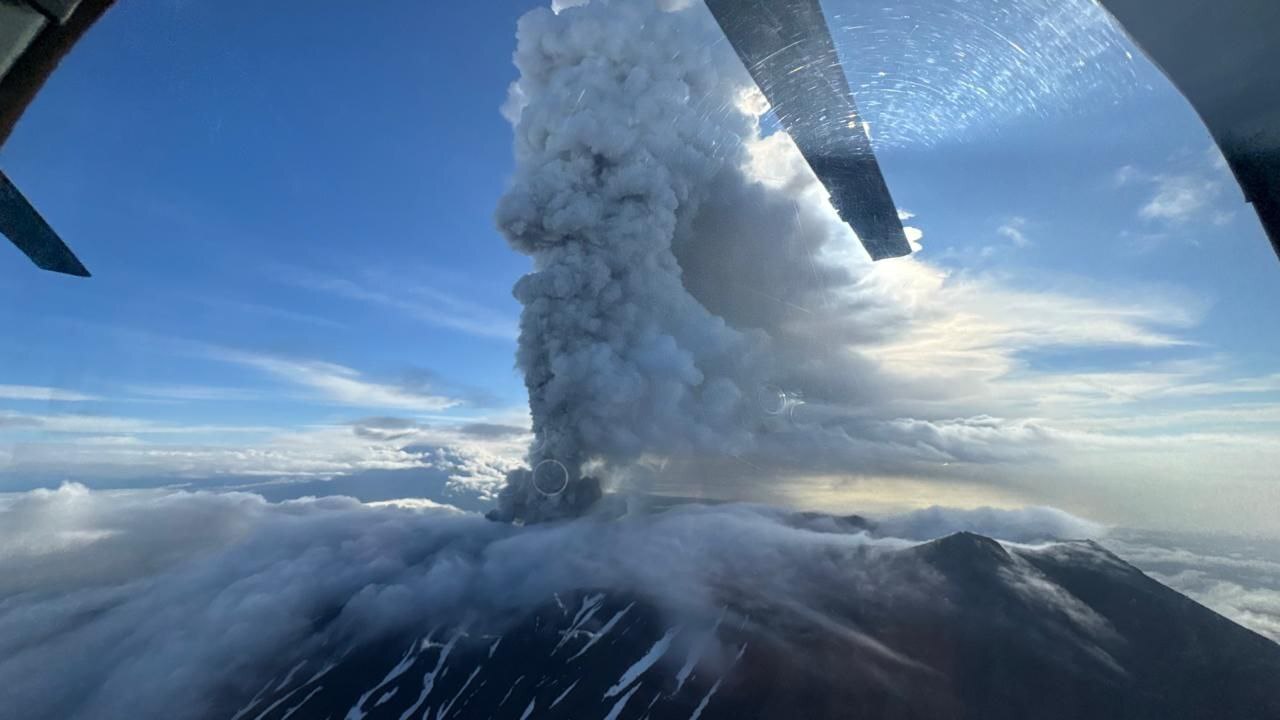
The roughly 6,000-foot-tall (1,800 meters) Krasheninnikov volcano erupted overnight into Sunday (Aug. 3), for the first time in about 500 years. The eruption blew a plume of ash 3.7 miles (6 kilometers) into the sky but posed no threat to populated areas, Russia’s Ministry for Emergency Situations for the Kamchatka Territory wrote in Telegram posts.

A magnitude 7.0 earthquake also hit the region on Sunday. The National Oceanic and Atmospheric Administration (NOAA) Tsunami Warning System registered the latest earthquake at 6:37 a.m. local time in the Kuril Islands, a volcanic archipelago that stretches from the southern end of the Kamchatka Peninsula to the northeastern tip of Japan.


You may like

Image 1 of 2

A photograph of ash erupting from Krasheninnikov volcano, taken from inside of a helicopter.
Krasheninnikov volcano hasn’t erupted for hundreds of years. (Image credit: Sheldovitsky Artem Igorevich / IViS / Handout/Anadolu via Getty Images)

An aerial photograph of a giant ash cloud rising above Krasheninnikov volcano.
The ash plume rose 3.7 miles into the sky. (Image credit: Sheldovitsky Artem Igorevich / IViS / Handout/Anadolu via Getty Images)

Following the earthquake, Russia issued a tsunami warning for the peninsula, but officials later cancelled this alert, Reuters reported.

This latest eruption and earthquake could be linked to the megaquake that hit the peninsula on July 30, which is also thought to have intensified the eruption of Klyuchevskoy volcano.

Related: 400-mile-long chain of fossilized volcanoes discovered beneath China

Last week, Russian scientists warned that strong aftershocks could occur in the peninsula region for several weeks, Reuters reported.

Get the world’s most fascinating discoveries delivered straight to your inbox.

It’s unclear precisely what time the Krasheninnikov volcano began erupting. Nikolai Solovyov, head of the security service of Russia’s Federal State Budgetary Institution “Kronotsky State Nature Reserve,” reported receiving a message about the beginning of the eruption at 6 a.m. local time on Sunday, according to a translated statement released by the Kronotsky State Nature Reserve, where the volcano is located.

Krasheninnikov volcano has been dormant for hundreds of years. Olga Girina, head of the Kamchatka Volcanic Eruption Response Team, told Russia’s RIA state news agency that this was the first historically confirmed eruption in 600 years, Reuters reported. On the Institute of Volcanology and Seismology Telegram channel, Girina also said that the last lava effusion, or outpouring of lava, occurred within 40 years of 1463, Reuters reported. However, the Smithsonian Institution’s Global Volcanism Program states that the last known eruption was later, in 1550.

Researchers still have a lot to learn about last week’s megaquake and the more recent activity on the Kamchatka Peninsula. Large earthquakes (magnitude 6.0 or higher) can be linked to subsequent eruptions or volcanic unrest. However, the volcanoes must already be poised to erupt for this to be the case, with enough “eruptible” magma and significant pressure where the magma is stored, according to the U.S. Geological Survey (USGS) website

“If those conditions exist, it’s possible that large tectonic earthquakes might cause dissolved gases to come out of the magma (like a shaken soda bottle), increasing the pressure and possibly leading to an eruption,” USGS representatives wrote on the website.

Source link

Share. Facebook Twitter Pinterest LinkedIn Tumblr Email
Previous ArticleHelicopter hoists hikers from dangerous beach trap
Next Article Travel influencers boost tourism to Taliban-run Afghanistan
Editor
  • Website

Related Posts

Lifestyle

Why does metal stick together in space?

June 29, 2026
Lifestyle

Faster ‘biological aging’ in young adults may help explain rise in early-onset cancers, study hints

June 29, 2026
Lifestyle

Computer scientists are rushing to tame tame AI’s voracious appetite for energy

June 28, 2026
Add A Comment

Comments are closed.

Categories
  • Entertainment
  • Lifestyle
  • News
  • Sports
  • Tech
  • Travel
Recent Posts
  • Why does metal stick together in space?
  • Faster ‘biological aging’ in young adults may help explain rise in early-onset cancers, study hints
  • Computer scientists are rushing to tame tame AI’s voracious appetite for energy
  • Our brains aren’t wired to handle this much bad news. But ‘looking away is not the fix,’ expert says.
  • ‘The fate of Earth depends on a delicate balance’: Our planet may survive the death of the sun after all, new models hint
calendar
June 2026
M T W T F S S
1234567
891011121314
15161718192021
22232425262728
2930  
« May    
Recent Posts
  • Why does metal stick together in space?
  • Faster ‘biological aging’ in young adults may help explain rise in early-onset cancers, study hints
  • Computer scientists are rushing to tame tame AI’s voracious appetite for energy
About

Welcome to Baynard Media, your trusted source for a diverse range of news and insights. We are committed to delivering timely, reliable, and thought-provoking content that keeps you informed
and inspired

Categories
  • Entertainment
  • Lifestyle
  • News
  • Sports
  • Tech
  • Travel
Facebook X (Twitter) Pinterest WhatsApp
  • Contact Us
  • About Us
  • Privacy Policy
  • Disclaimer
  • UNSUBSCRIBE
© 2026 copyrights reserved

Type above and press Enter to search. Press Esc to cancel.