

Time may fly when you’re having fun, but at other times, it seems to crawl along at a glacial pace. For many, time seems to move more slowly while they exercise — you glance at the clock between miles on the treadmill or sets in the weightroom, and you discover that your last half hour of effort was actually only 10 minutes long.
So do people really sense time differently during exercise? And if so, why is that?
At least in experimental studies, people do perceive time as moving more slowly during exercise, whether they’re exercising alone or competing against others, according to a study published April 2024 in the journal Brain and Behavior.
Earlier research had shown that exercise can distort our perception of time, making it feel like it’s dragging. But it wasn’t clear from that work whether the presence of a competitor might distract from the discomfort of exercise and make time feel like it’s passing more quickly. So researchers set out to test whether competing against an opponent would shift attention away from internal sensations and, in turn, speed up perceived time.
Related: ‘Flow state’ uncovered: We finally know what happens in the brain when you’re ‘in the zone’
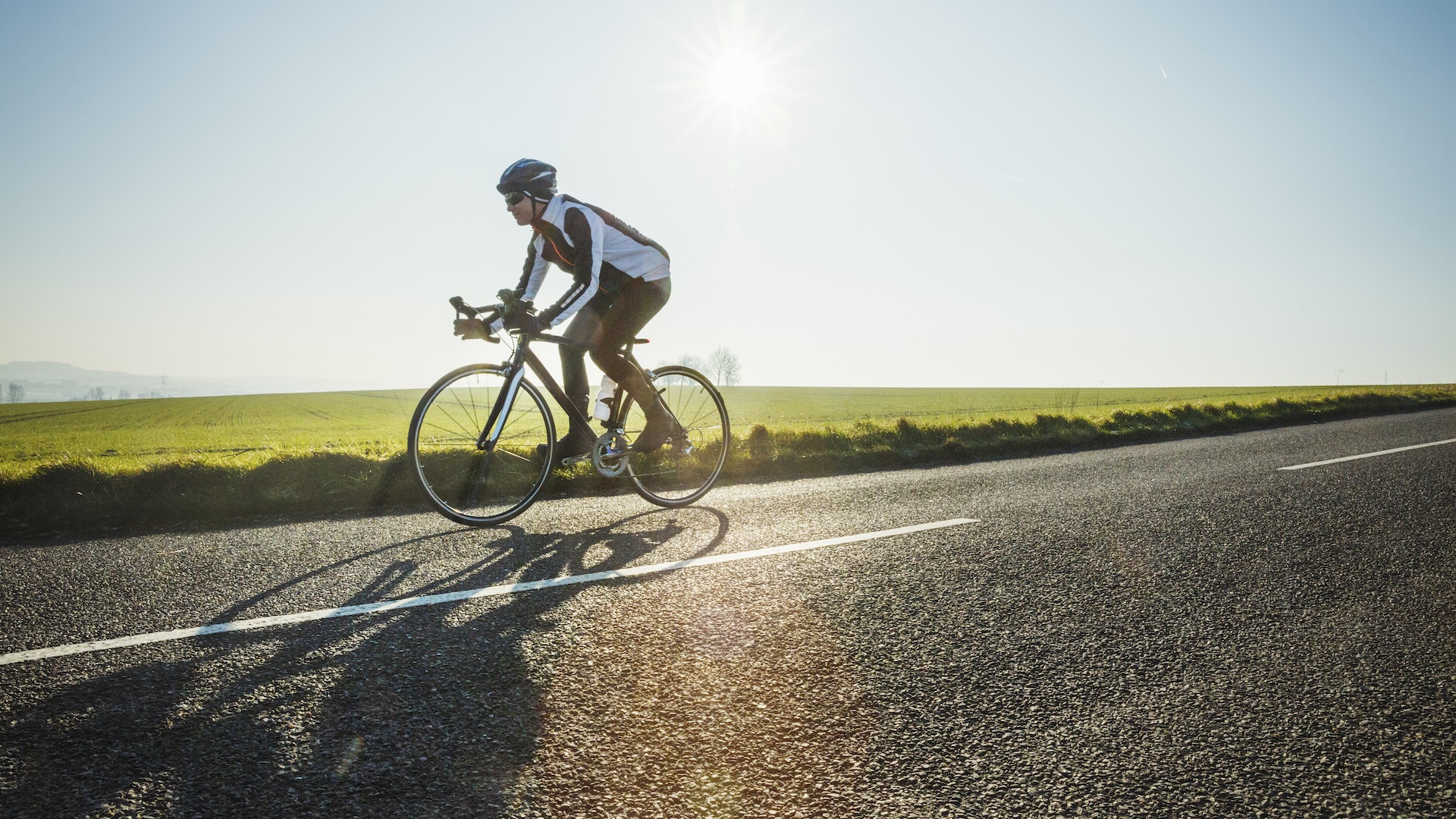
They recruited 33 physically active adults —16 women and 17 men — who completed three separate 2.5-mile (4 kilometers) cycling trials in a virtual environment. One was a solo trial, while the others involved biking with a virtual person who was either a noncompetitive cycling buddy or an active competitor in a race.
Before, during and after each trial, researchers asked participants to rate how hard they felt they were working out on a scale of 0 to 10 and to estimate when 30 seconds had passed while the researchers measured the actual time with a stopwatch.
“During exercise, participants said ‘stop’ at 28.0 seconds. In contrast, before and after exercise, they stopped the clock at 31.4 and 31.6 seconds, respectively,” study co-author Stein Menting, now a research associate at Ulster University, told Live Science in an email. “This led us to conclude that time was perceived to run slower during exercise compared to at rest.” They observed this effect throughout each trial and across both solo and competitive rounds.
While the virtual competitors didn’t affect time perception, they did push participants to cycle faster. When participants were told to race against an on-screen competitor and try to win, they finished in 459 seconds, on average. This was quicker than when they saw the same on-screen person but were only told to go as fast as they could (about 467 seconds), or when they exercised alone (about 470 seconds).
Although participants felt the exercise got harder as they went on, this effort didn’t seem to affect their perception of time. This suggests “that it is exercise itself, rather than its intensity, that might distort time perception,” Menting said. However, prior research has shown that higher fixed intensities may slow time perception, indicating that the exercise type — self-paced or fixed — may influence this effect, he added.
Additionally, “It’s still unclear whether the results are generalisable,” study co-author Andrew Edwards, head of the School of Psychology and Life Sciences at Canterbury Christ Church University, said in a statement. The sample size was small, and “while the participants weren’t professional cyclists, they were in good physical shape, which isn’t true of everybody,” he noted.
For athletes, having a distorted sense of time during intense effort may cause them to slow down, potentially limiting performance. Managing how they perceive time could be a key factor in staying on pace. But if the study’s findings are generalizable, their implications go beyond elite sports — they could be useful for anyone who exercises, as we often misjudge how much time has passed when we’re physically pushing ourselves.
“Setting a timer for very intense exercise would be wise so that we persist exercising for a set amount of time,” Philip Gable, a professor of social psychology at the University of Delaware, who was not involved in the study, told Live Science in an email.
Why time seems to slow
The researchers suggested that attention might help explain why time slows. During intense exercise, people shift into a hyper-aware mental state and thus become more conscious of physical discomfort, they suggest. This heightened awareness may increase the number of sensations they perceive in a short time, making it feel longer than it actually is.
But this attention-based mechanism of time distortion is up for debate.
“The authors of the study did not investigate a mechanism,” Gable said. “However, the studies run in my lab reveal that attention is not the mechanism of time perception speeding or slowing. It is motivation.”
In a series of studies, Gable and his colleagues found that our perception of time can speed up or slow down depending on the type of motivation we feel during a given activity. When people are driven by so-called approach motivation — a desire to move toward something positive — time tends to fly. But when they experience avoidance motivation — the urge to escape something unpleasant — time drags.
“In this current [2024] study, the ‘all-out’ pace from the participants is likely to be aversive and cause avoidance motivation,” Gable said. Because the body can’t sustain that level of intensity for long, the participants were motivated to stop cycling, he suggested.
In this aversive state, Gable said, time can feel like it’s slowing down. It’s the brain’s way of discouraging us from continuing something that’s physically unsustainable.
According to Gable, the impression that time is slowing down indicates that an exercise regime is causing dread. Based on this, Gable recommends finding “a pace of exercise that is sustainable and doesn’t cause too much avoidance — you don’t want to hate your exercise!”
This article is for informational purposes only and is not meant to offer medical or fitness advice.
