Close Menu
  • Home
  • UNSUBSCRIBE
  • News
  • Lifestyle
  • Tech
  • Entertainment
  • Sports
  • Travel
Facebook X (Twitter) WhatsApp
Trending
  • ‘I have no doubt that life is out there’: Why radio astronomers are convinced alien contact is only a matter of time
  • 800-year-old ‘hugging skeletons’ are genetically confirmed as Poland’s only medieval same-sex double burial
  • There’s a new T. rex from the dinosaur age — and it ruled the seas with a skull-crushing bite
  • Great Pyramid of Giza is remarkably resilient to earthquakes —‬ and it’s due to the ancient Egyptians’ ‘extraordinary’ engineering knowledge
  • China’s real-life ‘transformer’ mech is a giant humanoid robot that can switch from bounding on 4 legs to walking on 2
  • How can we prevent AI models from cannibalizing themselves when human-generated data runs out? Scientists say they’ve found the answer.
  • ‘The system is likely to reach a breaking point’: Major Italian volcano is speeding toward a transition, and a major eruption could be on the way
  • China installs world’s largest floating wind turbine in deep water test — it generates enough energy to power 4,200 homes annually
Facebook X (Twitter) WhatsApp
Baynard Media
  • Home
  • UNSUBSCRIBE
  • News
  • Lifestyle
  • Tech
  • Entertainment
  • Sports
  • Travel
Baynard Media
Home»Lifestyle»Do cats communicate with their tails?
Lifestyle

Do cats communicate with their tails?

EditorBy EditorDecember 7, 2024No Comments4 Mins Read
Share Facebook Twitter Pinterest LinkedIn Tumblr Reddit Telegram Email
Share
Facebook Twitter LinkedIn Pinterest Email

You may have noticed that your cat’s tail moves in all sorts of ways, from quivering in an upright position, to swishing from side to side, to being held down close to the ground. But besides using their tails to maintain their balance and control their movements, do cats‘ tails reveal anything about their state of mind? And what do the tail movements mean?

Feline behavior experts agree that cats use their tails as part of a broader system of body language to communicate a wide range of emotions. Cats rely on their eyes, ears, body and tail to express fear, anger, joy, contentment and curiosity, according to research published in the Irish Veterinary Journal.

A cat’s tail is remarkably flexible, thanks to its unique anatomy. It consists of 18 to 23 small bones, known as caudal vertebrae, which interlock like a chain, enabling the tail to move in many directions. When a cat experiences an emotion, its brain sends signals to muscles in the tail through the pudendal nerve, or the nerve that connects tail muscles to the central nervous system. “This communication occurs almost instantaneously, allowing cats to move their tails with lightning speed and precision,” Reda Mohamed, a lecturer in animal anatomy at Washington State University College of Veterinary Medicine, told Live Science in an email.

An upward-pointing tail signals a friendly, social approach, said Mikel Delgado, an animal behaviorist at Purdue University in Indiana.

However, the upward-pointing tail isn’t universal. A doctoral study on communication in domesticated and wild cats found that while wild cats displayed many of the same social behaviors as domestic cats, they did not use the “tail up” signal commonly seen in domestic cats during friendly interactions. This suggests that the “tail up” signal likely developed during the process of domestication.

Related: Why do cats ‘chatter’?

A quivering tail often indicates excitement, Delgado said.

Get the world’s most fascinating discoveries delivered straight to your inbox.

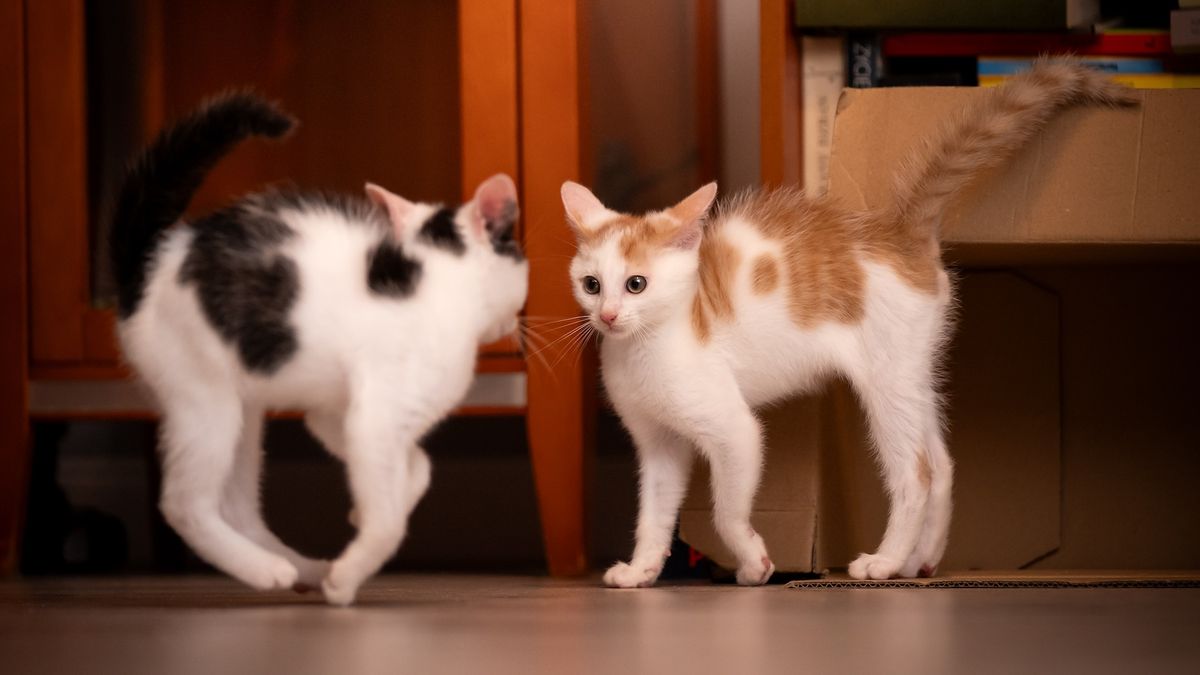
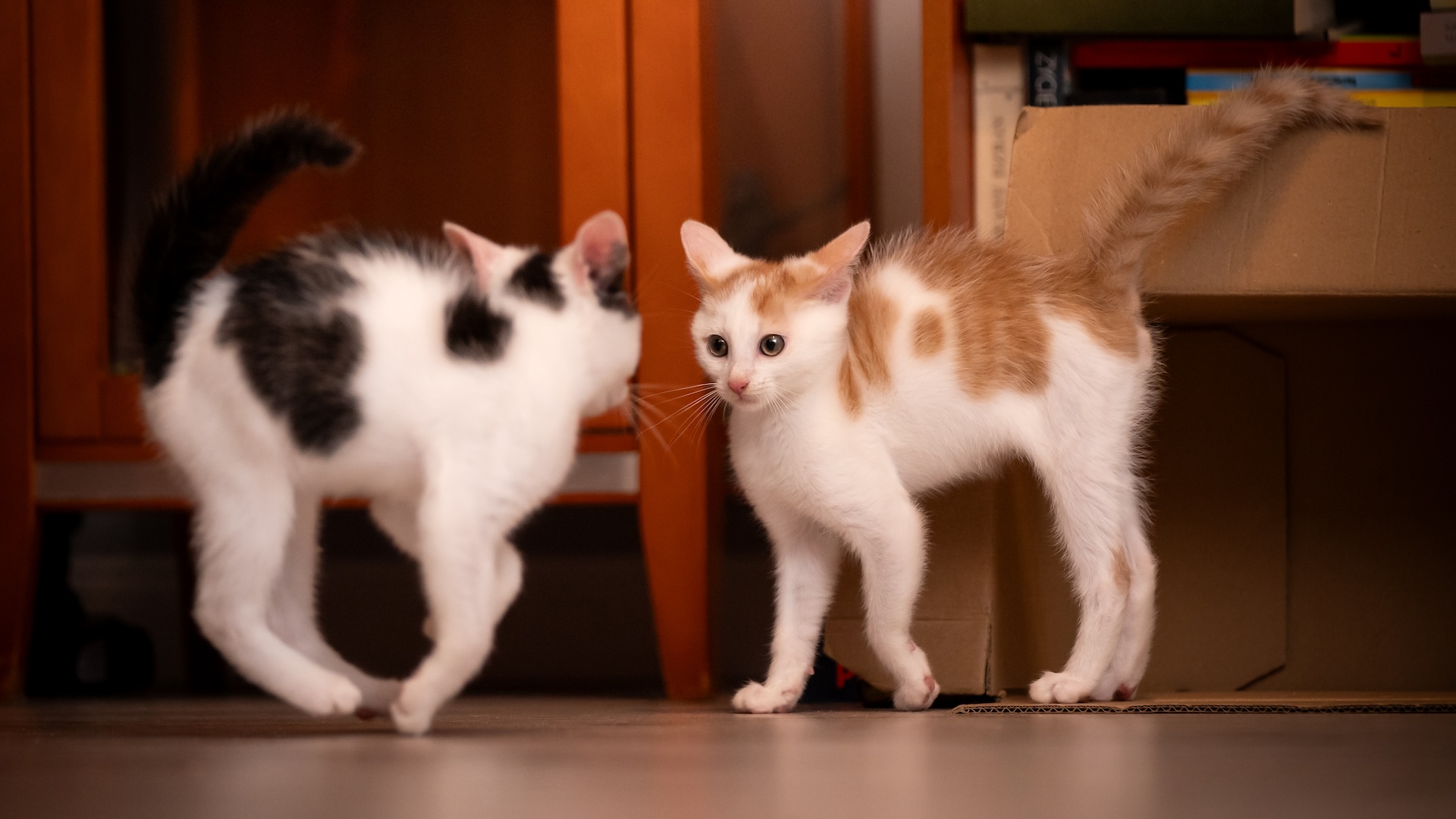
Meanwhile, “a puffed-up tail is often a response to a threat — such as seeing a cat outdoors — and is assumed to be a defensive attempt to make themselves appear bigger,” Delgado explained. This reaction is similar to what humans experience when they get goosebumps in response to fear. Humans have tiny muscles called arrector pili at the base of our hair follicles, and when we’re scared, these muscles contract, causing our hairs to stand on end. Similarly, cats have the same muscles at the base of their tails, and when they feel threatened, these muscles cause their tail to puff up, making them look larger and more intimidating.

“A lowered tail [‘tail down’] is generally associated with fear, as the cat tries to make itself smaller or protect itself,” Delgado said.

A fearful cat may also keep their tail tucked under or wrapped around its body, according to a guide to feline emotions published in 2021. And if a cat slaps their tail against the ground or moves it rapidly from side to side or up and down, it may be a sign that they are feeling angry.

Interpreting a cat’s emotional state from its tail may seem simple, but context is also crucial.

“It’s important to remember that you can’t know how a cat is feeling by looking at just one part of their body,” Delgado told Live Science in an email. “You always have to consider the cat’s entire body as well as what is happening in the cat’s environment.”

Additionally, cats may communicate with their tails in distinct ways depending on whether they are interacting with humans or other cats.

For example, a 2021 study in the journal Animals found that when cats interact with each other, they usually keep their tails down and rely more on their ears to express how they’re feeling. (Erect ears signal friendliness, while flattened ears indicate hostility.) Meanwhile, when approaching humans, cats often hold up their tails, especially before rubbing against their legs, the researchers observed.

The next time you’re with your cat, take a moment to notice what they’re trying to tell you using their tail.

Source link

Share. Facebook Twitter Pinterest LinkedIn Tumblr Email
Previous ArticleChild rape and violent incidents reported at Massachusetts migrant shelters, former director says
Next Article DAVID MARCUS: Triumphant Trump at Notre Dame signals America and the West are back
Editor
  • Website

Related Posts

Lifestyle

‘I have no doubt that life is out there’: Why radio astronomers are convinced alien contact is only a matter of time

May 22, 2026
Lifestyle

800-year-old ‘hugging skeletons’ are genetically confirmed as Poland’s only medieval same-sex double burial

May 21, 2026
Lifestyle

There’s a new T. rex from the dinosaur age — and it ruled the seas with a skull-crushing bite

May 21, 2026
Add A Comment

Comments are closed.

Categories
  • Entertainment
  • Lifestyle
  • News
  • Sports
  • Tech
  • Travel
Recent Posts
  • ‘I have no doubt that life is out there’: Why radio astronomers are convinced alien contact is only a matter of time
  • 800-year-old ‘hugging skeletons’ are genetically confirmed as Poland’s only medieval same-sex double burial
  • There’s a new T. rex from the dinosaur age — and it ruled the seas with a skull-crushing bite
  • Great Pyramid of Giza is remarkably resilient to earthquakes —‬ and it’s due to the ancient Egyptians’ ‘extraordinary’ engineering knowledge
  • China’s real-life ‘transformer’ mech is a giant humanoid robot that can switch from bounding on 4 legs to walking on 2
calendar
May 2026
M T W T F S S
 123
45678910
11121314151617
18192021222324
25262728293031
« Apr    
Recent Posts
  • ‘I have no doubt that life is out there’: Why radio astronomers are convinced alien contact is only a matter of time
  • 800-year-old ‘hugging skeletons’ are genetically confirmed as Poland’s only medieval same-sex double burial
  • There’s a new T. rex from the dinosaur age — and it ruled the seas with a skull-crushing bite
About

Welcome to Baynard Media, your trusted source for a diverse range of news and insights. We are committed to delivering timely, reliable, and thought-provoking content that keeps you informed
and inspired

Categories
  • Entertainment
  • Lifestyle
  • News
  • Sports
  • Tech
  • Travel
Facebook X (Twitter) Pinterest WhatsApp
  • Contact Us
  • About Us
  • Privacy Policy
  • Disclaimer
  • UNSUBSCRIBE
© 2026 copyrights reserved

Type above and press Enter to search. Press Esc to cancel.