
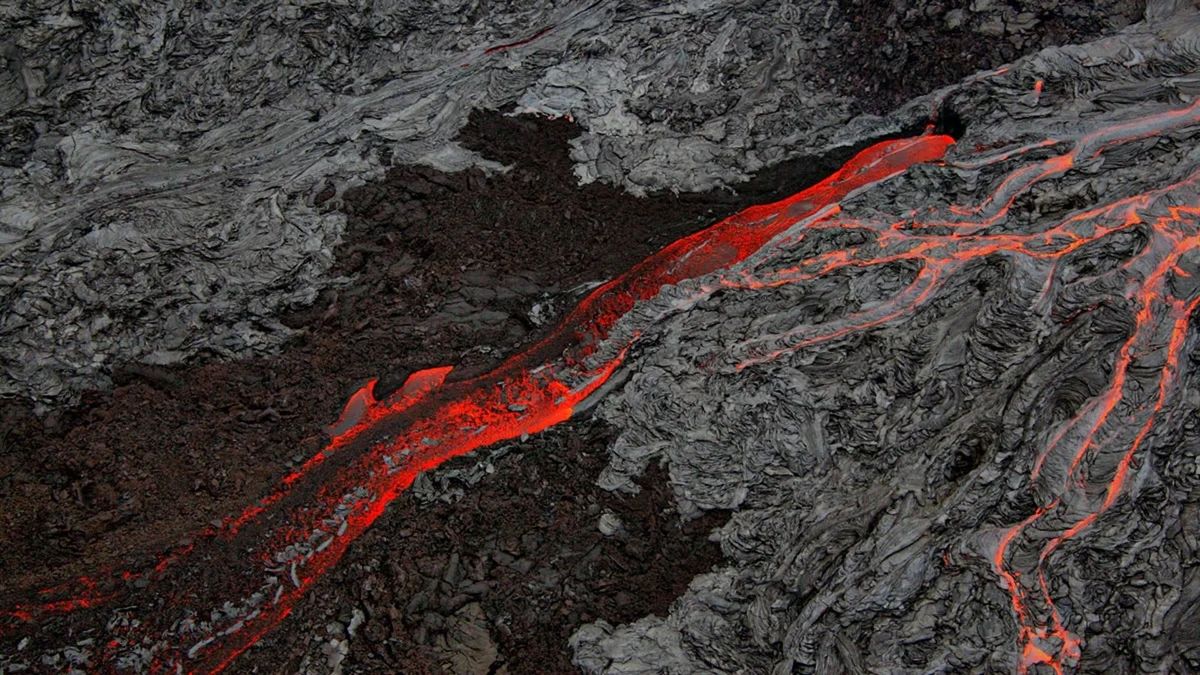
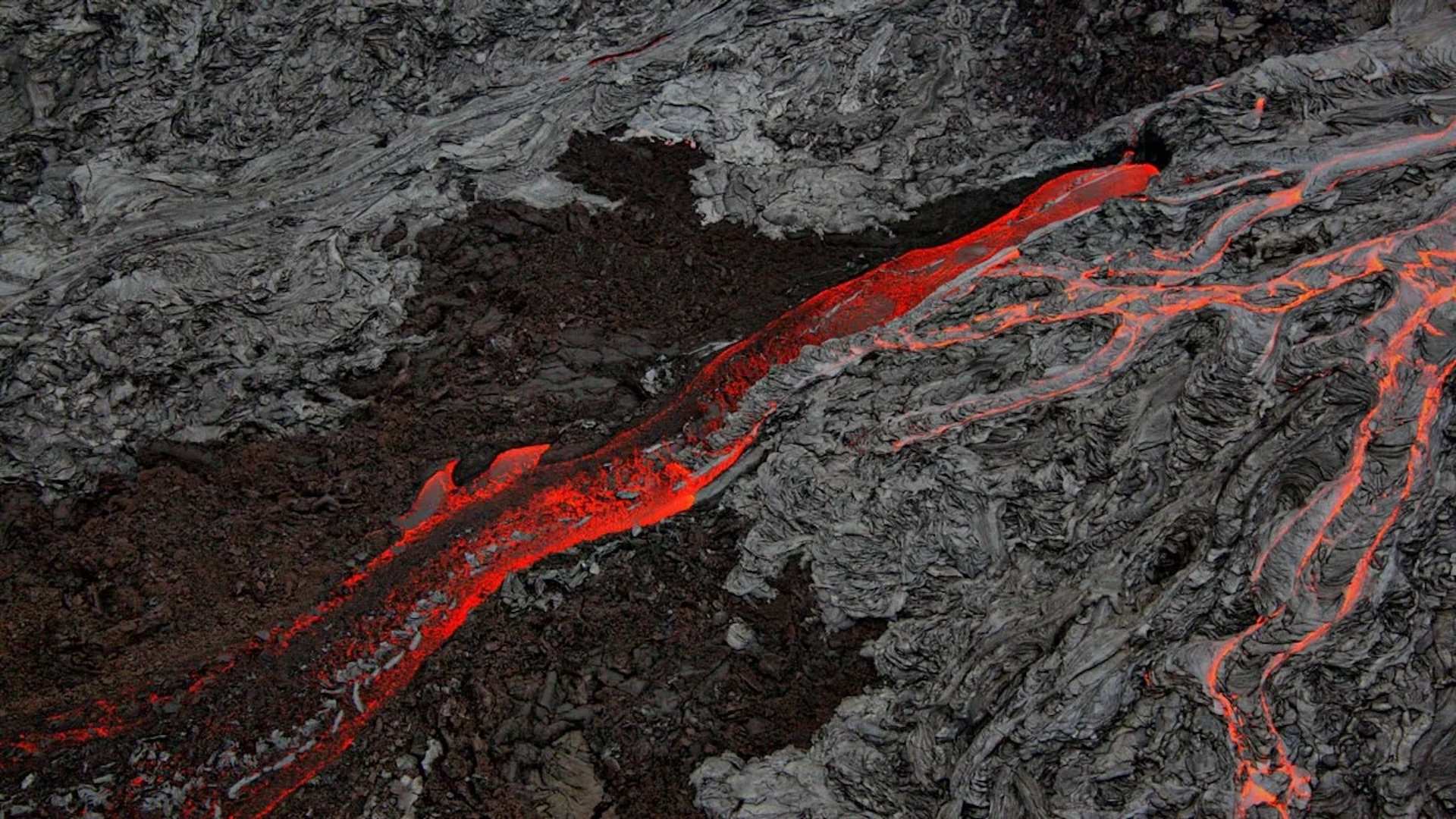
Massive volcanic eruptions have reshaped Earth and its climate at several points in history. New research suggests that long after these surface eruptions ceased, carbon dioxide (CO2) dissolved in underground magmas could have slowly escaped to the surface. This “cryptic carbon” may have contributed to prolonged periods of warming, slow climate recovery, and mass extinctions.
“There’s the potential for this gas release that’s not tied in a specific way to the generation of a lava flow,” said Isabel Fendley, a geologist at Pennsylvania State University who was not involved in the study. Without considering this protracted CO2 release, “some of the ways we’re currently understanding gas emission events are going to be missing a piece.”
The volcanoes in question are known as large igneous provinces, large regions where magma wells up to the surface. No large igneous provinces are active today; the most recent, the relatively small Columbia River Basalt Group, erupted about 16 million years ago. A large igneous province could extrude roughly a million cubic kilometers of volcanic rocks over the span of a million years.
“The scale of these volcanic provinces, I think, is very difficult for humans to comprehend,” said Ben Black, the study’s lead author, a volcanologist at Rutgers University in New Jersey. “We’re talking about volcanic events that can mobilize enough magma to cover the continental U.S. half a kilometer deep.”
Related: The 12 biggest volcanic eruptions in recorded history
Climate-altering magmas
Such extensive volcanism has occurred in conjunction with periods of climate disruption throughout Earth’s history: Large igneous provinces emitted large volumes of greenhouse gases such as CO2 into the atmosphere, raising temperatures. These events were also sometimes accompanied by major biological changes.
The eruptions of the Siberian Traps 252 million years ago coincided with massive biodiversity loss, known as the end-Permian mass extinction, or the Great Dying. But during that event, temperatures and CO2 levels remained high for about 5 million years after volcanic eruptions stopped. Scientists have hypothesized that the unexpectedly long warming periods following this and other large igneous province eruptions are due to a weakened silicate weathering feedback, a cycle that acts as a sort of natural thermostat.
In the new study, published in Nature Geoscience, Black and his colleagues proposed another explanation — that carbon continued to leak from the volcanoes after their eruptions ceased.
Using a numerical model to simulate the climate response to perturbations in carbon and nutrient cycles, the researchers found that CO2 emissions solely from surface eruptions aren’t enough to explain the protracted warm periods. The observed warming would require carbon emissions to continue long after the youngest volcanic rocks cooled.
To determine whether CO2 release could occur after surface eruptions ended, the researchers simulated magma movement through Earth’s crust over time to determine how the crust would deform and shift during periods of large igneous province activity.
Their simulations showed that initially, pressure in a magma chamber builds until cracks in the crust form, allowing the magma to seep out onto Earth’s surface. But over time, the magma warms the crust enough that the surrounding rock flows more easily, making it harder to build up enough pressure for a surface eruption.
As the magma rises and cools, dissolved CO2 can escape, even when the magma itself cannot. The dissolved gas acts like bubbles in a bottle of soda, said study coauthor Tamsin Mather, a volcanologist at the University of Oxford.
“When you’ve got the lid on [the soda bottle], you don’t see any bubbles in it. That’s like a magma at depth,” Mather said. “When you take the lid off — or in the case of a magma, you raise it to more shallow depths — the pressure reduces, and bubbles form.” Those buoyant bubbles then rise to the surface, escaping through cracks or faults in the crust.
This CO2 release could last for millions of years after surface eruptions end, the team found. Cryptic carbon could explain the extended warming observed after large igneous province eruptions subsided and may have affected biological recovery following events such as the end-Permian mass extinction.
“I think there’s some really interesting, important questions in terms of how recovery happens after those mass extinctions or climate disruptions, the role that solid Earth processes play and the implications for the new life that comes after the disruption,” Black said.
The findings could also help scientists learn about the effects of present-day warming. “Large igneous provinces are one of the best analogues for carbon emission fluxes on the scale of human carbon emission fluxes, but they still don’t emit carbon as fast as we are right now,” Mather said. Understanding how the planet recovers after a similarly abrupt disruption could aid in understanding possible impacts of anthropogenic emissions, she added.
This article was originally published on Eos.org. Read the original article.
