Close Menu
  • Home
  • UNSUBSCRIBE
  • News
  • Lifestyle
  • Tech
  • Entertainment
  • Sports
  • Travel
Facebook X (Twitter) WhatsApp
Trending
  • Memory may not work how we thought, study of mice in artificial hibernation finds
  • Romans unceremoniously dumped plague victims down a well, mysterious mass grave in Croatia suggest
  • New AI lets robots complete tasks twice as fast
  • Mammal ancestors may have given live birth 90 million years earlier than we thought, rewriting evolutionary timelines
  • How to see and photograph the partial lunar eclipse on August 27-28
  • Watch now! The Aug. 12 total solar eclipse has begun (live stream)
  • ‘No longer will anything seem impossible or marvellous’: How an ‘immoral, foul-mouthed and violent man’ wrote the first eyewitness account of a total solar eclipse​​
  • ‘They’ll surf into the eclipse’: Readers share their plans for today’s epic solar eclipse and meteor shower mash-up
Facebook X (Twitter) WhatsApp
Baynard Media
  • Home
  • UNSUBSCRIBE
  • News
  • Lifestyle
  • Tech
  • Entertainment
  • Sports
  • Travel
Baynard Media
Home»Lifestyle»‘Contagious’ peeing may have deep evolutionary roots, chimp study suggests
Lifestyle

‘Contagious’ peeing may have deep evolutionary roots, chimp study suggests

EditorBy EditorJanuary 20, 2025No Comments3 Mins Read
Share Facebook Twitter Pinterest LinkedIn Tumblr Reddit Telegram Email
Share
Facebook Twitter LinkedIn Pinterest Email

Chimpanzees tend to pee when others in their group do, in a phenomenon scientists have dubbed “contagious urination.”

Because groups of people often go to the bathroom together too, and chimpanzees are our’ closest living relatives, this social behavior could be traced back to our common ancestor, researchers said.

“In humans, we know that our decision to urinate is influenced by social contexts that lead us to urinate simultaneously with others, and that this simultaneous urination could also promote further social bonding,” study co-author Shinya Yamamoto, a wildlife researcher at Kyoto University, told Live Science in an email. “Our study with chimpanzees clearly shows that they share some similarities in this phenomenon, suggesting the deep evolutionary origin of contagious urination.”

The team decided to study the behavior after noticing that a group of chimpanzees at a zoo tended to urinate at about the same time, and wondered whether it could be similar to contagious yawning, which has been observed in other primates and wolves.

Related: Humans’ big brains may not be the reason for difficult childbirth, chimp study suggests

For the study, published Monday (Jan. 20) in the journal Current Biology, researchers observed 20 chimpanzees in captivity at the Kumamoto Sanctuary in Japan for more than 600 hours.

They found that when one chimpanzee in the group peed, others were more likely to follow. The researchers recorded the number of urinations that occurred within 60 seconds of one another, and then compared these data with randomized computer simulations. The study found that this contagious urination behavior increased with physical proximity, so chimpanzees seeing another chimpanzee close to them peeing were more likely to follow suit.

Get the world’s most fascinating discoveries delivered straight to your inbox.

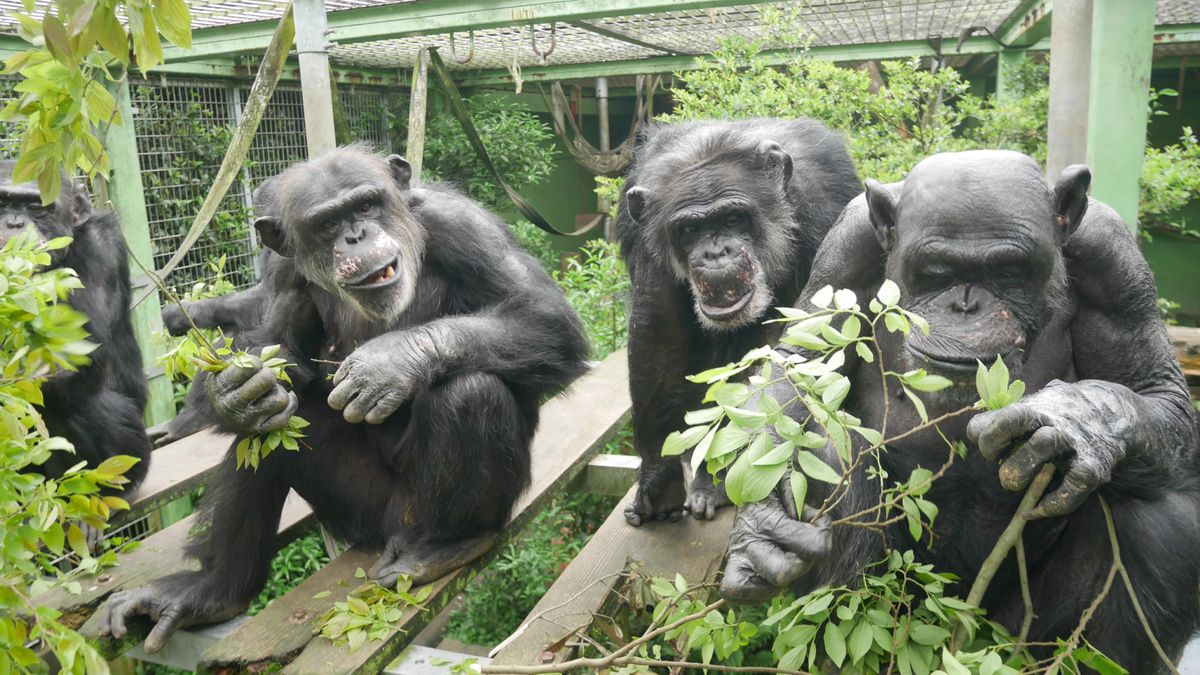
Two chimpanzees in an enclosure, eating leaves.

The scientists found social ranking impacted contagious peeing, with lower ranking members more likely to pee when others did. (Image credit: Kumamoto Sanctuary)

Social rank also influenced this behavior: Chimpanzees with lower dominance ranks were more likely to pee when others were peeing. Social closeness, measured by time in close proximity and grooming with another chimpanzee, had no effect on the peeing phenomenon — unlike with social yawning, which increases in socially closer pairs.

Contagious urination could be important to social group cohesion, coordination or reinforcing social bonds, the researchers said.

The behavior could exist to encourage “state-matching,” where chimpanzees improve group cohesion by all being in a similar state, study co-author Ena Onishi, a wildlife researcher at Kyoto University, told Live Science in an email. The behavior could also reinforce social connections.

Another possibility is that multiple chimpanzees urinating in a single location can deter or confuse predators, by reducing the risk of being tracked through scattered urine odors.

While no similar studies have yet been conducted on chimpanzees in the wild, some researchers have noted similar behaviors in wild populations, Onishi said. The researchers are also curious about whether other species show this contagious urination behavior.

“We are greatly influenced by the presence of others, even in mundane activities,” Onishi said. “For example, in both chimpanzees and humans, behaviors like yawning, walking, rhythmic tapping, and even pupil size are known to be contagious.”

Studying contagious urination could help scientists understand the behavior of humans’ common ancestors with chimpanzees, and the origin of the social custom in humans, Onishi said.”

Source link

Share. Facebook Twitter Pinterest LinkedIn Tumblr Email
Previous ArticleWhat Donald Trump Had to Say About Melania Trump’s Inauguration Hat
Next Article Bitcoin hits all-time high on Inauguration Day
Editor
  • Website

Related Posts

Lifestyle

Memory may not work how we thought, study of mice in artificial hibernation finds

August 13, 2026
Lifestyle

Romans unceremoniously dumped plague victims down a well, mysterious mass grave in Croatia suggest

August 13, 2026
Lifestyle

New AI lets robots complete tasks twice as fast

August 13, 2026
Add A Comment

Comments are closed.

Categories
  • Entertainment
  • Lifestyle
  • News
  • Sports
  • Tech
  • Travel
Recent Posts
  • Memory may not work how we thought, study of mice in artificial hibernation finds
  • Romans unceremoniously dumped plague victims down a well, mysterious mass grave in Croatia suggest
  • New AI lets robots complete tasks twice as fast
  • Mammal ancestors may have given live birth 90 million years earlier than we thought, rewriting evolutionary timelines
  • How to see and photograph the partial lunar eclipse on August 27-28
calendar
August 2026
M T W T F S S
 12
3456789
10111213141516
17181920212223
24252627282930
31  
« Jul    
Recent Posts
  • Memory may not work how we thought, study of mice in artificial hibernation finds
  • Romans unceremoniously dumped plague victims down a well, mysterious mass grave in Croatia suggest
  • New AI lets robots complete tasks twice as fast
About

Welcome to Baynard Media, your trusted source for a diverse range of news and insights. We are committed to delivering timely, reliable, and thought-provoking content that keeps you informed
and inspired

Categories
  • Entertainment
  • Lifestyle
  • News
  • Sports
  • Tech
  • Travel
Facebook X (Twitter) Pinterest WhatsApp
  • Contact Us
  • About Us
  • Privacy Policy
  • Disclaimer
  • UNSUBSCRIBE
© 2026 copyrights reserved

Type above and press Enter to search. Press Esc to cancel.