
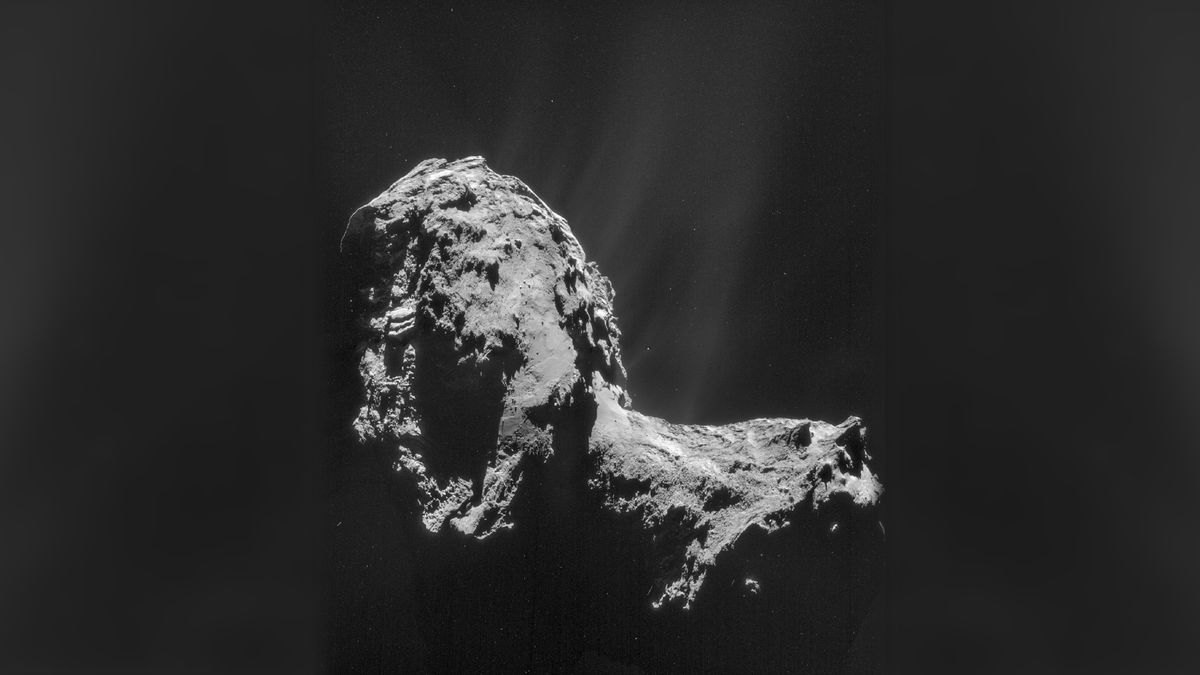
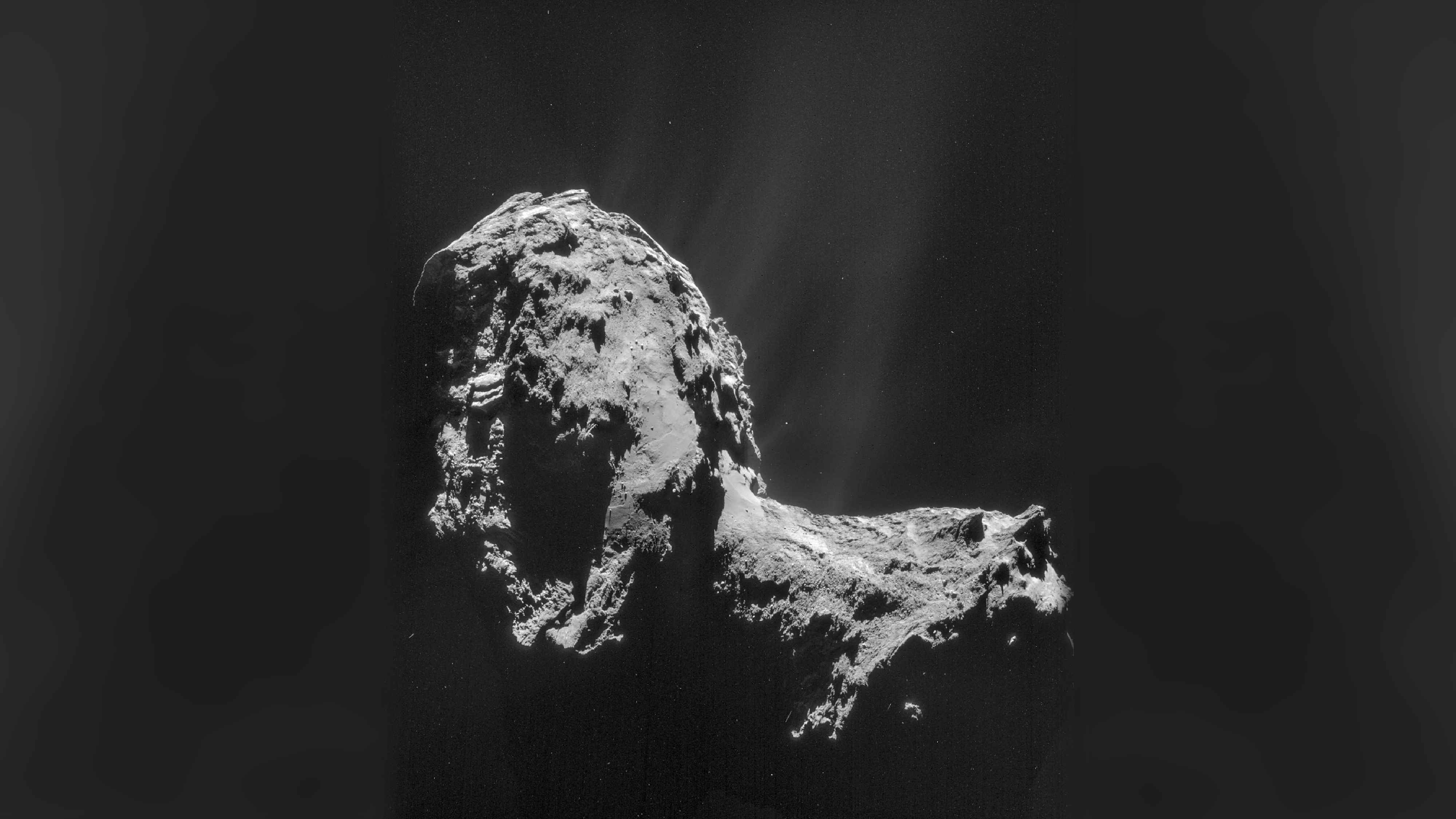
The idea that comets delivered water to early Earth has fallen out of favor in the past decade, but a new look at data from the European Space Agency’s (ESA) Rosetta mission to an iconic “rubber ducky” comet has reopened that possibility.
Water has a pretty simple chemical makeup: just three atoms (two hydrogen and one oxygen) in each molecule. It’s also one of Earth’s most abundant molecules, with our planet’s oceans brimming with about a million trillion tons of the liquid.
How all of this water ended up on Earth, though, has remained a mystery. Some scientists think that although Earth’s geological processes may have generated a tiny fraction of it, most water was likely deposited by comets or asteroids via repeated, cataclysmic collisions.
Figuring out which of these two groups was responsible involves a special chemical signature that arises because the hydrogen in water occurs in two distinct isotopes, or forms. Whereas most hydrogen atoms contain just one proton in their nucleus, a tiny fraction harbors an additional neutron. The chemical signature involves measuring the amount of this heavier hydrogen isotope, called deuterium, relative to its lighter, regular form — a quantity called the deuterium-to-hydrogen ratio, or D/H.
“The D/H in water tells us at what temperature the ice formed, and from that how far a comet formed from the Sun,” Kathleen Mandt, a planetary scientist at NASA and corresponding author of a new study describing the reanalysis, told Live Science in an email. The lower the D/H value is, the farther from the sun the asteroid or comet was born.
Related: ‘Crumb trails’ of meteoroids could reveal potential ‘planet-killer’ comets years before they reach Earth
Research over the past few decades has shown that Earth’s D/H ratio is similar to those of many asteroids and a handful of Jupiter-family comets — a group of comets that swing past the sun roughly every 20 years and whose paths are tweaked by Jupiter’s gravity.
But the D/H value of the “rubber ducky” comet 67P/Churyumov-Gerasimenko, determined in a 2015 study, essentially ended the case for comets. Averaged over 150 measurements collected by ESA’s Rosetta mission during the spacecraft’s 2014 rendezvous with Comet 67P, the D/H value was roughly three times Earth’s. The researchers interpreted this as evidence that comets were very unlikely to have delivered water to Earth.
The results were perplexing, Mandt said, because the D/H value was way higher than those of other Jupiter-family comets. Plus, “the comet should have a lot more CO [carbon monoxide] and N2 [nitrogen] than Rosetta measured because these ices also form at really cold temperatures,” she added.
To understand Comet 67P’s apparently high D/H ratio, Mandt and other astronomers from research institutes in the U.S., France and Switzerland decided to comb through the entire Rosetta dataset. Using an innovative statistical technique developed by Jacob Lustig-Yaeger from the Johns Hopkins Applied Physics Laboratory, the team identified signals coming only from deuterium-containing water molecules, allowing them to collate about 4,000 D/H measurements.
The researchers found that the D/H values varied wildly along the comet’s long axis, with the highest being near the “nucleus” — the rocky part that resembles a rubber ducky — and decreasing along the tail.
Such variation likely occurs because of processes occurring within the comet, the researchers wrote in their study, published Nov. 13 in the journal Science Advances. As the comet approaches the sun, the comet’s surface warms up, which releases gas along with ice-coated dust particles into the coma (the halo that develops around the nucleus). Previous, unrelated lab studies had shown that deuterium-containing ice tends to stick to dust grains more than to normal ice. The scientists realized that such dust grains, upon entering the coma, could account for the high D/H values recorded there.
However, the researchers noted that dust particles about 75 miles (120 kilometers) from the nucleus are essentially dried out, meaning they lack any deuterium-enriched ice that could generate spuriously high D/H values. Using only the data collected at this distance, the authors calculated that Comet 67P’s actual D/H value was only 1.5 times that of Earth.
The revised D/H value means that “all Jupiter Family Comets that we have been able to measure have a D/H closer to the Earth’s water D/H,” Mandt said. This implies that comets played a major, rather than minor, role in irrigating Earth. Plus, she added, a lower D/H value suggests Comet 67P was born closer to the sun than scientists previously thought.
