Close Menu
  • Home
  • UNSUBSCRIBE
  • News
  • Lifestyle
  • Tech
  • Entertainment
  • Sports
  • Travel
Facebook X (Twitter) WhatsApp
Trending
  • New robotic heart mimics common, mysterious condition to help researchers study it
  • Canon EOS R6 III review: A wildlife wonder
  • Medieval babies and adults buried together in Sweden were not related, archaeologists discover — raising big questions about early Christian burial practices
  • NASA is creating a fifth state of matter on the ISS, thanks to an upgrade to a mini-fridge-sized quantum lab
  • New sodium metal battery design charges in just 4 minutes and retains its capacity for years
  • Quantum computing wielded to create extremely rare material critical to nuclear fusion
  • Scientists build tiny ‘diving suit’ for cockroaches, turning them into search-and-rescue cyborgs
  • Physicists develop the first working model of quantum mechanics using only ‘real’ numbers
Facebook X (Twitter) WhatsApp
Baynard Media
  • Home
  • UNSUBSCRIBE
  • News
  • Lifestyle
  • Tech
  • Entertainment
  • Sports
  • Travel
Baynard Media
Home»Lifestyle»Comet 3I/ATLAS’ upcoming encounter with the sun could change it in big ways — Space photo of the week
Lifestyle

Comet 3I/ATLAS’ upcoming encounter with the sun could change it in big ways — Space photo of the week

EditorBy EditorOctober 26, 2025No Comments3 Mins Read
Share Facebook Twitter Pinterest LinkedIn Tumblr Reddit Telegram Email
Share
Facebook Twitter LinkedIn Pinterest Email

QUICK FACTS

What it is: The interstellar comet 3I/ATLAS, growing a tail

Where it is: The inner solar system, barreling toward Mars

When it was shared: Sept. 4, 2025

Even as a brilliant, naked-eye comet slices through Earth’s sky (cheers, Comet Lemmon!), the most famous object in the solar system right now is hidden on the far side of the sun: the interstellar comet 3I/ATLAS.

This alien visitor, which most astronomers believe to be a comet originating from an unknown star system far beyond our own, is only the third interstellar object ever detected in our solar system. It is the largest, fastest-moving, and quite likely the oldest interstellar object ever seen.

Though it was just confirmed by NASA in early July, the freewheeling ball of ice and dust is already nearing the halfway point on its tour of our solar system. This Wednesday (Oct. 29), 3I/ATLAS will reach perihelion — its closest point to the sun — before beginning its months-long departure from our cosmic neighborhood.


You may like

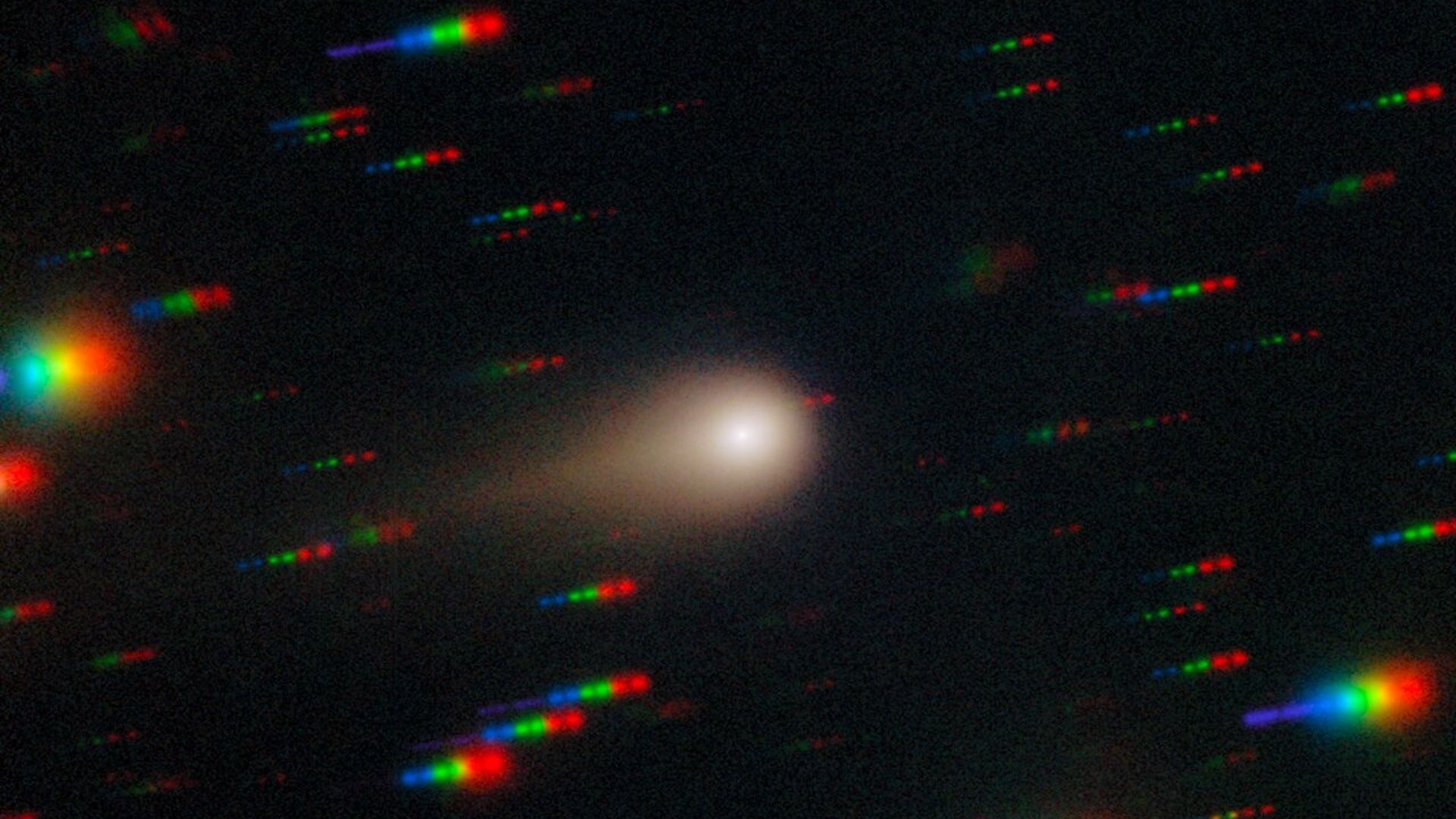
a photo of the comet 3I/ATLAS with its long tail shooting through space

An edited version of the image ‘freezes’ the background stars in place as 3I/ATLAS charges through the center of the frame. (Image credit: International Gemini Observatory/NOIRLab/NSF/AURA/Shadow the ScientistImage Processing: J. Miller & M. Rodriguez (International Gemini Observatory/NSF NOIRLab), T.A. Rector (University of Alaska Anchorage/NSF NOIRLab), M. Zamani (NSF NOIRLab))

We’ll miss our interstellar friend, but at least we’ll always have the photos. The image above, captured Aug. 27 by the National Science Foundation-operated Gemini South telescope in Chile, may be the clearest image we have so far. As 3I/ATLAS zooms closer to the sun, radiation from our star heats the ice on the comet’s body (its nucleus), causing geysers of gas and dust to shoot outward and form a glowing plume (a coma) around it. Radiation pressure from our star’s unrelenting solar wind pushes this material into a long, prominent tail angled away from the sun.

As 3I/ATLAS reaches perihelion this week — coming within 1.4 astronomical units, or 130 million miles (210 million kilometers) of the sun, according to NASA — it may start releasing gas in overdrive. When the comet becomes visible to telescopes again in early November, it may look both bigger and brighter than how it appeared two months ago. Instruments on the ground, in orbit and even on their way to Jupiter will snap to attention, making 3I/ATLAS an even bigger space celebrity as it zooms away from our solar system forever.

Studying the interstellar comet with the full range of humankind’s astronomical instruments could yield untold secrets about the outer reaches of our galaxy and its mysterious history. Until then, all we can do is wait, feel the warm sunlight on our faces, and know that a trove of cosmic information lurks just on the other side of our star.

For more sublime space images, check out our Space Photo of the Week archives.

Get the world’s most fascinating discoveries delivered straight to your inbox.

Source link

Share. Facebook Twitter Pinterest LinkedIn Tumblr Email
Previous ArticleTrump’s use of force against cartels is justified
Next Article Destroyed U.S. tanks displayed at Russian war museum
Editor
  • Website

Related Posts

Lifestyle

New robotic heart mimics common, mysterious condition to help researchers study it

July 11, 2026
Lifestyle

Canon EOS R6 III review: A wildlife wonder

July 10, 2026
Lifestyle

Medieval babies and adults buried together in Sweden were not related, archaeologists discover — raising big questions about early Christian burial practices

July 10, 2026
Add A Comment

Comments are closed.

Categories
  • Entertainment
  • Lifestyle
  • News
  • Sports
  • Tech
  • Travel
Recent Posts
  • New robotic heart mimics common, mysterious condition to help researchers study it
  • Canon EOS R6 III review: A wildlife wonder
  • Medieval babies and adults buried together in Sweden were not related, archaeologists discover — raising big questions about early Christian burial practices
  • NASA is creating a fifth state of matter on the ISS, thanks to an upgrade to a mini-fridge-sized quantum lab
  • New sodium metal battery design charges in just 4 minutes and retains its capacity for years
calendar
July 2026
M T W T F S S
 12345
6789101112
13141516171819
20212223242526
2728293031  
« Jun    
Recent Posts
  • New robotic heart mimics common, mysterious condition to help researchers study it
  • Canon EOS R6 III review: A wildlife wonder
  • Medieval babies and adults buried together in Sweden were not related, archaeologists discover — raising big questions about early Christian burial practices
About

Welcome to Baynard Media, your trusted source for a diverse range of news and insights. We are committed to delivering timely, reliable, and thought-provoking content that keeps you informed
and inspired

Categories
  • Entertainment
  • Lifestyle
  • News
  • Sports
  • Tech
  • Travel
Facebook X (Twitter) Pinterest WhatsApp
  • Contact Us
  • About Us
  • Privacy Policy
  • Disclaimer
  • UNSUBSCRIBE
© 2026 copyrights reserved

Type above and press Enter to search. Press Esc to cancel.