Close Menu
  • Home
  • UNSUBSCRIBE
  • News
  • Lifestyle
  • Tech
  • Entertainment
  • Sports
  • Travel
Facebook X (Twitter) WhatsApp
Trending
  • Microplastics absorb heat in the atmosphere and contribute to global warming — as if they weren’t bad enough
  • ‘Insect apocalypse’ is already fueling malnutrition in some regions, first-of-its-kind study reveals
  • Hantavirus LIVE: American passengers from cruise head to specialized facilities in Nebraska
  • New ‘trick’ fixes major flaw in neutral-atom quantum computers — inching us closer to a superpowerful system
  • A 2025 Alaskan tsunami was one of the largest on record, new research finds
  • Lion’s head pendant: An ancient Egyptian board game piece that was later repurposed into a magical religious object with baboons
  • Are we more closely related to cats or dogs?
  • Declassified Apollo 12 images show UFOs on the moon — Space photo of the week
Facebook X (Twitter) WhatsApp
Baynard Media
  • Home
  • UNSUBSCRIBE
  • News
  • Lifestyle
  • Tech
  • Entertainment
  • Sports
  • Travel
Baynard Media
Home»Lifestyle»Comet 3I/ATLAS has been transformed by billions of years of space radiation, James Webb Space Telescope observations reveal
Lifestyle

Comet 3I/ATLAS has been transformed by billions of years of space radiation, James Webb Space Telescope observations reveal

EditorBy EditorOctober 31, 2025No Comments5 Mins Read
Share Facebook Twitter Pinterest LinkedIn Tumblr Reddit Telegram Email
Share
Facebook Twitter LinkedIn Pinterest Email

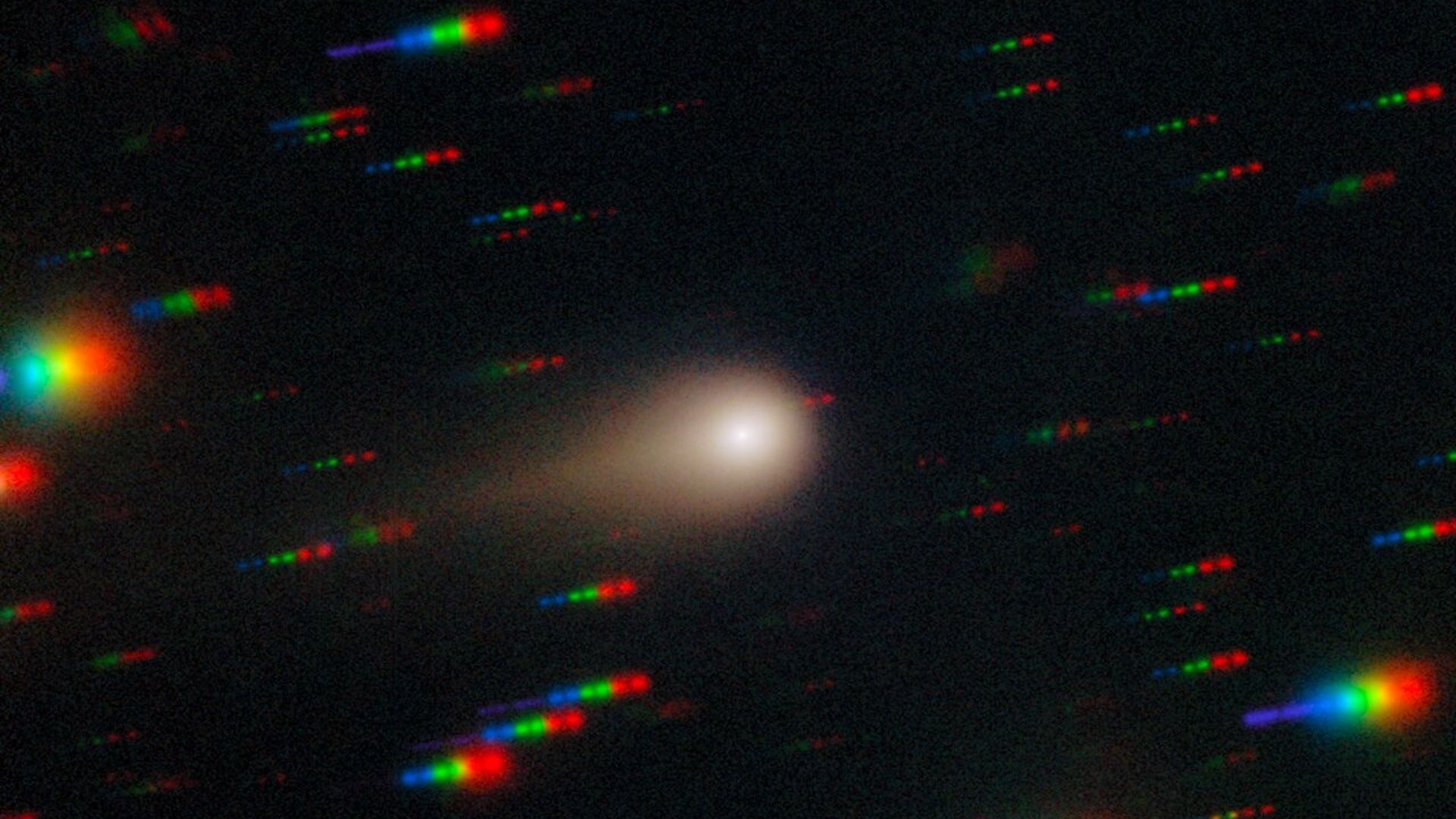
Comet 3I/ATLAS is extremely irradiated from billions of years of cosmic ray bombardments, new research using observations from the James Webb Space Telescope (JWST) has revealed.

The comet has soaked up so many galactic cosmic rays during its interstellar journey through the Milky Way that it has developed a deep irradiated crust that no longer resembles the material of its home star system, the new research hints.

Using JWST observations and computer simulations, researchers have determined that the comet’s previously documented “extreme” levels of carbon dioxide (CO2) enrichment are from space radiation absorbed over its estimated 7-billion-year lifespan, according to the study posted to the preprint server arXiv on Friday (Oct. 31). The findings have not yet been peer reviewed.


You may like

Galactic cosmic rays — a kind of space radiation made up of high-energy particles from outside of the solar system — strike carbon monoxide (CO) in space to convert it to carbon dioxide (CO2). In our solar system, the heliosphere — the enormous bubble of radiation emitted by the sun — shields Earth and its neighbors from a majority of this cosmic radiation. But in interstellar space, where 3I/ATLAS has spent most of its life, no such protection exists.

The authors of the new study concluded that over billions of years, cosmic rays have significantly altered the physical state of comet 3I/ATLAS’ ice, down to a depth of about 50 to 65 feet (15 to 20 meters).

“It’s very slow, but over billions of years, it’s a very strong effect,” study lead author Romain Maggiolo, a research scientist at the Royal Belgian Institute for Space Aeronomy, told Live Science.

The findings, which the researchers described as a “paradigm shift” for studying interstellar objects, suggest that objects like comet 3I/ATLAS are primarily made up of galactic cosmic ray-processed material rather than pristine material that is representative of the environments in which they formed.

Get the world’s most fascinating discoveries delivered straight to your inbox.

In other words, comet 3I/ATLAS is now a product of its interstellar journey rather than where it came from — at least on the outside.

Tracking the interstellar visitor

Comet 3I/ATLAS is currently flying around the sun. The comet reached perihelion (its closest point to our star) on Thursday (Oct. 29). Comets heat up as they draw closer to stars, causing ices on their surface to sublimate into gas. The new findings suggest that before perihelion, any gases ejected from the comet were merely from its irradiated outer shell. This is likely to continue post-perihelion, but Maggiolo noted that while it’s unlikely, solar erosion might be strong enough to expose the pristine materials from the comet’s home star that are locked away in its nucleus.

“It will be very interesting to compare observations before perihelion, so the first observation we had when it arrived in the solar system, with observations made after perihelion when there was some erosion,” Maggiolo said. “Maybe by looking at these differences, we can have some indication about its initial composition.”


You may like

Since its discovery in July, researchers have been using various telescopes to learn all they can about 3I/ATLAS. Their findings so far indicate that the comet is zooming through our solar system at speeds in excess of 130,000 mph (210,000 km/h) in an unusually flat and straight trajectory. 3I/ATLAS could also be the oldest comet ever seen, with one study suggesting it’s around 3 billion years older than our 4.6 billion-year-old solar system.

Observations of 3I/ATLAS captured using the James Webb Space Telescope's Near-Infrared Spectrograph instrument.

Researchers used NASA’s James Webb Space Telescope to observe 3I/ATLAS on Aug. (Image credit: NASA/James Webb Space Telescope)

The new research builds on a previous work that documented comet 3I/ATLAS is rich in CO2, based on JWST’s first images of the interstellar visitor in August, and observations from NASA’s SPHEREx orbiter, also made in August.

Maggiolo and his colleagues had been studying the irradiation of a domestic comet (comet 67P), which passes between the orbits of Jupiter and Earth, and adapted their models from a 2020 study published in The Astrophysical Journal Letters to apply to comet 3I/ATLAS.

The team modeled the cumulative effects of galactic cosmic ray exposure on both ice structure and chemical composition after 1 billion years of irradiation. The method relies on laboratory experiments that simulated the effects of galactic cosmic rays, and thus might not be completely representative of interstellar conditions. Nonetheless, the tests offer a robust indicator of what comets experience on their lonely, multibillion-year journeys through interstellar space, according to the study.

The simulations found that 1 billion years of irradiation was sufficient for comet 3I/ATLAS to form its deep irradiated crust. Maggiolo noted that comet 3I/ATLAS is still full of interesting information, but it has aged and changed, which researchers will need to take into account during their analyses.

“We have to be careful and take into account aging processes, so it’s more work for scientists, but [3I/ATLAS] remains very interesting,” Maggiolo said.

Source link

Share. Facebook Twitter Pinterest LinkedIn Tumblr Email
Previous ArticleCBP seizes 90 pounds of liquid meth hidden in bottles at Eagle Pass
Next Article Mom scrambles to control giant inflatable pumpkin
Editor
  • Website

Related Posts

Lifestyle

Microplastics absorb heat in the atmosphere and contribute to global warming — as if they weren’t bad enough

May 12, 2026
Lifestyle

‘Insect apocalypse’ is already fueling malnutrition in some regions, first-of-its-kind study reveals

May 11, 2026
Lifestyle

Hantavirus LIVE: American passengers from cruise head to specialized facilities in Nebraska

May 11, 2026
Add A Comment

Comments are closed.

Categories
  • Entertainment
  • Lifestyle
  • News
  • Sports
  • Tech
  • Travel
Recent Posts
  • Microplastics absorb heat in the atmosphere and contribute to global warming — as if they weren’t bad enough
  • ‘Insect apocalypse’ is already fueling malnutrition in some regions, first-of-its-kind study reveals
  • Hantavirus LIVE: American passengers from cruise head to specialized facilities in Nebraska
  • New ‘trick’ fixes major flaw in neutral-atom quantum computers — inching us closer to a superpowerful system
  • A 2025 Alaskan tsunami was one of the largest on record, new research finds
calendar
May 2026
M T W T F S S
 123
45678910
11121314151617
18192021222324
25262728293031
« Apr    
Recent Posts
  • Microplastics absorb heat in the atmosphere and contribute to global warming — as if they weren’t bad enough
  • ‘Insect apocalypse’ is already fueling malnutrition in some regions, first-of-its-kind study reveals
  • Hantavirus LIVE: American passengers from cruise head to specialized facilities in Nebraska
About

Welcome to Baynard Media, your trusted source for a diverse range of news and insights. We are committed to delivering timely, reliable, and thought-provoking content that keeps you informed
and inspired

Categories
  • Entertainment
  • Lifestyle
  • News
  • Sports
  • Tech
  • Travel
Facebook X (Twitter) Pinterest WhatsApp
  • Contact Us
  • About Us
  • Privacy Policy
  • Disclaimer
  • UNSUBSCRIBE
© 2026 copyrights reserved

Type above and press Enter to search. Press Esc to cancel.