
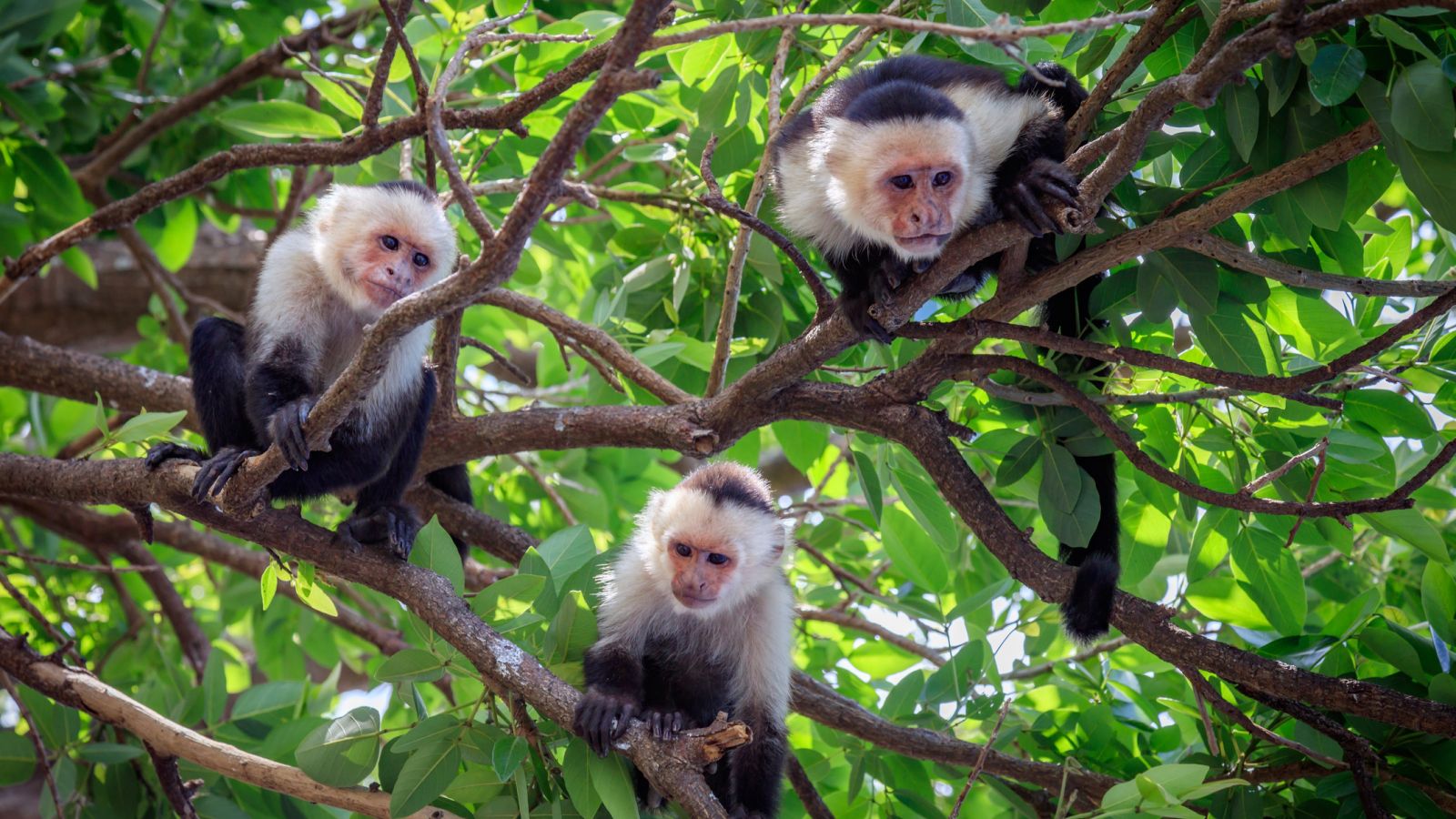
Plants, insects, and larger animals, like the forest’s white-faced capuchin monkeys, are well adapted to these changes. But in 2015, during an abnormally severe drought influenced by the El Niño–Southern Oscillation (ENSO), Perry, an evolutionary anthropologist at the University of California, Los Angeles, observed behaviors that once seemed impossible.
Under normal conditions “The [capuchin] mothers are quite devoted,” she explained. “Now, I was seeing babies crying on the ground piteously. And the mothers just looking down like ‘Too much trouble’ and walking off, abandoning their infants.”
“Even capuchins have their limits,” Perry said. “And we need to start paying attention because all the weather predictions are saying that we’re going to get more unpredictability and more climate extremes.”
Monkeying around
Odd Jacobson, a behavioral ecologist at the Max Planck Institute of Animal Behavior, was a student at Lomas Barbudal in 2016, a year after this severe drought. His focus was on understanding how the study site’s 12 different capuchin groups were moving through the forest. But now he’s set out to investigate how else climate extremes may affect the behaviors and social structures of these monkeys.
In a paper published in Nature Ecology and Evolution, Jacobson and his coauthors — including Perry — analyzed how climate variability correlated to the 33 years of geolocation data they had on the capuchins.
Their first step was understanding how the size of each group was affecting the relationships between monkeys within the same group. To do this, they observed variables such as daily fruit intake, the size of the group’s home range, and the distance the group traveled each day to find food.
Finally, to understand how monkey groups interacted, they used a “hierarchical social relations model,” which allowed the scientists to predict how two different monkey groups would move through the forest and where their territories would overlap.
Get the world’s most fascinating discoveries delivered straight to your inbox.
The team repeated this process, two monkey groups at a time, until they analyzed the interactions between all 12 monkey groups at Lomas Barbudal. Then, they added the climate-over-time layer to predict how the home range overlap and encounter rates (meaning moments where capuchins from two different groups engaged, often violently) would change with the seasons.
Strength (and weakness) in numbers
Generally, large monkey groups have advantages and disadvantages in the forest. One key advantage is the ability to control resource-rich areas, such as land with fruiting trees known as food patches. A key disadvantage is increased intragroup competition for food, meaning the daily fruit intake of individual monkeys was lower.
The researchers found that during climatic extremes, such as extremely wet or dry seasons, this intragroup competition intensifies, making the group less efficient at foraging overall. Behavior between groups changed with the climate as well. For example, in a typical dry season, large groups often overpower smaller ones to take over areas with more available fruit, such as along rivers.
But the new research found that this long-understood idea doesn’t always hold true: During extreme climate events, like a dry season made even drier by the effects of El Niño, capuchins didn’t try to hoard the higher-quality areas.
“We don’t really know exactly why,” Jacobson said. “Maybe there’s not as much heterogeneity in the landscape during these resource poor times, and so there’s not much that larger groups can monopolize.”
Climate extremes, the research suggests, may be upsetting the balance that determines the optimal size of monkey groups. And, as a warming atmosphere makes climate extremes like El Niño or La Niña more intense, it’s growing increasingly important to understand how these changes will affect animal societies.
Filippo Aureli, an ethologist at the Universidad Veracruzana, in Mexico, was not involved with this study, but he has studied the effects of extreme weather events on spider monkeys in Mexico. He also registered the infant mortality rates of capuchin and spider monkeys in the Costa Rican dry tropical forest during that 2015 drought. Capuchin populations experienced high infant mortality during the extreme event, while spider monkey populations tended to stop reproducing.
“With climate change, [climate extremes] are going to be more frequent and intense,” Aureli said. “And we don’t know what’s going to happen. For this period [so far], they’ve held on very well, the spider monkeys, but we don’t know for how much longer.”
Perry agreed, noting “the importance of having a baseline when you’re trying to study rare events like El Niño droughts.”
“We know what normal is,” she explained. “If you just try to drop in right now in all the chaos that we’re starting to feel around the planet, then you really can’t study it.”
This article was originally published on Eos.org. Read the original article.
