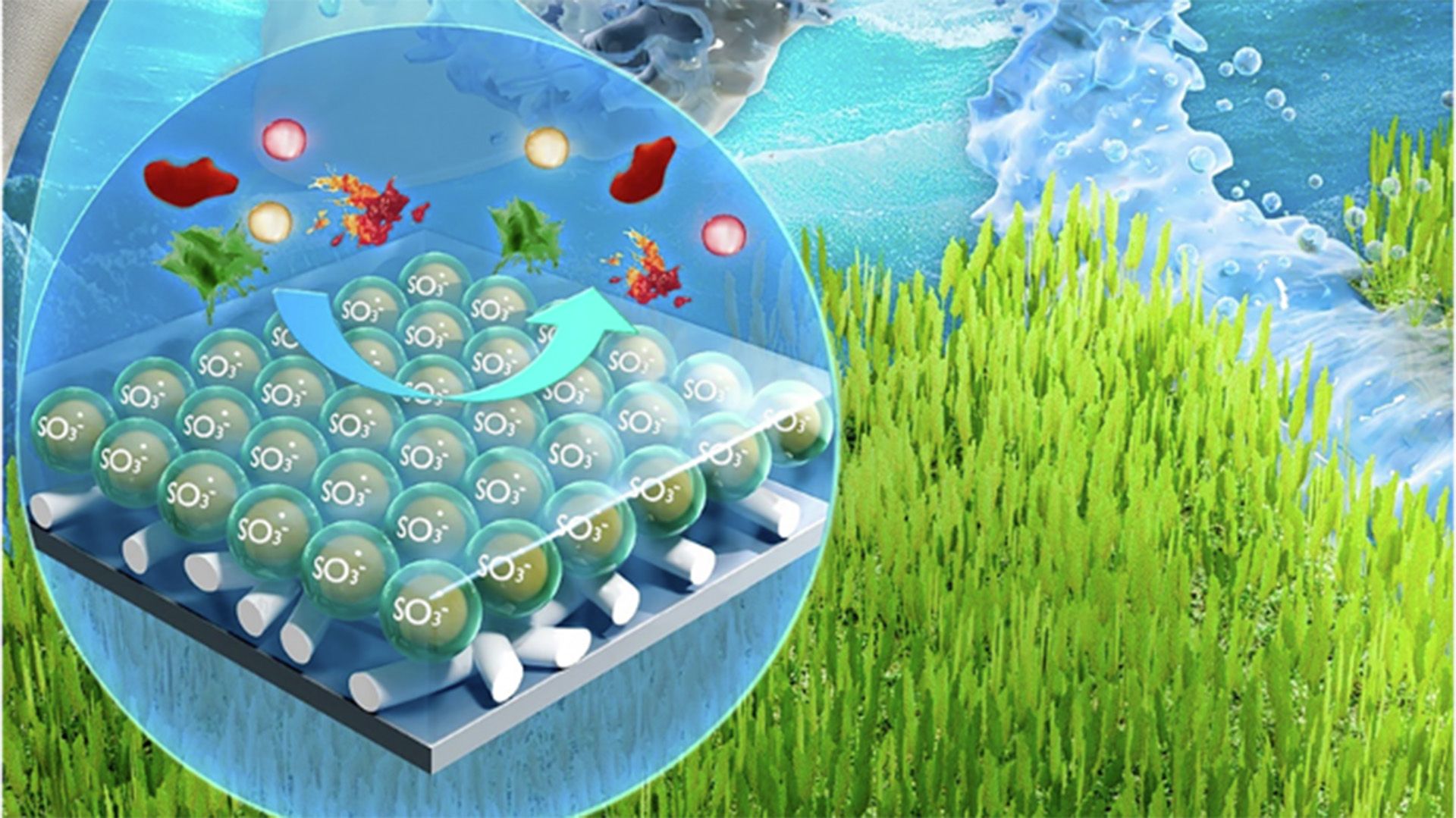
Scientists have invented a self-cleaning coating that prevents stains from food, oil or dirt from sticking to a fabric’s surface, making the spots easy to remove without detergent or large amounts of water. The coating, which creates a protective ultrathin layer of water its developers call “molecular water armor,” could reduce the water and electricity demand of household laundry by over 80%, new research suggests.
Washing clothes is a basic necessity of everyday life, but laundry has a huge environmental footprint because it produces vast amounts of wastewater. A single cycle in a household washing machine uses 10.5 to 16 gallons (40 to 60 liters) of clean water, while the detergents required to remove stains promote the release of microplastics from synthetic fibers and leave chemical residues in the discharged water.
In the new work, reported in the journal Communications Chemistry March 19, researchers tackled this problem from a completely different perspective, focusing on the design of the textiles themselves.
“Instead of relying on detergent to remove strongly attached dirt, we modify the textile surface so that stains do not adhere strongly in the first place,” material scientists Chongling Chengof Southeast University andDayang Wang of Jilin University in China, both co-authors of the research, told Live Science in a joint email. “As a result, many common stains can be removed using water alone and a much shorter rinsing process.”
“Molecular water armor”
The team, based at Southeast and Jilin universities in China, spray-coated alternating layers of positively and negatively charged polymers onto cotton, silk and polyester clothing. The resulting multilayer film formed a surface rich in sulfonate groups — sulfur-containing chemical units — which attracted and organized water molecules into an ultrathin layer on the fabric’s surface.
“We sometimes describe this layer as a molecular ‘water armour,'” Cheng and Wang said. “[It] acts as a barrier between the fabric and contaminants. Oils, food stains, sweat residues, and microorganisms find it difficult to make direct, strong contact with the coated fiber surface. Therefore, stains are much less strongly attached and can be removed by water flow, without the need for detergent.” This contrasts with waterproof materials which simply allow water droplets to roll straight off, rather than producing a cleaning effect.
Get the world’s most fascinating discoveries delivered straight to your inbox.
The researchers demonstrated this superior cleaning performance by pitting the new coating against conventional detergent-based washing to launder cloth soiled with ketchup, chili oil and soy sauce. It proved particularly effective for these oily surface stains, and the coated fabrics cleaned with just a single rinse — matching or outperforming the detergent wash for stain removal.
Various comparisons of stains on coated versus un-coated fabrics when washed with water or detergent. Even without detergent, the new coating helped remove stains with great efficiency.
(Image credit: Communications Chemistry / Wang et al.)
An analysis of the small amount of wastewater produced by the rinse wash also revealed that this additional layer drastically suppressed the release of microplastics during washing, trapping any stray particles within the coating itself.
Overall, the polymer layer substantially improved the environmental footprint of the laundry process; the team calculated that it reduced the water and electricity demand by more than 82% compared with a normal cycle. From a cost perspective, these stain-resistant fabrics are more expensive to manufacture than standard textiles, but the team noted that this upfront expenditure could be recouped in as few as 15 laundry cycles, depending on the cost of the detergent.
The coating also addresses laundry hygiene. The coated fabrics showed both antibacterial and antifungal effects, which are most likely related to the water armor barrier, Cheng and Wang said. The repellent surface prevents microbes, sweat and skin cells from adhering to the fabric, allowing them to be easily removed by rinsing. As a result, a quick soak completely eliminates odors and prevents the growth of mold or mildew, which can occur during prolonged storage.
But convincing consumers of these clean credentials could prove challenging. “Many people associate detergent foam and fragrance with cleanliness, even though foam and fragrance are not necessarily direct measures of hygiene,” Cheng and Wang said. “Therefore, we expect that consumer trust will require clear evidence, transparent testing, and practical demonstration.”
The coating is still in the proof-of-concept stage. Preliminary investigations by the team have suggested that it is safe to use against skin and remains effective over more than 100 laundry cycles. Given the coating’s nanoscale thickness, the team doesn’t expect it to change the texture or breathability of treated clothing. However, a crucial next step will be to have consumers test the materials to validate their comfort and practicality in real-world settings.
“Commercialization will also require independent safety assessment, durability standards, [and] environmental lifecycle analysis,” Cheng and Wang said. “Our current study demonstrates the central scientific principle. The next challenge is to translate this principle into a robust, affordable, and trusted product for everyday use.”
Wang, R., Wang, H., Chen, Y., Cheng, C., & Wang, D. (2026). A versatile self-cleaning fabric coating as a detergent-free laundry product. Communications Chemistry, 9(1). https://doi.org/10.1038/s42004-026-01942-7