Close Menu
  • Home
  • UNSUBSCRIBE
  • News
  • Lifestyle
  • Tech
  • Entertainment
  • Sports
  • Travel
Facebook X (Twitter) WhatsApp
Trending
  • Rare genetic disease makes scientists reconsider what the ‘seat of fear’ in the brain really is
  • It’s illegal to repair most of our devices. There’s a surprising reason for that.
  • Jupiter’s Ganymede, the largest moon in the solar system, may be heating up
  • Bizarre patterns on Venus have scientists puzzled
  • Scientists trained an AI model using an IBM quantum computer — and it answered questions correctly that the base model couldn’t
  • How did animals survive the asteroid that killed the dinosaurs?
  • ‘We can identify these really early, before the clinical diagnosis’: Epigenetic markers may help explain why Native Hawaiians are aging faster
  • Catapult the cow: 6 medieval castles that were never conquered
Facebook X (Twitter) WhatsApp
Baynard Media
  • Home
  • UNSUBSCRIBE
  • News
  • Lifestyle
  • Tech
  • Entertainment
  • Sports
  • Travel
Baynard Media
Home»Lifestyle»Caergwrle Bowl: A gold-decorated bowl discovered in a boggy field in Wales — and may have been left by Bronze Age sailors as an offering to the gods
Lifestyle

Caergwrle Bowl: A gold-decorated bowl discovered in a boggy field in Wales — and may have been left by Bronze Age sailors as an offering to the gods

EditorBy EditorNovember 17, 2025No Comments2 Mins Read
Share Facebook Twitter Pinterest LinkedIn Tumblr Reddit Telegram Email
Share
Facebook Twitter LinkedIn Pinterest Email

QUICK FACTS

Name: Caergwrle Bowl

What it is: A shale bowl with gold and tin decorations

Where it is from: Caergwrle Castle, in Wales

When it was made: Circa 1300 to 1150 B.C.

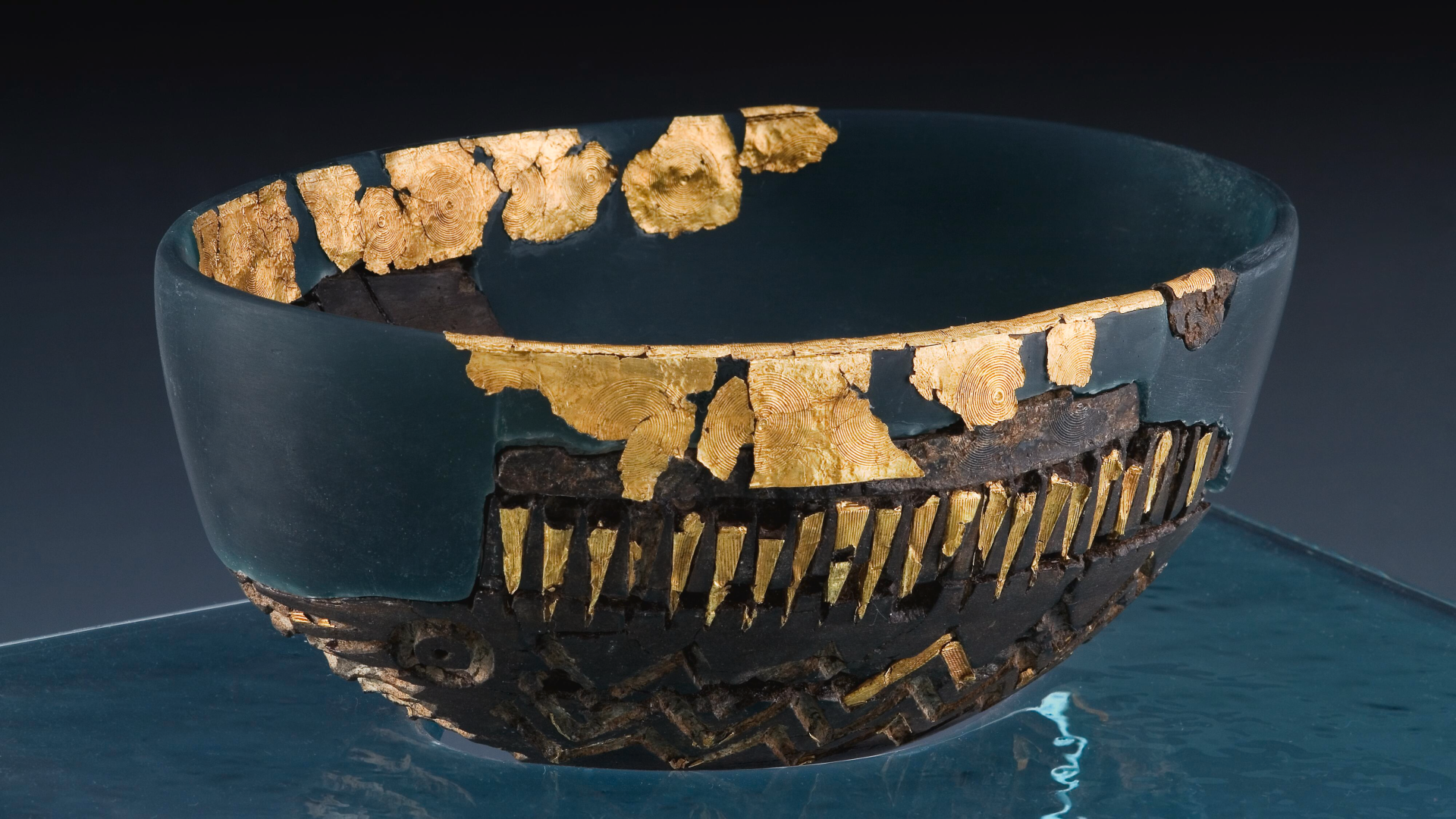
About 200 years ago, while digging in a boggy field in Wales, a worker struck a rare, ancient bowl shaped like a ship. The Caergwrle Bowl, named after a nearby castle, showcases the importance of nautical travel in Great Britain’s Middle Bronze Age (roughly 1500 to 1000 B.C.).

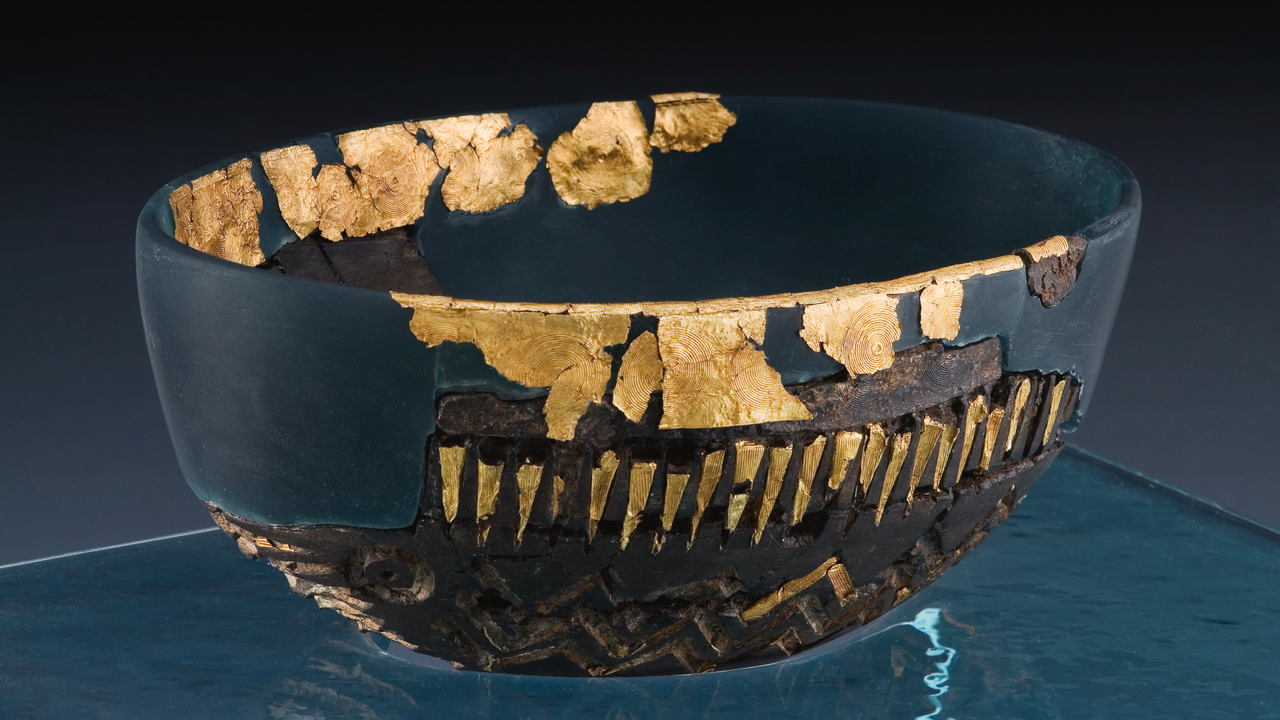
According to Museum Wales, which has the artifact in its collection, the Caergwrle Bowl was made from shale and tin from counties in southwest England; and gold from Ireland or Wales. About half the original artifact remains today, but when complete, the oval bowl was about 7.2 inches (18.2 centimeters) long and 3.1 inches (7.8 cm) deep.

The inside of the bowl is not decorated, but the exterior and the rim have been ornamented with gold-foil-covered tin in a variety of shapes.


You may like

“We think the zig-zags around the base are waves and the long triangles are oars,” Museum Wales representatives wrote. “The eye symbol protected sailors. The circles are the shields of its heroic voyagers.”

But a slightly different interpretation was put forward by nautical archaeologists in a 1980 study of the bowl.

Rather than seeing the concentric circles on the gold rim as shields, researchers argued that the closest parallel can be found in Bronze Age sun symbolism, such as the Nebra Sky Disc — which may also depict a boat — and the Nordic “Sun Chariot.” And instead of the zigzag lines representing waves, the lines could depict the boat’s wooden frame showing through the skins that were stretched over it.

MORE ASTONISHING ARTIFACTS

Regardless of the exact meaning of the designs on the Caergwrle Bowl, its discovery in a boggy field near the River Alun, which flows toward the Irish Sea, strongly suggests it was created as a representation of a boat, according to Museum Wales. And considering many Bronze Age sun artifacts have been found in bogs as offerings to the gods, the Caergwrle Bowl was likely meant to be an ancient votive offering, perhaps by sailors seeking a safe sea journey.

Get the world’s most fascinating discoveries delivered straight to your inbox.

For more stunning archaeological discoveries, check out our Astonishing Artifacts archives.

Source link

Share. Facebook Twitter Pinterest LinkedIn Tumblr Email
Previous ArticleDr. Oz outlines Trump’s healthcare reform plan with greater consumer choice
Next Article U.N. Security Council votes on U.S. resolution
Editor
  • Website

Related Posts

Lifestyle

Rare genetic disease makes scientists reconsider what the ‘seat of fear’ in the brain really is

May 25, 2026
Lifestyle

It’s illegal to repair most of our devices. There’s a surprising reason for that.

May 25, 2026
Lifestyle

Jupiter’s Ganymede, the largest moon in the solar system, may be heating up

May 25, 2026
Add A Comment

Comments are closed.

Categories
  • Entertainment
  • Lifestyle
  • News
  • Sports
  • Tech
  • Travel
Recent Posts
  • Rare genetic disease makes scientists reconsider what the ‘seat of fear’ in the brain really is
  • It’s illegal to repair most of our devices. There’s a surprising reason for that.
  • Jupiter’s Ganymede, the largest moon in the solar system, may be heating up
  • Bizarre patterns on Venus have scientists puzzled
  • Scientists trained an AI model using an IBM quantum computer — and it answered questions correctly that the base model couldn’t
calendar
May 2026
M T W T F S S
 123
45678910
11121314151617
18192021222324
25262728293031
« Apr    
Recent Posts
  • Rare genetic disease makes scientists reconsider what the ‘seat of fear’ in the brain really is
  • It’s illegal to repair most of our devices. There’s a surprising reason for that.
  • Jupiter’s Ganymede, the largest moon in the solar system, may be heating up
About

Welcome to Baynard Media, your trusted source for a diverse range of news and insights. We are committed to delivering timely, reliable, and thought-provoking content that keeps you informed
and inspired

Categories
  • Entertainment
  • Lifestyle
  • News
  • Sports
  • Tech
  • Travel
Facebook X (Twitter) Pinterest WhatsApp
  • Contact Us
  • About Us
  • Privacy Policy
  • Disclaimer
  • UNSUBSCRIBE
© 2026 copyrights reserved

Type above and press Enter to search. Press Esc to cancel.