

In December 2019, an ordinary galaxy 300 million light-years from us in the constellation Virgo suddenly woke up. After decades of inactivity, the black hole at the galaxy’s heart burst with light. Now, the cosmic monster appears to be doing something that is forcing astronomers to re-evaluate their understanding of these massive celestial bodies.
The black hole now gives off powerful X-rays at nearly regular intervals. These outbursts are known as quasi-periodic eruptions (QPEs), and have been observed emitting from other black holes. But the bursts observed here are up to 100 times more powerful than normal, according to new research. First observed in February 2024 by astronomers at Valparaiso University in Chile, this behavior grants scientists an unprecedented view of a black hole that seems to be awakening from dormancy with no sign of going back to sleep.
Led by the Valparaiso team, a group of researchers published their observations of the black hole’s QPE in a study on April 11 in the journal Nature Astronomy. In addition to giving astronomers a novel view of black holes, these events are also spurring researchers to reconsider how black holes behave.
“This is the first time we have observed such an event in a black hole that seems to be waking up,” the paper’s first author Lorena Hernández-García, an astronomy researcher at Valparaiso University, said in a statement. “This rare event provides an opportunity for astronomers to observe a black hole’s behaviour in real time.”
Related: Supermassive black hole at the heart of the Milky Way is approaching the cosmic speed limit, dragging space-time along with it
The galaxy, called SDSS1335+0728, first called attention to itself in 2019 when it unexpectedly started gleaming. At that time, astronomers from the European Southern Observatory studied the event by consulting NASA’s Swift X-ray space telescope and data from the eROSITA X-ray telescope. After investigating the galaxy’s central region — nicknamed Ansky — they concluded that the flash resulted from Ansky’s massive black hole beginning an active phase.
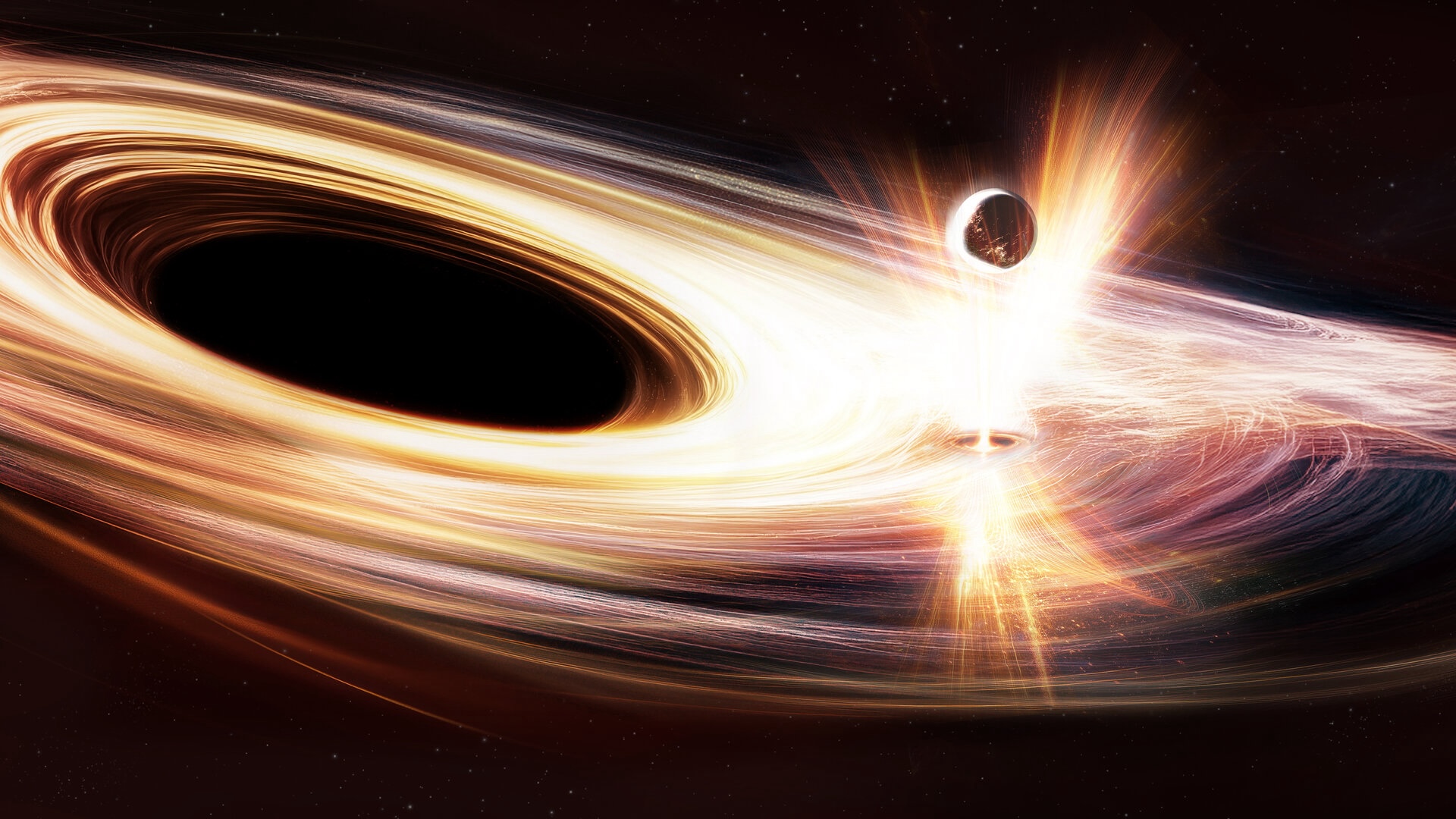
But in February 2024, Hernández-García’s team noticed bursts of previously undetected X-rays emanating from Ansky, caught by X-ray space telescopes XMM-Newton and NASA’s NICER, Chandra, and Swift. These QPEs are momentary, recurring X-ray flares. Astronomers believe QPEs result from interaction between accretion disks — the swirling ring of red-hot matter that surrounds a black hole — and nearby objects, like a star or a smaller black hole.
Stronger and longer
But Ansky’s QPEs aren’t typical. They’re remarkable because they last 10 times longer and are 10 times more luminous than average QPEs, the researchers said. Persisting for more than four days, they each release one hundred times more energy than what’s expected. These QPEs reveal a whole new aspect of black holes that don’t fit neatly into astronomers’ prior understanding of the cosmic bodies.
In particular, these unusual QPEs can help broaden our understanding of how these events occur. For example, there’s no evidence that Ansky has shredded a star into its accretion disk, which is what researchers currently believe triggers most QPEs. Therefore, there must be another explanation for the impetus that causes the QPEs in this case.
The X-ray bursts may instead come from energetic shocks in the accretion disk spurred by a small celestial object repeatedly disrupting its orbiting material, according to the paper.
It’s also possible that these repeated QPEs come from gravitational waves. The European Space Agency’s upcoming Laser Interferometer Space Antenna (LISA), set to launch in 2035, may confirm that connection by detecting gravitational waves with greater fidelity than ever before.
For now, Ansky is reshaping how we conceive of black holes.
“Studying Ansky will help us to better understand black holes and how they evolve,” Hernández-García said.
