
QUICK FACTS
Where is it? La Palma, Canary Islands, Spain [28.62120467, -17.89960469]
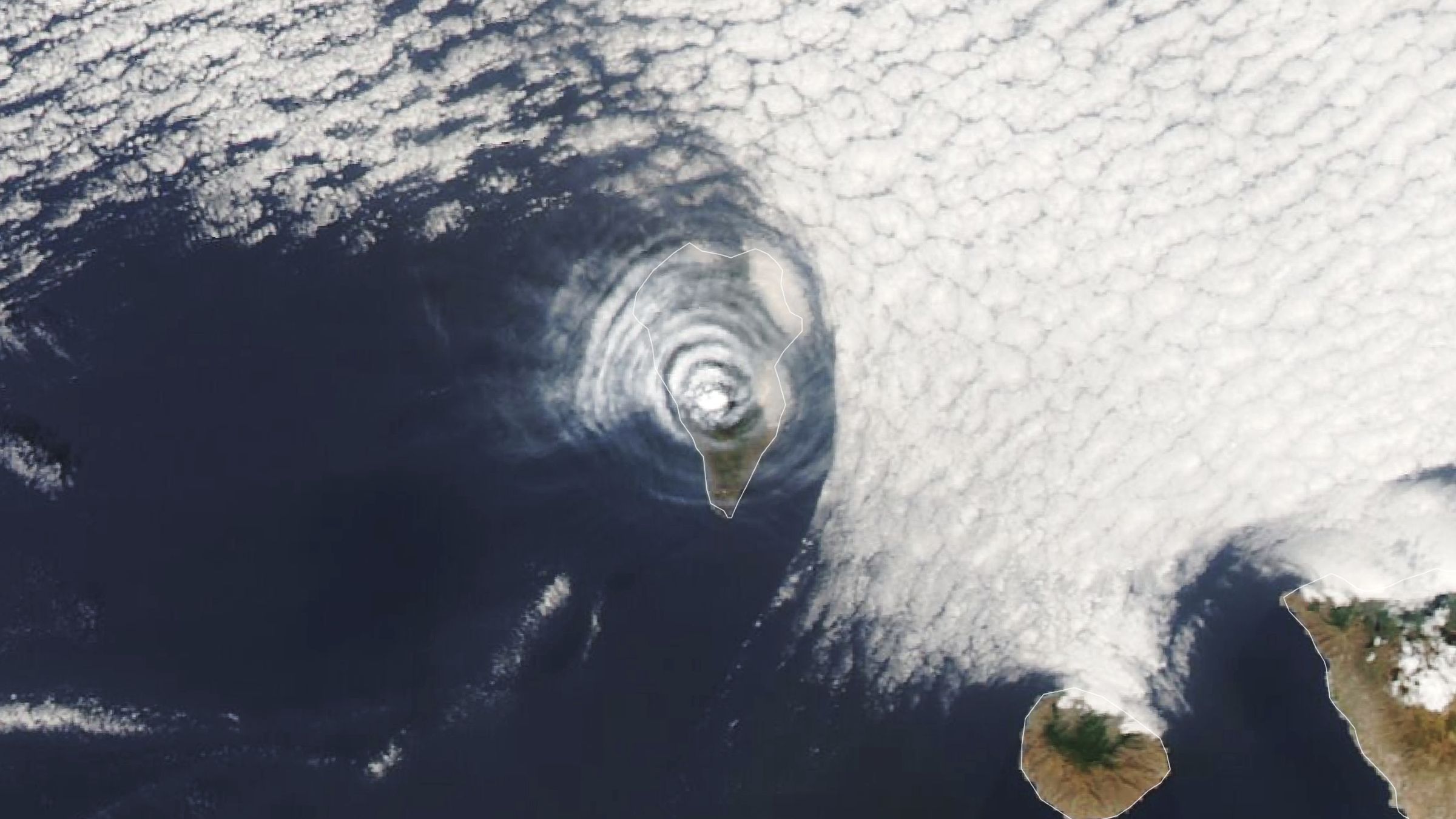
What’s in the photo? Concentric cloud rings over an erupting volcano
Which satellite took the photo? NASA’s Aqua satellite
When was it taken? Oct. 1, 2021
This eye-catching satellite snap shows off a “bull’s-eye-like” set of concentric cloud rings that formed above an erupting volcano on La Palma in Spain’s Canary Islands.
The eruption, the first on La Palma in 50 years, began Sept. 19, 2021, when a fissure opened up on the western flank of Cumbre Vieja — a volcanic ridge that runs through the southern half of the island — and spewed massive lava fountains into the air. The violent outburst created a 660-foot-tall (200 meters) vent, dubbed Tajogaite, which continued to slowly pump out lava until Dec. 13, 2021.
The molten rock flowed into the Atlantic Ocean in a giant “river of fire” that destroyed a town and unleashed deadly gases that are still causing issues for locals today, Live Science previously reported.
The concentric cloud rings in this image are made up of steam, smoke and ash — known as an eruption plume — that rose above Tajogaite for weeks.
Normally, such a plume would continue to climb into the cold air of the stratosphere — the second layer of the atmosphere, which extends from around 6 to 31 miles (10 to 50 kilometers) above Earth’s surface. However, when this image was captured, a rare “temperature inversion” created a layer of elevated warm air that acted as a lid, preventing the plume from rising and forcing it to spread outward, according to NASA’s Earth Observatory.

At the start of the eruption, giant fiery fountains shot out of the ground near the town of Todoque, which was destroyed by the resulting lava flows.
(Image credit: DESIREE MARTIN/AFP via Getty Images)
The trapped plume created concentric rings that formed from the natural ebb and flow in the intensity of volcanic activity. This pulse in the emissions given off by the volcano is visible in time-lapse footage captured by the Izaña Atmospheric Research Center on Tenerife, another Canary Island.
The official name for this type of concentric cloud formation is a “gravity wave,” according to the National Weather Service. However, the formation has nothing to do with gravity, and it’s completely separate from the ripples in space-time called gravitational waves.
Get the world’s most fascinating discoveries delivered straight to your inbox.
“River of fire”
During the 85-day eruption, around 7.1 billion cubic feet (200 million cubic meters) of lava — reaching temperatures of up to 2,000 degrees Fahrenheit (1,100 degrees Celsius) — seeped from the ground.
This molten rock traveled around 4 miles (6.4 kilometers), destroying around 3,000 buildings in the town of Todoque, before falling into the Atlantic Ocean in a fiery waterfall. The estimated damage exceeded 700 million euros ($780 million), according to the Spanish newspaper El País.

This photo, also captured Oct. 1 by the European Space Agency’s Copernicus satellite, shows the infrared heat radiating from the lava flow as it flows into the sea to create new land.
(Image credit: ESA/Copernicus)
Where lava fell into the sea, around 4.6 million square feet (430,000 square meters) of new land was created. The reaction between the molten rock and the water also released high levels of volcanic gases, such as sulfur dioxide and hydrogen cyanide.
At least one person, a 72-year-old man who returned to his home prematurely, is believed to have died from inhaling these toxic fumes, according to AFP. Thousands of wild and agricultural animals are also thought to have been killed by the gases.
The damage was “truly terrible,” Marie Edmonds, a volcanologist at the University of Cambridge, told Live Science at an event on La Palma in April 2025. “Most shocking to me is the closeness of the vent to the communities,” she added when describing what it was like to visit the area. “It must have been absolutely terrifying to see the eruption so close.”


A false-color satellite photo from 2023 shows a devilish pair of lava flows and an enormous plume of smoke spewing from Klyuchevskoy, the tallest volcano in Europe and Asia.

A 2014 astronaut photo shows a pair of volcanic lakes appearing to stare up into space from the Chiltepe Peninsula of Nicaragua’s Lake Managua. These “eyes” and “skull” were created by violent eruptions thousands of years ago.
