
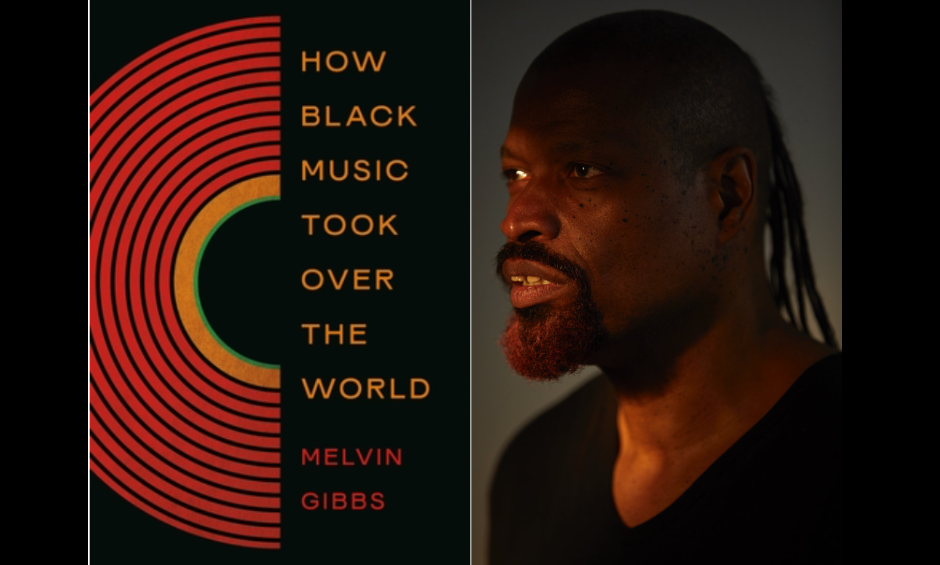
Melvin Gibbs really appreciates the airport.
Asked why he chose to make a second home in the Twin Cities nearly two years ago, after high-rise construction obstructed the view of the East River and the Manhattan skyline from his longtime, rent-controlled abode in Brooklyn, Gibbs stares into his decaf coffee and pauses a long beat before answering.
“I mean, if I am going to be honest, one of the most important attractions is the airport. It is often rated the top airport in America. It is small, easy to get to, very efficient. I’ve got to go all over the world and I can hop back on a plane and be off in a couple of hours. It is much more efficient than the New York airports.”
That seemingly mundane response becomes more trenchant in the context of Gibbs’ abundant artistry. He doesn’t want to be constrained, and ironically figures out disciplined, systemic patterns that further set him free to pursue his ambitious agenda.
The 67-year-old bassist, composer, producer, and now author has earned an intimate working knowledge of dozens of global musical styles and genres and is thus especially adept at developing creative hybrids that don’t siphon off the cultural and physical essence that made them foundational in the first place.
Melvin Gibbs has played tunefully throbbing bass to tens of thousands of moshing fans at outdoor festivals in the heyday of the punk-metal Rollins Band. He has collaborated with icons of Brazilian pop such as Caetano Veloso and Marisa Monte. He cut his teeth in the increasingly legendary downtown (New York) music scene of the early 1980s alongside the funky apostles of seminal “free jazz” composer and saxophonist Ornette Coleman and freewheeling spirits such as John Zorn and Arto Lindsay. He cofounded the influential Black Rock Coalition. And he hasn’t stopped, with credits near or above 200 records by now.
Numerous projects continue to move through the process of conception, development, performance and/or release. In the past six months he has put out another album from Amasia, a project that mashes together, jazz, experimental electronics, archival music and hip hop; a sixth record from the funk-jazz power trio Harriet Tubman; and, just this week, his first book, entitled “How Black Music Took Over The World.”
Gibbs has spent the past week in and around his native Brooklyn, reading and talking about the book for two events at the Arts Library, playing two gigs (one with pianist Vijay Iyer, the other an electronic-infused take on the Gullah Geechee music of his grandfather’s heritage in South Carolina) and watching an ensemble perform one of his new compositions.
Related: Read Britt Robson’s 2024 interview with Vijay Iyer
He’ll be back at his second home in time to do a book signing, reading and discussion of “How Black Music Took Over the World” at Magers & Quinn on Monday night, and then a talk at the University of Minnesota about the 80s downtown music scene and other items related to the book.
Before he left for New York, Gibbs and I had coffee at the Midtown Global Market and talked about the book and why, aside from the airport, he chose Minneapolis. I’d seen him on a semi-regular basis in the audience at the Walker, Icehouse and the Dakota, often in the company of the great local jazz vocalist and spoken word artist Mankwe Ndosi, and assumed he was passing through on business rather than staying put for a minute. He acknowledged the low profile, then said, “The whole ICE situation is what made me kind of come out of the closet a little more. To say ‘I am here and I am part of this thing too.’
“The food here is another attraction. That was something that took a lot of cities off my list, but it is a really good food scene here. And a lot of great musicians. [AACM member and jazz elder] Douglas Ewart is like my uncle now; it is like a chosen family here.”
Related: Read Britt Robson’s 2025 story about AACM
Melvin Gibbs on experience vs. music theory
“How Black Music Took Over the World,” has the same feel, style, piquant juxtapositions and culturally personal narrative as much of the music Melvin Gibbs conceives. “There are a lot of people who write about music theory,” he said in the coffee shop. “What makes my theory on music compelling is that it comes from my experience.”
The way he puts it in the prelude of the book, is, “I learned what I know about music the way I learned what I know about life: by making it.” Consequently, he adds, “This book encompasses the streets of Brooklyn and the South Bronx, Senegalese sabar drummers, Brazilian pop stars, NEA Jazz Masters, Charles Dickens, a Gullah-Geechee Ph.D., frogs in Mississippi, a punk rock icon, legendary graffiti artists, and a whole lot more.”
The book also speaks to readers on different levels. Gibbs said he was inspired by the videos put out by Wired Magazine that explain concepts at five levels: To a child, a teen, a college student, a graduate student, and finally an expert.
“It is written in a way where you could get the point if you didn’t know anything about what I’m doing; but also, if you’re an expert, you’ll learn something. That is the structural idea behind it,” he said.
Some segments, especially the diagrams he made to explain the differences in “Black” musics compared to traditionally Western musics, went over my head, and level of interest, but were easily glossed over for things better suited to my non-expert level.
For example, the first extended narrative plunges the reader alongside Gibbs in a marathon march of more than 100 drummers through the streets of Salvador da Bahia at the height of Carnaval in Brazil. He describes seven hours of nonstop polyrhythms, climaxed by a nationally televised meeting of drummers with singers and dancers in the predawn part of the morning. It feels intensely spiritual and yet the opposite of an out-of-body experience. Gibbs wonders out loud: “Is the dance the result of the music or is the music the result of the dance?”
These lived-experience narratives ingeniously serve as entrees to the book’s central thesis: Most of the creative music we enjoy today stems from people caught in the various diaspora of the slave trade learning to make the music endemic to their cultural tradition without access to many of the implements and freedoms they originally possessed. These adjustments were made, and passed down, by people who weren’t guided by Western musical structures, hierarchies, and tunings – it is a different mindset.
My favorite chapter in the book begins with Gibbs correctly guessing that the sheathed instrument being carried by a dignified gentleman at a Manhattan subway stop was a kora – a 21-stringed African harp. The man’s name was Papa Suso, from the Suso family of jelis in The Gambia. A jeli is more commonly known as a griot in this county and much of Africa, and Gibbs defines what that is better than anyone I’ve heard or read:
Griots are people whose job is to carry the history of their peoples in their heads and keep that history alive using their voices and musical instruments. They use their life force to reanimate the stories and achievements of past generations, for the purpose of making them resonate in their communities in the present. They spend years learning the history…and the songs used to transmit that history. Once they’ve achieved a certain level of mastery and respect, they spend time chronicling the stories and achievements of the communities that support them, and make music that adds the history of those communities to the corpus.
Gibbs was excited to perform with Suso, set up rehearsals and a concert to showcase him. They worked out about five songs for a set of music. But when the concert started, what was supposed to be a seven-minute song became three times that length. The griot needed to tell a relatively whole story in front of this audience. It is one of the many cultural lessons recounted by Gibbs in his narratives.
But the kicker is later in the chapter, when Gibbs shifts into a history of American blues music; all the ways it evolved, but kept constant in the ways it rigorously described everyday life in the cotton fields, plantations, but then later on, too, in the cities of Chicago and St. Louis, with each having their own tributary of the music to describe what was going on.
Without coming right out and saying it, Gibbs shows that American blues musicians were (and still are in some places) griots in the grand tradition keeping the narrative and culture through song.
My favorite anecdote in the book is when Gibbs is invited to play in a Senegalese sabar band. A sabar is a traditional drum made of wood, covered in goatskin, cradled under one arm while the other hand hits it with a stick. For two rehearsals, Gibbs was embarrassed by his inability to parse the specific beats in the rhythm. It seemed impossibly elusive.
Then he happened to watch a group of women dancing to sabar music. Suddenly, “I could see, and properly feel, where the beat actually was…that the point of the cadences was to set up a situation that would get women’s bodies, and especially their backsides, moving.”
Is the dance the result of the music or the music the result of the dance?
Melvin Gibbs book talk:
Melvin Gibbs will talk about his book, “How Black Music Took Over the World,” with Philip Bither.
7 p.m. Monday at Magers & Quinn
