Close Menu
  • Home
  • UNSUBSCRIBE
  • News
  • Lifestyle
  • Tech
  • Entertainment
  • Sports
  • Travel
Facebook X (Twitter) WhatsApp
Trending
  • Amazon Wish List changes its shipping policy — and some are worried
  • Jack Draper’s ATP Tour comeback from injury ended by Arthur Rinderknech at Dubai Tennis Championships after gruelling encounter | Tennis News
  • Alex Honnold on Pooping During Climbs, Free Solos
  • How many immigration agents remain in Minnesota?
  • Babies weren’t supposed to be mourned in the Roman Empire. These rare liquid-gypsum burials prove otherwise.
  • Anthropic’s AI safety policy just changed for this reason
  • Netball Super League: England’s Jess Shaw targeting NSL final after return to Loughborough Lightning for 2026 season | Netball News
  • Harry Styles on Hair Transplant Rumors
Facebook X (Twitter) WhatsApp
Baynard Media
  • Home
  • UNSUBSCRIBE
  • News
  • Lifestyle
  • Tech
  • Entertainment
  • Sports
  • Travel
Baynard Media
Home»Lifestyle»Babies weren’t supposed to be mourned in the Roman Empire. These rare liquid-gypsum burials prove otherwise.
Lifestyle

Babies weren’t supposed to be mourned in the Roman Empire. These rare liquid-gypsum burials prove otherwise.

EditorBy EditorFebruary 25, 2026No Comments5 Mins Read
Share Facebook Twitter Pinterest LinkedIn Tumblr Reddit Telegram Email
Share
Facebook Twitter LinkedIn Pinterest Email

The mysterious Roman-era burial rite of pouring liquid gypsum over the dead wasn’t limited to elite adults as previously thought; it was also performed on children, including babies as young as 1 month old, researchers have found.

The finding contradicts Roman-era legal sources who wrote that infants under 12 months old were not supposed to be mourned at all, according to two blog posts published by the Seeing the Dead project, a collaboration between the University of York and the York Museums Trust. Their team is investigating the discovery of children among the rare “gypsum burials” found in York, in northern England.

Liquid-gypsum burials have long confounded researchers. The enigmatic practice involved placing the deceased in a stone or lead sarcophagus and then pouring liquid gypsum over them. The plaster-of-paris-like substance hardened over their bodies, preserving traces of high-status clothing. But new research found that even the youngest members of ancient society were mourned.


You may like

“Infants were the most vulnerable members of Roman society,” Maureen Carroll, a Roman archaeologist at the University of York, wrote in a Feb. 18 blog post, particularly given the high infant mortality rate of around 30%. But even though historical records say babies younger than 1 year old were not to be mourned because infant deaths were commonplace, Carroll has found that these restrictions applied only to public mourning.

“They had no bearing on sentiments such as grief or the sense of loss felt and expressed by the surviving family in private,” she wrote.

Among the more than 70 gypsum burials Carroll has studied, at least seven belonged to children, including three infants under 4 months old. The practice of liquid-gypsum burial seems to have been reserved for the Roman elite in York, and it was usually employed on adults. Infants were more often buried in large jars called amphorae; ceramic tile boxes; or small, wooden coffins.

fragment of a plaster cast revealing pinkish sheen left by an ancient purple fabric

The gypsum casing of an infant burial in York, showing pinkish-purple dye and gold threads. (Image credit: Seeing the Dead Project/University of York and York Museums Trust)

One remarkable infant burial was found in 1892 during the construction of the York Railway. The newborn, just 1 or 2 months old, was covered with a cloak of purple-dyed wool decorated with gold thread and tassels, before being placed in a lead sarcophagus and covered in liquid gypsum.

Get the world’s most fascinating discoveries delivered straight to your inbox.

Although nothing remains of the infant’s bones today, impressions of the brilliant purple-and-gold cloak can still be seen. This is the only gypsum burial with dyed fabric ever found, Sarah Hitchens, an archaeological textile expert at the University of York, wrote in a Feb. 23 blog post.

“It is likely that the purple textile was made from an animal fibre such as wool,” Hitchens wrote, and the cloak was likely draped over the infant’s body as a burial shroud.

fragment of ancient plaster with purplish dye spotted on it

Remnants of a textile and purple dye can be seen on the gypsum casing. (Image credit: Seeing the Dead Project/University of York and York Museums Trust)

Chemists on the project team are now analyzing the hardened gypsum covering to glean more information about Romano-British burial practices.


You may like

“We are testing the gypsum casing for evidence of aromatic substances, such as frankincense or mastic,” dried tree sap and resin, respectively, Carroll told Live Science in an email. They also plan to test the purple dye to determine whether it came from murex, a type of snail from which the ancient Romans extracted a natural reddish-purple dye. The gold threads will be analyzed as well, Carroll said.

Other liquid-gypsum burials found in York include a child of about 4 months old discovered wrapped between the legs of two adults. It’s unclear if these three people constituted a family, “but it is evident that they were closely associated in life and in death,” Carroll wrote.

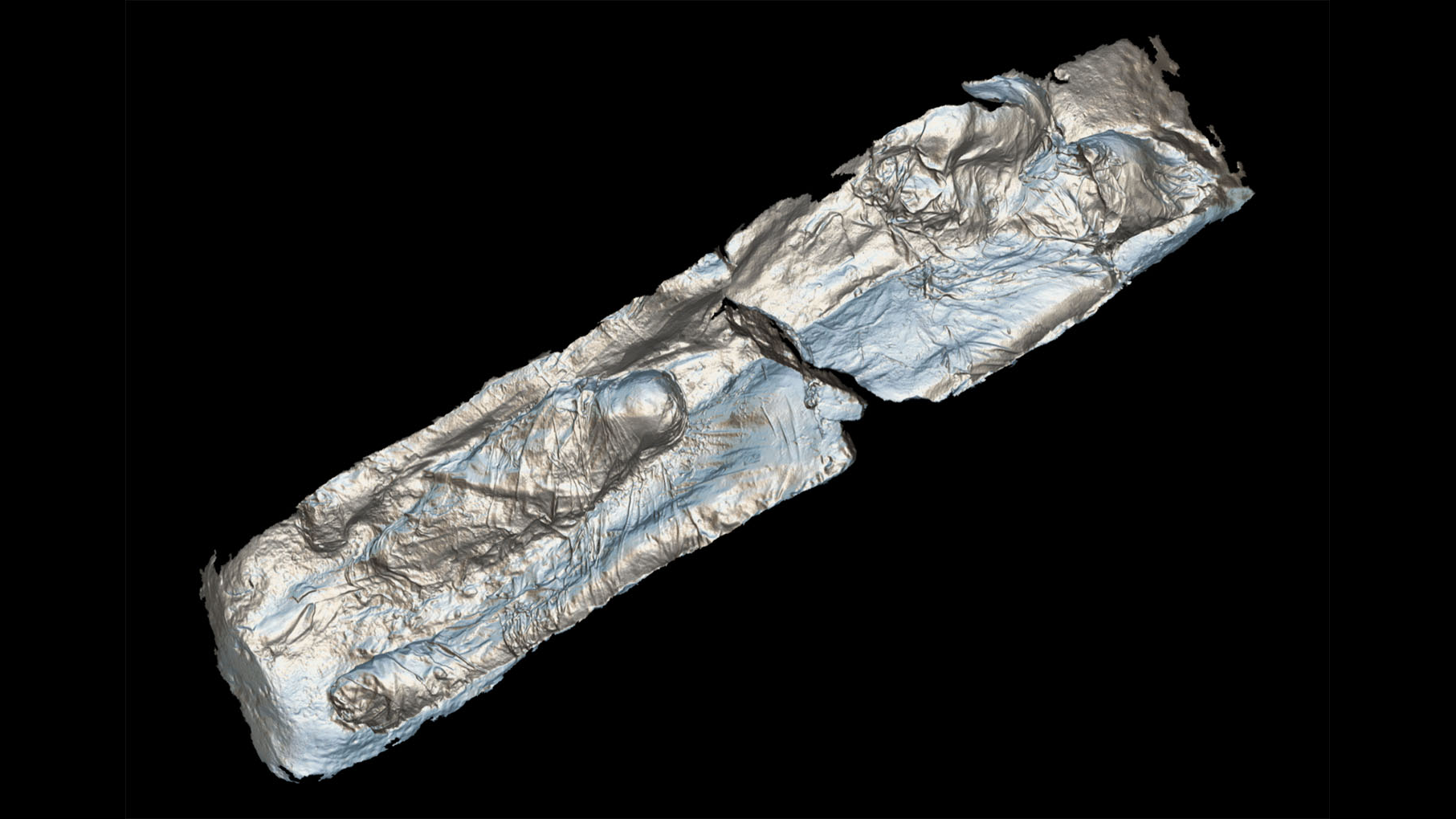
In another case, a girl who was between 7 and 9 years old when she died was buried with an array of gold, silver, copper, jet, glass and coral jewelry. Two pairs of boots and a pair of sandals were discovered near her feet, and the bones of what was likely a pet chicken were found in her coffin as well.

“The 3D scan of her body visible under a shroud or sheet reveals how frail and thin she was, perhaps pointing to a protracted illness before her death,” Carroll wrote.

These lavish burials of infants and children discovered in York show that Roman legal texts, which were written primarily by older men, did not reflect the reality of life and death in Roman Britain.

“It all certainly suggests that children this young were valued and cared for, unlike the age-old notion that Romans did not care when their infants died because infant mortality was high,” Carroll said. “Utter nonsense!”


Roman Britain quiz: What do you know about the Empire’s conquest of the British Isles?

Source link

Share. Facebook Twitter Pinterest LinkedIn Tumblr Email
Previous ArticleAnthropic’s AI safety policy just changed for this reason
Next Article How many immigration agents remain in Minnesota?
Editor
  • Website

Related Posts

Lifestyle

Chinese astronauts describe moment a crack was discovered on Shenzhou-20 spacecraft

February 25, 2026
Lifestyle

We now know why shoes squeak, and it involves miniature lightning bolts

February 25, 2026
Lifestyle

COVID-19 vaccination during pregnancy may cut risk of preeclampsia

February 25, 2026
Add A Comment

Comments are closed.

Categories
  • Entertainment
  • Lifestyle
  • News
  • Sports
  • Tech
  • Travel
Recent Posts
  • Amazon Wish List changes its shipping policy — and some are worried
  • Jack Draper’s ATP Tour comeback from injury ended by Arthur Rinderknech at Dubai Tennis Championships after gruelling encounter | Tennis News
  • Alex Honnold on Pooping During Climbs, Free Solos
  • How many immigration agents remain in Minnesota?
  • Babies weren’t supposed to be mourned in the Roman Empire. These rare liquid-gypsum burials prove otherwise.
calendar
February 2026
M T W T F S S
 1
2345678
9101112131415
16171819202122
232425262728  
« Jan    
Recent Posts
  • Amazon Wish List changes its shipping policy — and some are worried
  • Jack Draper’s ATP Tour comeback from injury ended by Arthur Rinderknech at Dubai Tennis Championships after gruelling encounter | Tennis News
  • Alex Honnold on Pooping During Climbs, Free Solos
About

Welcome to Baynard Media, your trusted source for a diverse range of news and insights. We are committed to delivering timely, reliable, and thought-provoking content that keeps you informed
and inspired

Categories
  • Entertainment
  • Lifestyle
  • News
  • Sports
  • Tech
  • Travel
Facebook X (Twitter) Pinterest WhatsApp
  • Contact Us
  • About Us
  • Privacy Policy
  • Disclaimer
  • UNSUBSCRIBE
© 2026 copyrights reserved

Type above and press Enter to search. Press Esc to cancel.