
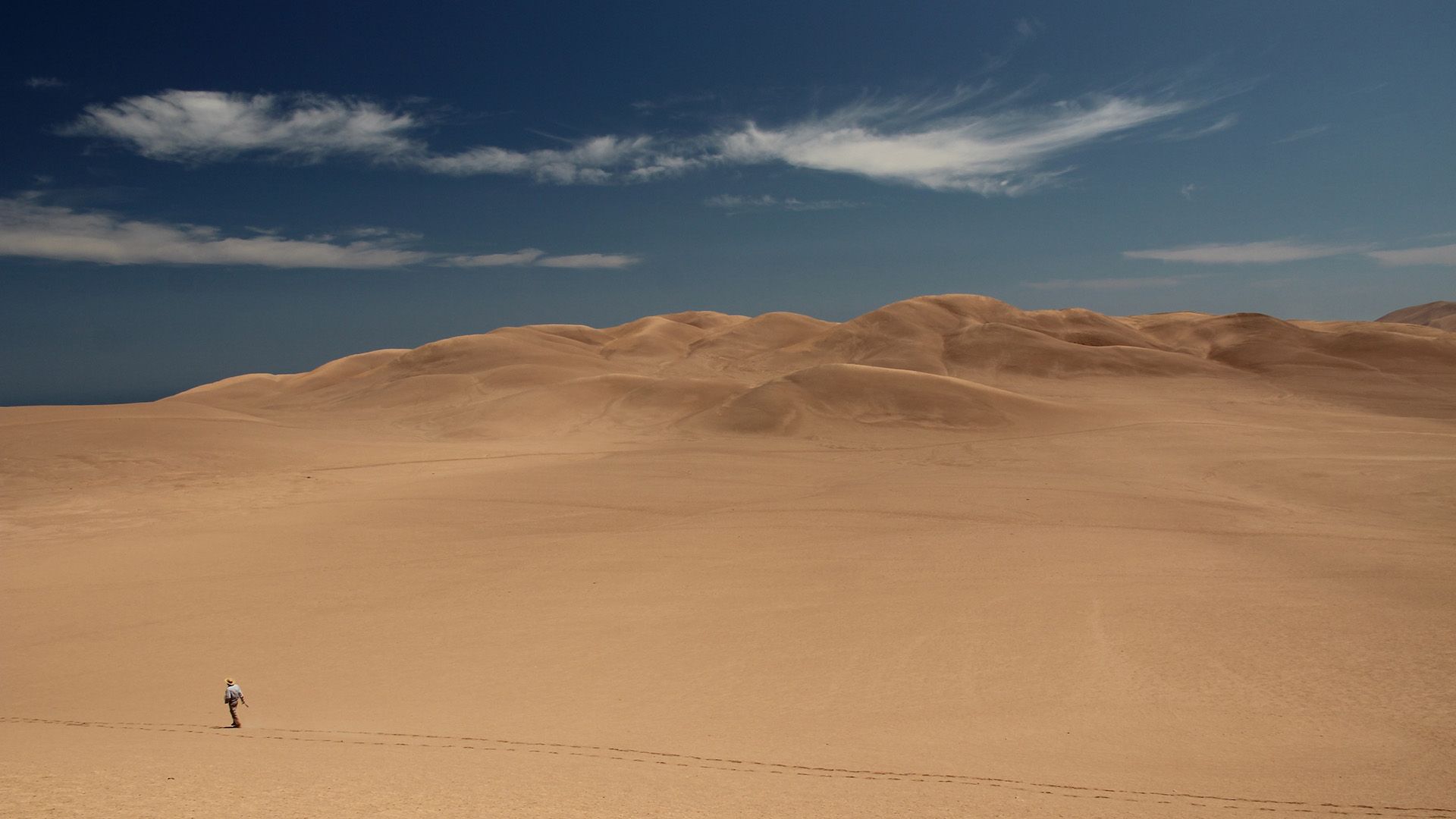
The Atacama Desert started forming about 20 million years earlier than scientists previously thought, long before the nearby Andes Mountains took shape, new research reveals.
Previously, the desert’s hyperarid core was thought to have developed between 15 million and 20 million years ago, around the time the Andes were forming and cold ocean currents were establishing off the Chilean coast. But the new study suggests those ultradry conditions were present more than 40 million years ago, indicating that one of the world’s oldest deserts is even more ancient than we thought.
“Our results indicate that the hyperarid core of the Atacama Desert was established in the Mid- to Late-Eocene [47.8 million to 33.9 million years ago], indicated by extremely low surface activity,” study co-author Benedikt Ritter-Prinz, a geologist at the University of Cologne in Germany, said in a statement. “This makes it the longest continuously dry region on Earth and forces us to reconsider how and when such extreme environments develop.”
The findings, published May 20 in the journal Nature Communications, could help scientists understand the global factors that contribute to desert formation and the evolution of life in dry regions.
Dating the Atacama’s arid core
Covering up to 50,000 square miles (130,000 square kilometers) in northern Chile, the Atacama Desert is one of the driest regions in the world. The Andes to the east block precipitation from the Atlantic, and a cliff to the west blocks moisture from fog from the Pacific. The central, hyperarid region of the desert typically receives less than 0.2 inches (5 millimeters) of rainfall per year.
This lack of rainfall limits erosion and allows fluffy, flour-like gypsum soil to build up over time, according to the study. Once the soil reaches a critical thickness, it absorbs rain while leaving the desert surface virtually unchanged over long periods.

The researchers collected quartz pebbles, which resist weathering and wind erosion, from different locations in the Atacama Desert.
(Image credit: B. Ritter-Prinz)
In the new study, Ritter-Prinz and his colleagues measured how long the surface of the desert’s center had remained unchanged — a clue to when the hyperarid conditions set in.
Get the world’s most fascinating discoveries delivered straight to your inbox.
The team collected quartz pebbles, which resist weathering and wind erosion, from different locations. That required an off-road venture deep into the desert.
“If you drive there, you can sink in up to 2 meters [6.5 feet] of this gypsum dust,” Ritter-Prinz told Live Science. “So getting the samples is quite difficult.”

The new research suggests the Atacama Desert’s core formed more than 40 million years ago, before the Andes Mountains took shape.
(Image credit: B. Ritter-Prinz)
Then, they measured the amount of rare isotopes, or versions, of the elements neon and beryllium in those samples. Called cosmogenic nuclides, those isotopes form when cosmic rays from outer space collide with objects on the planet’s surface.
About 24% of the samples contained higher-than-expected levels of cosmogenic nuclides, suggesting they had remained on Earth’s surface for longer than previously thought. While previous research estimated that the hyperarid core started drying out during the Early to Mid-Miocene epoch, about 20 million to 15 million years ago, the new findings suggest dry conditions may have been in place since at least the Late Eocene, about 40 million years ago.
“The idea just to have pebbles there, which are exposed for up to 45 million years … it’s quite amazing,” Ritter-Prinz told Live Science.
Instead of forming when the Andes rose and began blocking moisture from the ocean, the desert’s core may have started to form when temperatures cooled following the Early Eocene Climate Optimum (54 million to 49 million years ago), a period characterized by extremely high atmospheric carbon dioxide and global temperatures 18 to 29 degrees Fahrenheit (10 to 16 degrees Celsius) above preindustrial levels. This suggests the formation of the Andes merely intensified the drying in the desert, rather than initiating it. Future work using climate models could help discern exactly how that happened, Ritter-Prinz said.
Learning how and when the desert formed could also help to explain the history of plant and animal life in the region.
“With this data, we can better understand how life adapts to specific events,” and why certain species diverge, Ritter-Prinz said. For example, a shift to hyperarid conditions could cause certain migration pathways to close, eventually forming new species in isolated groups, he added.
Ritter-Prinz, B., Binnie, S. A., Stuart, F. M., Fabel, D., Albert, R., Wennrich, V., & Dunai, T. J. (2026). Evidence for Eocene aridification of the Atacama Desert’s hyperarid core. Nature Communications, 17(1). https://doi.org/10.1038/s41467-026-73422-4
