Close Menu
  • Home
  • UNSUBSCRIBE
  • News
  • Lifestyle
  • Tech
  • Entertainment
  • Sports
  • Travel
Facebook X (Twitter) WhatsApp
Trending
  • Do you really have to wash rice before you cook it?
  • Neuroscientists are searching for the ‘cellular substrate of loneliness’
  • Bow-Wow, Ding-Dong, Pooh-Pooh: Expert explains early theories of how human language evolved — and their silly names
  • Famous child mummies in Andes may belong to kids who were sacrificed to ‘ritually anchor’ the Inca’s presence as their empire expanded
  • Artemis II crew captures rare double auroras on the dark side of Earth as they zoom toward the moon — Space photo of the week
  • Has all the water on Earth been peed before?
  • ‘This might be the point of no return’: Experts on the current measles outbreak and where we go from here
  • NASA’s experimental X-59 jet breaks sound barrier for 1st time in step toward ‘quiet supersonic’ technology
Facebook X (Twitter) WhatsApp
Baynard Media
  • Home
  • UNSUBSCRIBE
  • News
  • Lifestyle
  • Tech
  • Entertainment
  • Sports
  • Travel
Baynard Media
Home»Lifestyle»Astronomers spy puzzlingly ‘perfect’ cosmic orb with unknown size and location
Lifestyle

Astronomers spy puzzlingly ‘perfect’ cosmic orb with unknown size and location

EditorBy EditorMay 21, 2025No Comments4 Mins Read
Share Facebook Twitter Pinterest LinkedIn Tumblr Reddit Telegram Email
Share
Facebook Twitter LinkedIn Pinterest Email

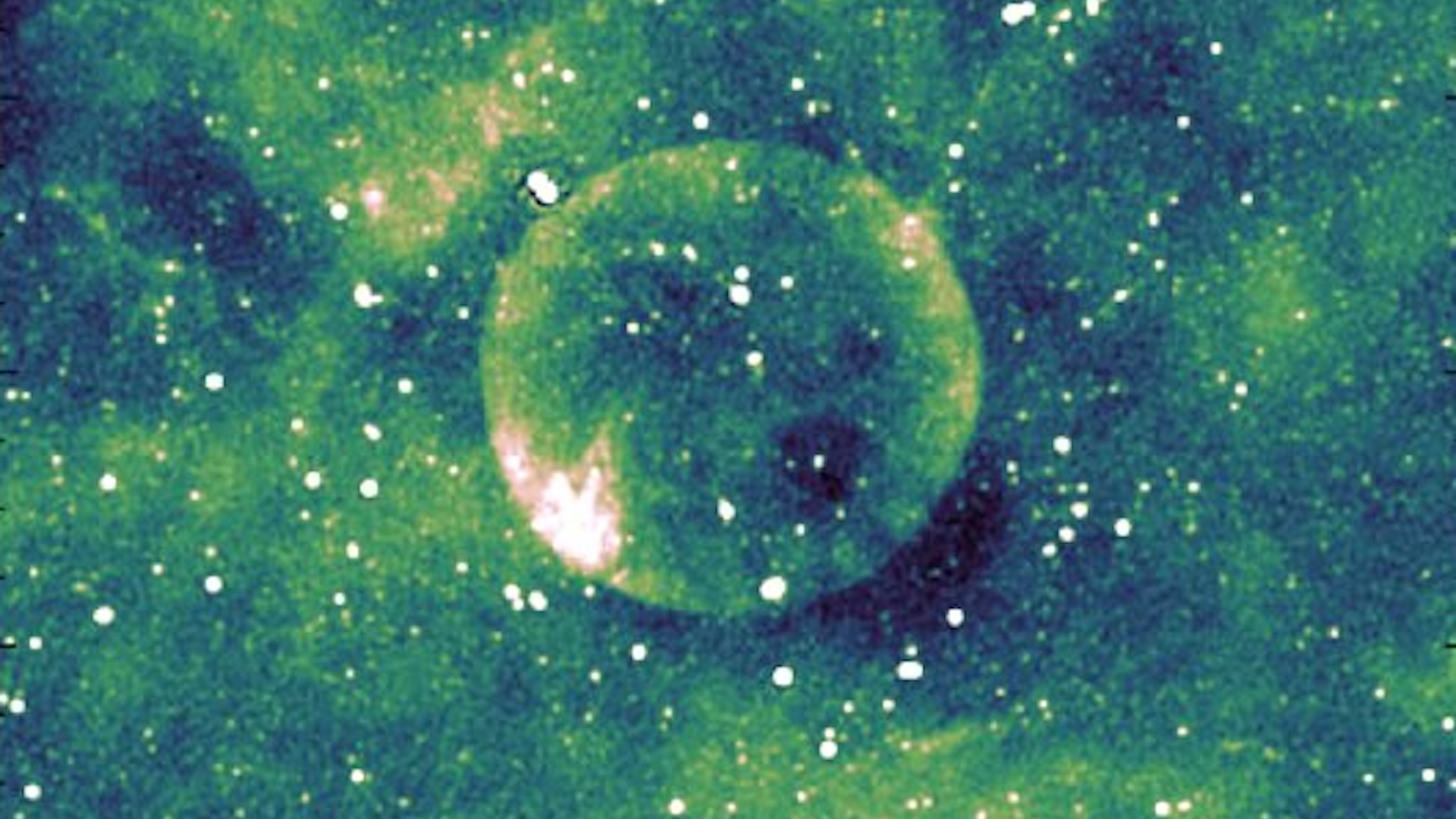
Astronomers have discovered the eerie remains of a supernova with an almost perfect spherical shape glowing faintly on the outskirts of the Milky Way. However, they are unsure exactly how large and how far away the ghostly orb is — or how it got its unusually symmetrical shape.

The scientists named the object G305.4–2.2, or Telios — Greek for “perfect.” Telios was spotted in radio images captured by the Australian Square Kilometre Array Pathfinder (ASKAP) telescope in Western Australia for the Evolutionary Map of the Universe project. It is a supernova remnant (SNR) — an expanding cloud of gas and radiation left over from an exploded star.

Most SNRs are at least vaguely spherical due to how supernovas explode outward in all directions, although some have more unorthodox shapes, as they dissipate over time or get bent out of shape by other explosions or stellar winds. However, it is rare to find remnants that appear to have almost no imperfections.


You may like

The researchers described the SNR in a new study, uploaded May 7 to the pre-print server arXiv and accepted for future publication in the journal Publications of the Astronomical Society of Australia.

“This object [Telios] displays a remarkable circular symmetry in shape, making it one of the most circular galactic SNRs known,” the researchers wrote in the paper.

Related: Rare quadruple supernova on our ‘cosmic doorstep’ will shine brighter than the moon when it blows up in 23 billion years

Telios is also unusual for its extremely low brightness compared with most other SNRs, which suggests that it is either really young or really old. Based on its perfect shape, it is most likely to be the former because most SNRs lose their shape as they age, the researchers wrote.

Get the world’s most fascinating discoveries delivered straight to your inbox.

The low brightness makes it hard to determine Telios’ distance from Earth, which also raises uncertainty about its size. The researchers believe it could be anywhere from 7,170 to 25,100 light-years from our planet, meaning it could span anywhere from 45.6 to 156.5 light-years across — dozens of times larger than our solar system.

The object is located below the galactic plane — the disk of matter swirling around the Milky Way’s supermassive black hole, where most objects in the galaxy, including the solar system, are situated. Its unusual location adds to the uncertainty about its distance and size. But despite being outside the galactic plane, Telios is still part of the Milky Way.

a series of graphs and figures about the supernova remnant

Images from the new study showing roughly where Telios was located (Image credit: Filipović et al., arXiv, 2025)

A perfect sphere

Orb-like SNRs are very rare. However, a handful have been discovered before in dwarf galaxies that orbit the Milky Way. These include SN1987A and MC SNR J0509–673, located in the Small Magellanic Cloud (SMC); and SNR J0624–6948, which was discovered in the Large Magellanic Cloud (LMC) earlier this year.

There are two ways in which these perfect SNRs form: via a core-collapse supernova, where massive red giant stars implode, generating a shockwave that in turn pushes its matter outward; or via a Type Ia supernova, where smaller stars explode in much more violent explosions, which astronomers use to study some of cosmology’s biggest mysteries.

The researchers believe that a Type Ia supernova was the more likely origin for Telios because red giants are much less common outside the galactic plane. However, it is hard to tell for sure because they cannot identify the remnant’s progenitor — the shriveled husk of the exploded star that usually lurks at the heart of SNRs.

“While we deem the Type Ia scenario the most likely, we note that no direct evidence is available to definitively confirm any scenario and new sensitive and high-resolution observations of this object are needed,” the researchers wrote.

Source link

Share. Facebook Twitter Pinterest LinkedIn Tumblr Email
Previous ArticleOur teeth evolved from fish ‘body armor’ over 460 million years, scientists discover
Next Article ‘It was probably some kind of an ambush’: 17,000 years ago, a man died in a projectile weapon attack in what is now Italy
Editor
  • Website

Related Posts

Lifestyle

Do you really have to wash rice before you cook it?

June 15, 2026
Lifestyle

Neuroscientists are searching for the ‘cellular substrate of loneliness’

June 14, 2026
Lifestyle

Bow-Wow, Ding-Dong, Pooh-Pooh: Expert explains early theories of how human language evolved — and their silly names

June 14, 2026
Add A Comment

Comments are closed.

Categories
  • Entertainment
  • Lifestyle
  • News
  • Sports
  • Tech
  • Travel
Recent Posts
  • Do you really have to wash rice before you cook it?
  • Neuroscientists are searching for the ‘cellular substrate of loneliness’
  • Bow-Wow, Ding-Dong, Pooh-Pooh: Expert explains early theories of how human language evolved — and their silly names
  • Famous child mummies in Andes may belong to kids who were sacrificed to ‘ritually anchor’ the Inca’s presence as their empire expanded
  • Artemis II crew captures rare double auroras on the dark side of Earth as they zoom toward the moon — Space photo of the week
calendar
June 2026
M T W T F S S
1234567
891011121314
15161718192021
22232425262728
2930  
« May    
Recent Posts
  • Do you really have to wash rice before you cook it?
  • Neuroscientists are searching for the ‘cellular substrate of loneliness’
  • Bow-Wow, Ding-Dong, Pooh-Pooh: Expert explains early theories of how human language evolved — and their silly names
About

Welcome to Baynard Media, your trusted source for a diverse range of news and insights. We are committed to delivering timely, reliable, and thought-provoking content that keeps you informed
and inspired

Categories
  • Entertainment
  • Lifestyle
  • News
  • Sports
  • Tech
  • Travel
Facebook X (Twitter) Pinterest WhatsApp
  • Contact Us
  • About Us
  • Privacy Policy
  • Disclaimer
  • UNSUBSCRIBE
© 2026 copyrights reserved

Type above and press Enter to search. Press Esc to cancel.