Close Menu
  • Home
  • UNSUBSCRIBE
  • News
  • Lifestyle
  • Tech
  • Entertainment
  • Sports
  • Travel
Facebook X (Twitter) WhatsApp
Trending
  • So CLOSE! Littler just misses out on nine-darter in Cardiff!
  • Jack Osbourne on Ozzy Osbourne Final Hours, Surprise Death
  • Trump criticizes MLB during Inter Miami White House celebration
  • Amazon outage: Here’s what we know so far
  • Mixed day for McIlroy as Berger leads at Bay Hill
  • Gypsy Rose Blanchard Weight Loss, Body Transformation
  • Strikes and explosions across the Middle East
  • James Webb Telescope updates odds that ‘city killer’ asteroid 2024 YR4 will hit the moon
Facebook X (Twitter) WhatsApp
Baynard Media
  • Home
  • UNSUBSCRIBE
  • News
  • Lifestyle
  • Tech
  • Entertainment
  • Sports
  • Travel
Baynard Media
Home»Lifestyle»Astronomers spot bizarre icy balls in space that are unlike anything seen before
Lifestyle

Astronomers spot bizarre icy balls in space that are unlike anything seen before

EditorBy EditorJanuary 24, 2025No Comments2 Mins Read
Share Facebook Twitter Pinterest LinkedIn Tumblr Reddit Telegram Email
Share
Facebook Twitter LinkedIn Pinterest Email

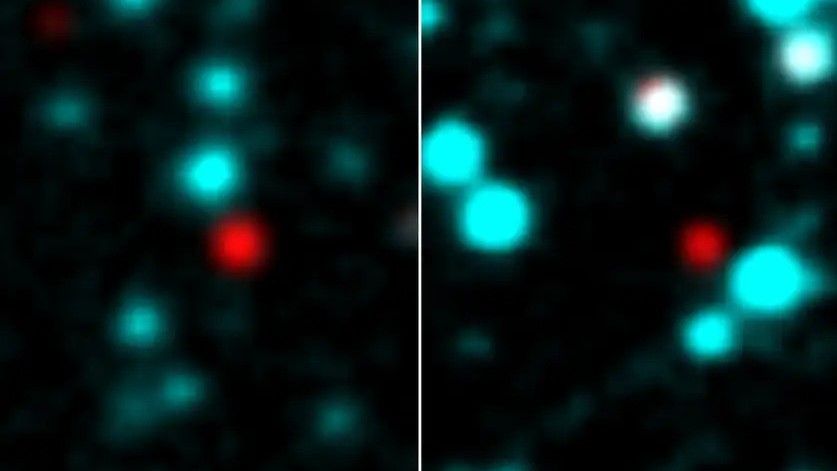
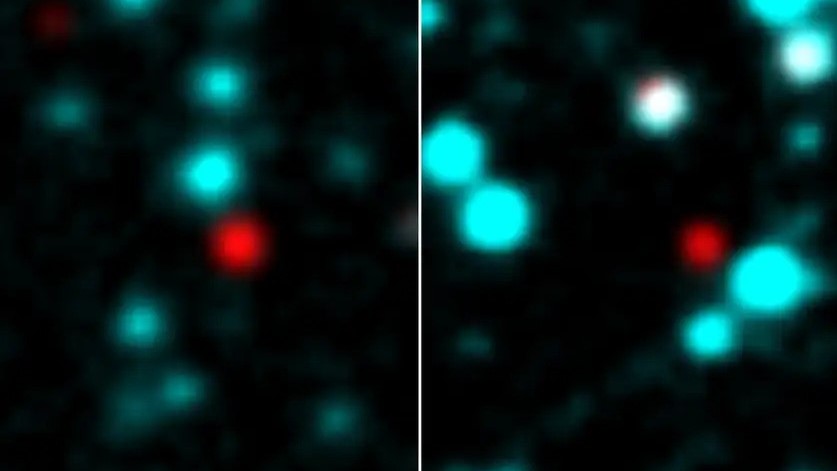
Astronomers have spotted a mysterious pair of icy balls in a remote region of the Milky Way, and they’re unlike anything they’ve ever seen before.

The peculiar objects appear in the same region of the sky but are 13,000 light-years apart and unrelated to each other. They were first spotted in 2021 lurking in data taken between 2006 and 2011 by Japan’s AKARI space telescope.

Now, new observations made using the Atacama Large Millimeter/submillimeter Array (ALMA) in Chile have deepened the mystery surrounding the turquoise objects.

They could be dense gas clouds or a never-before-seen type of star, but their unusual icy appearance and distance from regions where stars usually form mean they can’t yet be explained using known physics. The researchers published their findings Jan 9. on the preprint server arXiv, so the results have not yet been peer-reviewed.

Related: Bizarre new cosmic object is the most magnetic star in the universe

“Previous infrared observations have reported that both objects show deep ice and dust absorption features that are often seen in embedded young stellar objects (YSOs) or background stars sitting behind dense clouds, however, they are located neither in known star-forming regions nor in known dense clouds,” the researchers wrote in the study. “They may represent a previously unknown type of isolated icy objects.”

Stars take tens of millions of years to form, growing from dense, billowing clouds of turbulent dust and gas to gently glowing protostars, before materializing into gigantic orbs of fusion-powered plasma like our sun.

Get the world’s most fascinating discoveries delivered straight to your inbox.

Yet these strange blue balls are isolated from these star-forming regions. Sitting at respective distances of 30,332 light-years and 43,704 light-years from our sun, they each measure up to 10 times the size of our solar system.

This may seem large, but it’s tiny compared to the scales of other gas clouds, which can stretch up to many times the size of the entire Milky Way. Infrared readings show that the gas surrounding the objects is mainly silicon dioxide and some carbon monoxide — a ratio typically seen surrounding young stars. But given their small size and icy nature, it’s unlikely the mystery objects are stars.

To investigate the enigma further, the researchers have applied to use the James Webb Space Telescope’s sensitive infrared eye to take an even more detailed look at the orbs.

Source link

Share. Facebook Twitter Pinterest LinkedIn Tumblr Email
Previous ArticleKanye West Reveals $2 Billion Net Worth
Next Article Best Microsoft Surface deal: Save $200 on a Microsoft Surface Pro 11 Copilot+ PC
Editor
  • Website

Related Posts

Lifestyle

James Webb Telescope updates odds that ‘city killer’ asteroid 2024 YR4 will hit the moon

March 6, 2026
Lifestyle

Groundbreaking new drug shows promise for treating children with a devastating form of epilepsy

March 5, 2026
Lifestyle

Microscopic swimming robots navigate ‘artificial space-time’ mazes using Einstein’s relativity

March 5, 2026
Add A Comment

Comments are closed.

Categories
  • Entertainment
  • Lifestyle
  • News
  • Sports
  • Tech
  • Travel
Recent Posts
  • So CLOSE! Littler just misses out on nine-darter in Cardiff!
  • Jack Osbourne on Ozzy Osbourne Final Hours, Surprise Death
  • Trump criticizes MLB during Inter Miami White House celebration
  • Amazon outage: Here’s what we know so far
  • Mixed day for McIlroy as Berger leads at Bay Hill
calendar
March 2026
M T W T F S S
 1
2345678
9101112131415
16171819202122
23242526272829
3031  
« Feb    
Recent Posts
  • So CLOSE! Littler just misses out on nine-darter in Cardiff!
  • Jack Osbourne on Ozzy Osbourne Final Hours, Surprise Death
  • Trump criticizes MLB during Inter Miami White House celebration
About

Welcome to Baynard Media, your trusted source for a diverse range of news and insights. We are committed to delivering timely, reliable, and thought-provoking content that keeps you informed
and inspired

Categories
  • Entertainment
  • Lifestyle
  • News
  • Sports
  • Tech
  • Travel
Facebook X (Twitter) Pinterest WhatsApp
  • Contact Us
  • About Us
  • Privacy Policy
  • Disclaimer
  • UNSUBSCRIBE
© 2026 copyrights reserved

Type above and press Enter to search. Press Esc to cancel.