Close Menu
  • Home
  • UNSUBSCRIBE
  • News
  • Lifestyle
  • Tech
  • Entertainment
  • Sports
  • Travel
Facebook X (Twitter) WhatsApp
Trending
  • Strange mammal ancestor laid huge, leathery eggs —‬ and it was key to surviving the world’s worst mass extinction
  • Ancient process that created rare earth elements discovered — and it could help us locate desperately needed deposits
  • This humanoid robot does all your housework for you ‪—‬ and its makers say it’s ready for your home
  • ‘Nations need to prepare now’: Key Atlantic ocean current is much closer to collapse than scientists thought
  • Neanderthal toddlers grew faster than modern humans, probably because of the harsh environment they evolved in
  • NASA shuts off another Voyager 1 instrument as humanity’s most distant spacecraft prepares for risky ‘Big Bang’ maneuver to save power
  • Florida is facing its most intense drought in 15 years. Here’s how it got so bad and how long it will last.
  • New blood test aims to spot liver scarring when it’s still reversible and before it paves the way to cancer
Facebook X (Twitter) WhatsApp
Baynard Media
  • Home
  • UNSUBSCRIBE
  • News
  • Lifestyle
  • Tech
  • Entertainment
  • Sports
  • Travel
Baynard Media
Home»Lifestyle»Astronomers spot 1 of the most powerful ‘sonic booms’ in the universe as massive galaxy crashes into its neighbors
Lifestyle

Astronomers spot 1 of the most powerful ‘sonic booms’ in the universe as massive galaxy crashes into its neighbors

EditorBy EditorNovember 23, 2024No Comments3 Mins Read
Share Facebook Twitter Pinterest LinkedIn Tumblr Reddit Telegram Email
Share
Facebook Twitter LinkedIn Pinterest Email

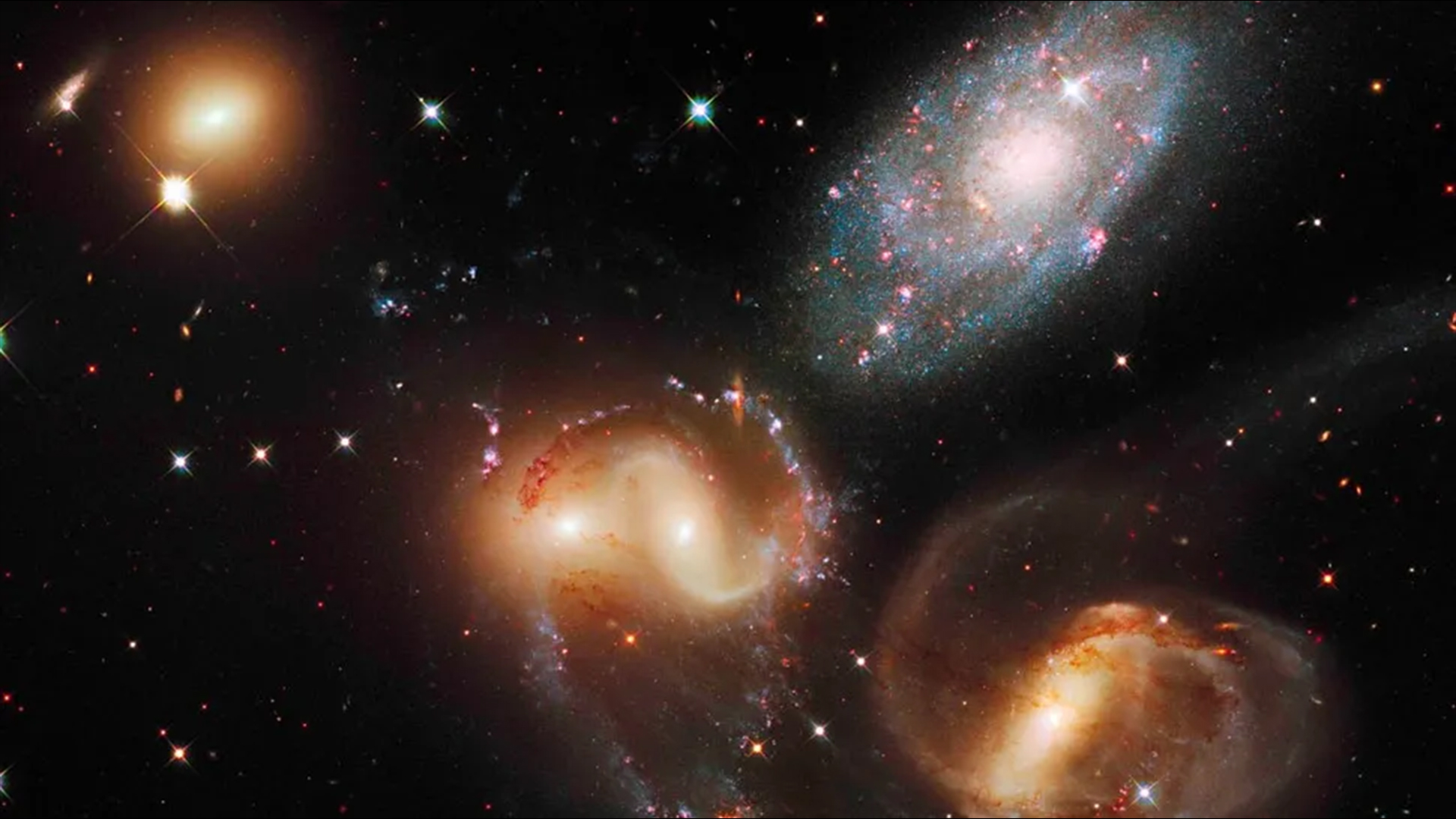
Astronomers have spotted one of the most powerful shock waves ever seen, caused by a galaxy slamming into four of its neighbors while traveling at 2 million mph (3.2 million km/h).

The cosmos-rattling event occurred in Stephan’s Quintet, when one of the system’s five galaxies, called NGC 7318b, smashed into the other four.

NGC 7318b’s entry into the system created an immensely powerful shock front akin to a “sonic boom from a jet fighter,” the researchers said. They hope that by studying it they can understand more about the violent and chaotic interactions between galaxies. They published their findings Nov. 22 in the journal Monthly Notices of the Royal Astronomical Society.

“It’s basically a huge intergalactic field of debris,” Marina Arnaudova, an astrophysicist at the University of Hertfordshire in the U.K., told Live Science. “The new intruder NGC7318b has smashed into the debris field, and compressed the plasma and gas in it. In doing so it has re-energised the plasma causing it to glow brightly at radio frequencies, and likely triggered star formation in the process.”

Named after French astronomer Édouard Stephan, who discovered it in the 19th century, Stephan’s Quintet is a group of five galaxies that are “locked in a cosmic dance of repeated close encounters,” according to NASA.

Related: James Webb Space Telescope discovers mysterious ‘red monster’ galaxies so large they shouldn’t exist

The quintet sits around 290 million light-years from Earth and was the first compact galaxy group ever spotted. It has been imaged by numerous telescopes, including the Hubble Space Telescope and the James Webb Space Telescope.

Get the world’s most fascinating discoveries delivered straight to your inbox.

To investigate the quintet’s behavior and cosmic history, the researchers behind the new study used the William Herschel Telescope Enhanced Area Velocity Explorer (WEAVE), a spectrograph mounted to the William Herschel Telescope on the island of La Palma.

By breaking light from the system down into its constituent parts, the WEAVE spectrograph tracked the debris remnants, the births of new stars and the trails of ionized gas left behind by the force of the collision. All of these elements were stirred up by the shock front, which rippled out at hypersonic speeds following NGC 7318b’s entry into the system.

Astronomers studying Stephan’s Quintet could gain valuable insights into how collisions and mergers stretching back to the Big Bang shaped the galaxies we see today, and what the system may look like in the future, the researchers said.

“This type of galaxy collision in Stephan’s Quintet is a rare chance to see a complex set of galaxies caught in the act of colliding,” Arnaudova said. “As to how it will end up, well it’s likely that it will eventually merge with one of the group members, but not for millions or billions of years because the sizes and speeds of these things are so vast.”

The observations are the first to be made by WEAVE, but far from the last. The researchers say the spectrograph will also be used to study the reionization of the universe in the aftermath of the Big Bang; cast new light on how stars form and accrete over time; and perform a number of “galactic archaeology” experiments to find how our own Milky Way grew over cosmic time.

Source link

Share. Facebook Twitter Pinterest LinkedIn Tumblr Email
Previous ArticleNFL great Brett Favre opens up about living with Parkinson’s disease: ‘I feel like a board’
Next Article RHOA’s Porsha Williams Says She’s “Really Into” New Man After Divorce
Editor
  • Website

Related Posts

Lifestyle

Strange mammal ancestor laid huge, leathery eggs —‬ and it was key to surviving the world’s worst mass extinction

April 22, 2026
Lifestyle

Ancient process that created rare earth elements discovered — and it could help us locate desperately needed deposits

April 22, 2026
Lifestyle

This humanoid robot does all your housework for you ‪—‬ and its makers say it’s ready for your home

April 22, 2026
Add A Comment

Comments are closed.

Categories
  • Entertainment
  • Lifestyle
  • News
  • Sports
  • Tech
  • Travel
Recent Posts
  • Strange mammal ancestor laid huge, leathery eggs —‬ and it was key to surviving the world’s worst mass extinction
  • Ancient process that created rare earth elements discovered — and it could help us locate desperately needed deposits
  • This humanoid robot does all your housework for you ‪—‬ and its makers say it’s ready for your home
  • ‘Nations need to prepare now’: Key Atlantic ocean current is much closer to collapse than scientists thought
  • Neanderthal toddlers grew faster than modern humans, probably because of the harsh environment they evolved in
calendar
April 2026
M T W T F S S
 12345
6789101112
13141516171819
20212223242526
27282930  
« Mar    
Recent Posts
  • Strange mammal ancestor laid huge, leathery eggs —‬ and it was key to surviving the world’s worst mass extinction
  • Ancient process that created rare earth elements discovered — and it could help us locate desperately needed deposits
  • This humanoid robot does all your housework for you ‪—‬ and its makers say it’s ready for your home
About

Welcome to Baynard Media, your trusted source for a diverse range of news and insights. We are committed to delivering timely, reliable, and thought-provoking content that keeps you informed
and inspired

Categories
  • Entertainment
  • Lifestyle
  • News
  • Sports
  • Tech
  • Travel
Facebook X (Twitter) Pinterest WhatsApp
  • Contact Us
  • About Us
  • Privacy Policy
  • Disclaimer
  • UNSUBSCRIBE
© 2026 copyrights reserved

Type above and press Enter to search. Press Esc to cancel.