Close Menu
  • Home
  • UNSUBSCRIBE
  • News
  • Lifestyle
  • Tech
  • Entertainment
  • Sports
  • Travel
Facebook X (Twitter) WhatsApp
Trending
  • New robotic heart mimics common, mysterious condition to help researchers study it
  • Canon EOS R6 III review: A wildlife wonder
  • Medieval babies and adults buried together in Sweden were not related, archaeologists discover — raising big questions about early Christian burial practices
  • NASA is creating a fifth state of matter on the ISS, thanks to an upgrade to a mini-fridge-sized quantum lab
  • New sodium metal battery design charges in just 4 minutes and retains its capacity for years
  • Quantum computing wielded to create extremely rare material critical to nuclear fusion
  • Scientists build tiny ‘diving suit’ for cockroaches, turning them into search-and-rescue cyborgs
  • Physicists develop the first working model of quantum mechanics using only ‘real’ numbers
Facebook X (Twitter) WhatsApp
Baynard Media
  • Home
  • UNSUBSCRIBE
  • News
  • Lifestyle
  • Tech
  • Entertainment
  • Sports
  • Travel
Baynard Media
Home»Lifestyle»Astronomers discover a ‘Great Wave’ spreading across the Milky Way in new map of thousands of stars
Lifestyle

Astronomers discover a ‘Great Wave’ spreading across the Milky Way in new map of thousands of stars

EditorBy EditorOctober 1, 2025No Comments3 Mins Read
Share Facebook Twitter Pinterest LinkedIn Tumblr Reddit Telegram Email
Share
Facebook Twitter LinkedIn Pinterest Email

A huge “wave” is rippling through our galaxy, pushing billions of stars in its wake, a new study reveals.

The Milky Way‘s galactic wave was spotted in mapping data from the European Space Agency’s (ESA) Gaia space telescope, which charted the positions and movement patterns of millions of stars with high accuracy before retiring earlier this year.

Like ripples in a pond, the wave has a very large influence: It affects stars between 30,000 and 65,000 light-years away from the galaxy’s center, ESA officials said in a statement. That’s a large percentage of the Milky Way, which is roughly 100,000 light-years across.


You may like

Astronomers still don’t know what started the motion. It could have been a past collision with a smaller, dwarf galaxy that caused the large shake, ESA officials said, but more investigation is required to answer that question.

The results were published July 14 in the journal Astronomy & Astrophysics.

Mapping the wave

Gaia mapped the speeds and motions of stars for nearly a dozen years. In 2020, the telescope observed that the disk of the Milky Way wobbles like a spinning top. The newfound wave was charted by following the movements and positions of young, giant stars as well as a set of Cepheids — stars that have predictable-but-variable brightness.

“Because young giant stars and Cepheids move with the wave, the scientists think that gas in the disc might also be taking part in this large-scale ripple,” ESA officials wrote in the statement. “It is possible that young stars retain the memory of the wave information from the gas itself, from which they were born.”

Get the world’s most fascinating discoveries delivered straight to your inbox.

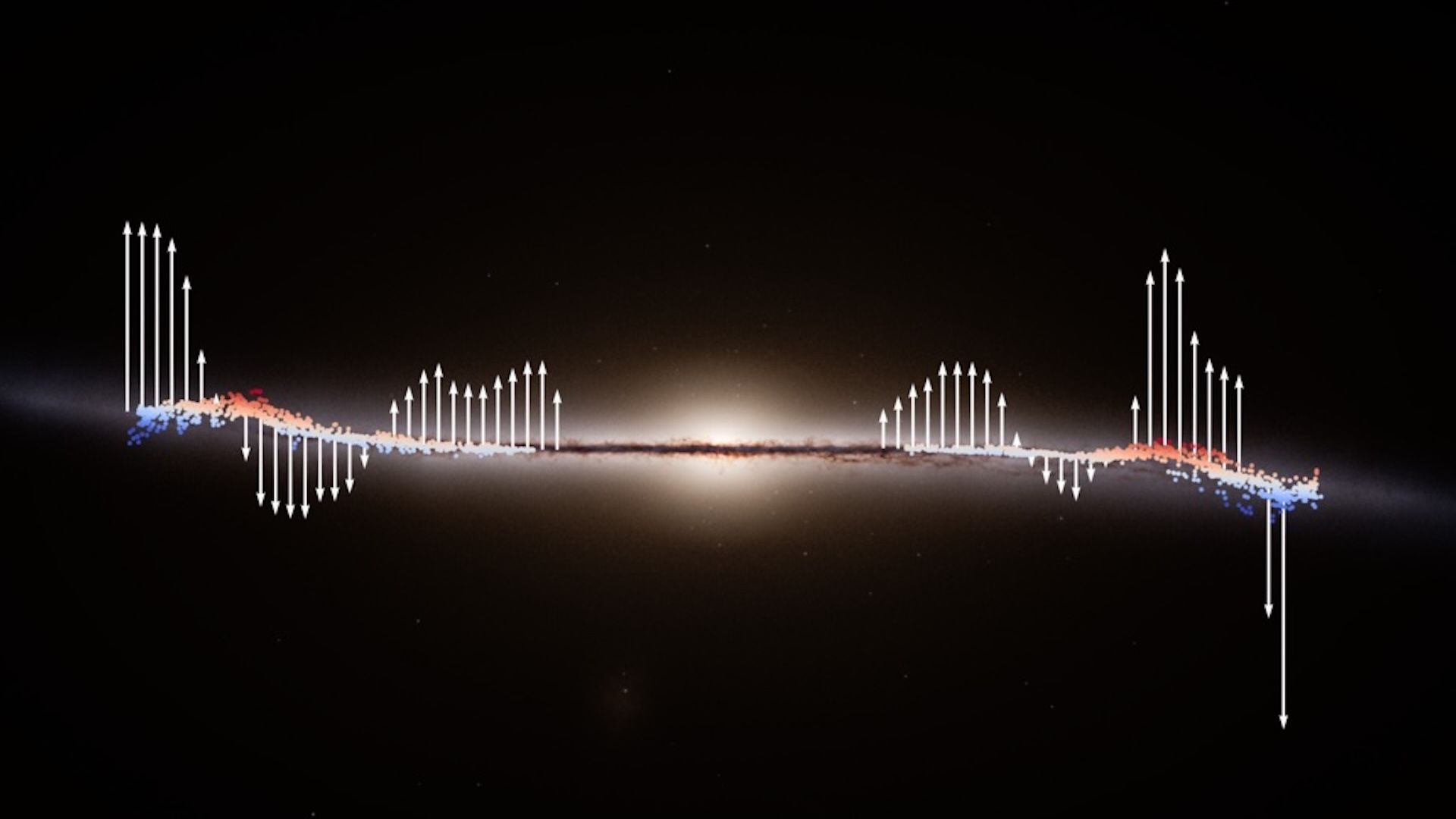
ESA officials likened the galactic wave to “the Wave” done by a crowd at a stadium: In a group movement starting from one side of the stadium and moving section by section to the other side, individuals rise from their seats, fully stand up with their arms extended, and then sit back down.

An image of a subtle wave pattern in blue and red colors with a glowing light behind it

A clear wave pattern emerges when looking at the motions of stars at the edges of the Milky Way, as seen here in this map of Gaia data. (Image credit: ESA/Gaia/DPAC, S. Payne-Wardenaar, E. Poggio et al (2025))

A similar type of wave motion is visible when our galaxy is observed edge-on. Such vertical motions, represented by arrows, show ripples of movement far across the Milky Way’s disk.

“This observed behaviour is consistent with what we would expect from a wave,” lead author Eloisa Poggio, an astronomer at the National Institute of Astrophysics in Italy, said in the statement.

The newly discovered wave could also be related to a much smaller Milky Way ripple already known by scientists. Called the Radcliffe Wave, it is visible about 500 light-years from the sun and stretches for 9,000 light-years across space.

“However, the Radcliffe Wave is a much smaller filament, and located in a different portion of the galaxy’s disc compared to the wave studied in our work,” Poggio said. “The two waves may or may not be related. That’s why we would like to do more research.”

Source link

Share. Facebook Twitter Pinterest LinkedIn Tumblr Email
Previous ArticleLDS members raise over $140K for family of Michigan church shooter
Next Article Sinking raft rescued by Royal Caribbean cruise ship
Editor
  • Website

Related Posts

Lifestyle

New robotic heart mimics common, mysterious condition to help researchers study it

July 11, 2026
Lifestyle

Canon EOS R6 III review: A wildlife wonder

July 10, 2026
Lifestyle

Medieval babies and adults buried together in Sweden were not related, archaeologists discover — raising big questions about early Christian burial practices

July 10, 2026
Add A Comment

Comments are closed.

Categories
  • Entertainment
  • Lifestyle
  • News
  • Sports
  • Tech
  • Travel
Recent Posts
  • New robotic heart mimics common, mysterious condition to help researchers study it
  • Canon EOS R6 III review: A wildlife wonder
  • Medieval babies and adults buried together in Sweden were not related, archaeologists discover — raising big questions about early Christian burial practices
  • NASA is creating a fifth state of matter on the ISS, thanks to an upgrade to a mini-fridge-sized quantum lab
  • New sodium metal battery design charges in just 4 minutes and retains its capacity for years
calendar
July 2026
M T W T F S S
 12345
6789101112
13141516171819
20212223242526
2728293031  
« Jun    
Recent Posts
  • New robotic heart mimics common, mysterious condition to help researchers study it
  • Canon EOS R6 III review: A wildlife wonder
  • Medieval babies and adults buried together in Sweden were not related, archaeologists discover — raising big questions about early Christian burial practices
About

Welcome to Baynard Media, your trusted source for a diverse range of news and insights. We are committed to delivering timely, reliable, and thought-provoking content that keeps you informed
and inspired

Categories
  • Entertainment
  • Lifestyle
  • News
  • Sports
  • Tech
  • Travel
Facebook X (Twitter) Pinterest WhatsApp
  • Contact Us
  • About Us
  • Privacy Policy
  • Disclaimer
  • UNSUBSCRIBE
© 2026 copyrights reserved

Type above and press Enter to search. Press Esc to cancel.