Close Menu
  • Home
  • UNSUBSCRIBE
  • News
  • Lifestyle
  • Tech
  • Entertainment
  • Sports
  • Travel
Facebook X (Twitter) WhatsApp
Trending
  • Why does metal stick together in space?
  • Faster ‘biological aging’ in young adults may help explain rise in early-onset cancers, study hints
  • Computer scientists are rushing to tame tame AI’s voracious appetite for energy
  • Our brains aren’t wired to handle this much bad news. But ‘looking away is not the fix,’ expert says.
  • ‘The fate of Earth depends on a delicate balance’: Our planet may survive the death of the sun after all, new models hint
  • Bullseye! Enormous ‘bow and arrow’ galaxy is unlike anything radio astronomers have ever seen — Space photo of the week
  • IBM creates first sub-1nm computer chip — cramming 100 billion transistors into a tiny fingernail-sized space
  • New chip harnesses quantum computing’s biggest weakness — and tries to turn it into a strength
Facebook X (Twitter) WhatsApp
Baynard Media
  • Home
  • UNSUBSCRIBE
  • News
  • Lifestyle
  • Tech
  • Entertainment
  • Sports
  • Travel
Baynard Media
Home»Lifestyle»Archaeologists locate ‘La Fortuna,’ a Spanish ship that exploded in 1748 along North Carolina’s coast
Lifestyle

Archaeologists locate ‘La Fortuna,’ a Spanish ship that exploded in 1748 along North Carolina’s coast

EditorBy EditorAugust 14, 2025No Comments4 Mins Read
Share Facebook Twitter Pinterest LinkedIn Tumblr Reddit Telegram Email
Share
Facebook Twitter LinkedIn Pinterest Email

Archaeologists have discovered four 18th-century shipwrecks off the coast of North Carolina, including what may be the wreck of La Fortuna, a Spanish privateer from Cuba that exploded during an attack in 1748.

The wrecks were found near Brunswick Town, a major Colonial port on the southern coast of North Carolina. The town was the first successful European settlement of the Cape Fear region (named due to 16th-century sailors’ fears of getting shipwrecked), and the port was used to export pine products like tar and turpentine used by the Royal Navy. But archaeologists surveying the area had not expected to find such a large number of wrecks and colonial artifacts.

“Visibility [underwater] is consistently pretty low in the Cape Fear River,” Cory van Hees, a graduate student at East Carolina University (ECU), said in a statement. Van Hees got disoriented while diving and came across beams of wood sticking out of the mud. “I didn’t understand what I was looking at in that moment,” van Hees said, “but I knew I should relay the wooden structure to faculty.”


You may like

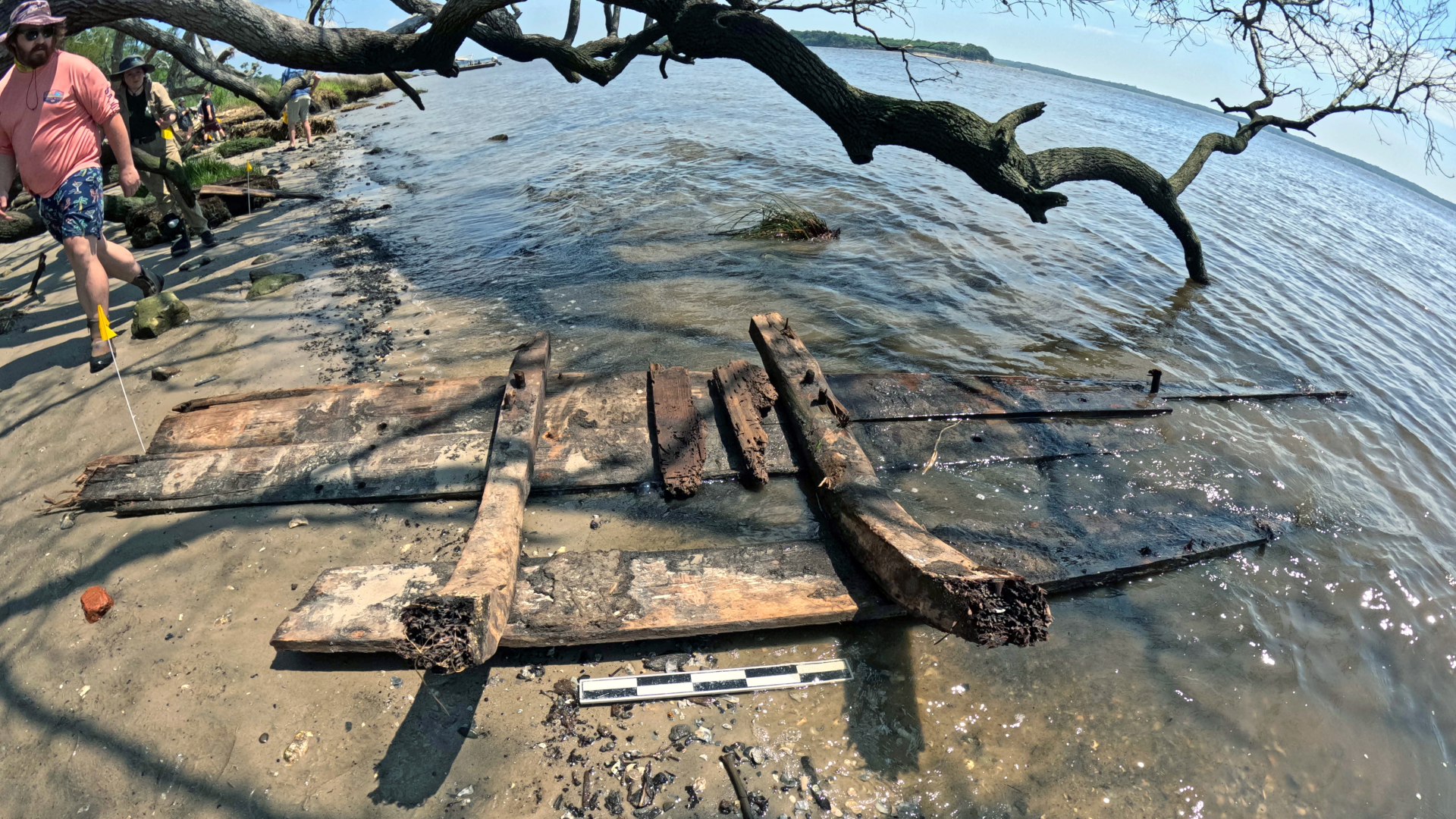
The project co-leaders, ECU maritime archaeologists Jason Raupp and Jeremy Borrelli, think one of the wrecks, which comprises 47 timbers, is La Fortuna. Historical records note that two Spanish ships anchored off Brunswick Town on Sept. 4, 1748. The Spanish began to raid the then-English town, but they were surprised by a counterattack from the colonists a couple of days later. During the attack, La Fortuna exploded and sank.

The project team found two major clues that the wreck is indeed La Fortuna: the timbers and the artifacts nearby, including Spanish pottery.

Some of the wood used in the ship’s construction was from a cypress species native to Central America. This suggests that shipbuilders used raw materials from a Spanish Caribbean colony to construct the ship, according to the statement, and La Fortuna is the only Spanish ship known to have sunk in this area.

Related: Coins worth over $1 million recovered from 1715 Spanish treasure shipwrecks in Florida

Get the world’s most fascinating discoveries delivered straight to your inbox.

Image 1 of 4

a tapering piece of wood with Roman numerals on a beach
(Image credit: ECU Program in Maritime Studies)

A barrel stave with the Roman numerals IIIIV inscribed on it, found near one of the Colonial wharves at Brunswick Town.

a rusted adze sits on a beach
(Image credit: ECU Program in Maritime Studies)

A cooper’s cuttingtool, known as an adze, was found on the beach at Brunswick Town.

A person holds a fragment of a blue-and-white piece of pottery
(Image credit: ECU Program in Maritime Studies)

A Spanish majolica ceramic sherd was found among the assemblage of shipwreck timbers recovered from the beach at Brunswick Town.

pieces of timber eroding out of the beach
(Image credit: ECU Program in Maritime Studies)

The Colonial timber-crib wharf site is exposed from the eroding coastal marsh at the Brunswick Town historic site.


While recording the shipwrecks this summer, the team “found hundreds of artifacts,” Borrelli told Live Science in an email, including “ceramic sherds, glass container bottles, clay tobacco pipes, a cooper’s adze [cutting tool], barrel heads and staves, sailcloth, leather shoes, possible clothing fragments, and butchered animal bone.” In addition, two fragments of 18th-century Spanish-American ceramics are “another clue supporting the preliminary identification of La Fortuna,” Borrelli said.

The other three wrecks are still something of a mystery. All of them have construction details and artifacts that suggest they were used in the 1700s, Borrelli said, which means the wrecks are likely associated with the 50-year lifespan of the Colonial port at Brunswick Town. But coastal erosion has dramatically impacted the archaeological site, scattering the shipwrecks’ remains over a wide area, he said.

Raupp and Borrelli plan to continue their investigation into the wrecks.

“As we dig deeper and uncover more evidence, it may lead us in another direction,” Borrelli said. “It is highly improbable that any of the other shipwrecks found at Brunswick Town are Spanish vessels, but we can’t rule anything out at the moment.”

Source link

Share. Facebook Twitter Pinterest LinkedIn Tumblr Email
Previous ArticleEven if Trump ends the Ukraine war, America’s greatest threat still lies ahead
Next Article How Trump gets what he wants from companies
Editor
  • Website

Related Posts

Lifestyle

Why does metal stick together in space?

June 29, 2026
Lifestyle

Faster ‘biological aging’ in young adults may help explain rise in early-onset cancers, study hints

June 29, 2026
Lifestyle

Computer scientists are rushing to tame tame AI’s voracious appetite for energy

June 28, 2026
Add A Comment

Comments are closed.

Categories
  • Entertainment
  • Lifestyle
  • News
  • Sports
  • Tech
  • Travel
Recent Posts
  • Why does metal stick together in space?
  • Faster ‘biological aging’ in young adults may help explain rise in early-onset cancers, study hints
  • Computer scientists are rushing to tame tame AI’s voracious appetite for energy
  • Our brains aren’t wired to handle this much bad news. But ‘looking away is not the fix,’ expert says.
  • ‘The fate of Earth depends on a delicate balance’: Our planet may survive the death of the sun after all, new models hint
calendar
June 2026
M T W T F S S
1234567
891011121314
15161718192021
22232425262728
2930  
« May    
Recent Posts
  • Why does metal stick together in space?
  • Faster ‘biological aging’ in young adults may help explain rise in early-onset cancers, study hints
  • Computer scientists are rushing to tame tame AI’s voracious appetite for energy
About

Welcome to Baynard Media, your trusted source for a diverse range of news and insights. We are committed to delivering timely, reliable, and thought-provoking content that keeps you informed
and inspired

Categories
  • Entertainment
  • Lifestyle
  • News
  • Sports
  • Tech
  • Travel
Facebook X (Twitter) Pinterest WhatsApp
  • Contact Us
  • About Us
  • Privacy Policy
  • Disclaimer
  • UNSUBSCRIBE
© 2026 copyrights reserved

Type above and press Enter to search. Press Esc to cancel.