Close Menu
  • Home
  • UNSUBSCRIBE
  • News
  • Lifestyle
  • Tech
  • Entertainment
  • Sports
  • Travel
Facebook X (Twitter) WhatsApp
Trending
  • The universe may end trillions of years sooner than we thought
  • ‘They weren’t burned by accident’: Mysterious green rocks discovered high in Pyrenees reveal ancient copper-smelting camp
  • Full moon helps paint vibrant, muddy ‘brushstrokes’ in Indonesian river — Earth from space
  • Estrogen in both the male and female brain shapes responses to trauma, study suggests
  • NASA just released 12,000 more Artemis II photos ‪—‬ here are a dozen of our favorites
  • Hantavirus infects at least 1 on cruise ship, while 5 others fall ill: Here’s what we know
  • Athena bowl: A silver and gold vessel of the goddess and her owl, buried in a German forest 2,000 years ago
  • ‘Moved to tears when we saw them’: Why archaeologists re-created gorgeous outfits from centuries-old Christian Nubian murals
Facebook X (Twitter) WhatsApp
Baynard Media
  • Home
  • UNSUBSCRIBE
  • News
  • Lifestyle
  • Tech
  • Entertainment
  • Sports
  • Travel
Baynard Media
Home»Lifestyle»Archaeologists excavated a seventh-century warrior’s tomb revealed by satellites — and found a rich assortment of grave goods
Lifestyle

Archaeologists excavated a seventh-century warrior’s tomb revealed by satellites — and found a rich assortment of grave goods

EditorBy EditorOctober 29, 2025No Comments4 Mins Read
Share Facebook Twitter Pinterest LinkedIn Tumblr Reddit Telegram Email
Share
Facebook Twitter LinkedIn Pinterest Email

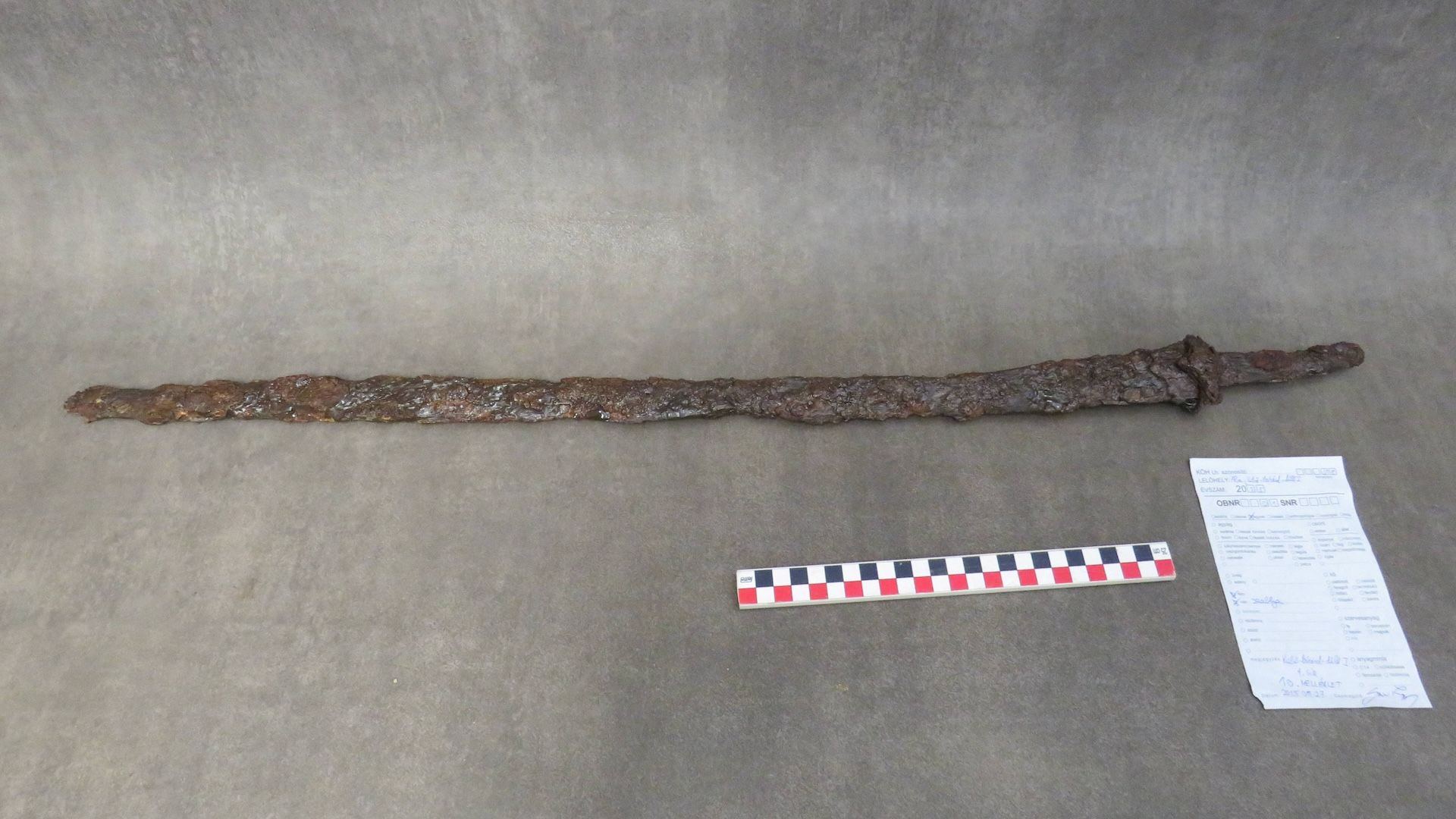
Archaeologists in Hungary have unearthed the remnants of a rare iron saber, jewelry and other artifacts in the 1,300-year-old tomb of an elite warrior.

The elegantly curved sword — a type used mainly by warriors on horseback — is badly rusted, but it still has traces of fine decorations on its blade that reveal the craftsmanship used to make the ancient weapon.

The tomb — located near the city of Székesfehérvár (also known as Fehérvár), about 30 miles (50 kilometers) southwest of Budapest — was spotted by satellites in orbit, according to a translated statement from the Szent István Király (King Saint Stephen) museum there.


You may like

The excavations are part of the Hungarian National Museum and the King Saint Stephen Museum’s Cemeteries from Space program, which analyses crop marks in satellite imagery to detect buried archaeological sites.

Pannonian Avars

The newfound tomb dates to between A.D. 670 and 690, when the region was part of a vast “Avar Khaganate” — a type of kingdom — in Central Europe, centered in the Carpathian Basin of what’s now Hungary.

The Avars from Central Europe are now called “Pannonian Avars” (the Byzantine Empire called that region “Pannonia”) to distinguish them from the semi-nomadic Avars of Central Asia, with whom a 2022 genetic study suggested they were related. (An entirely unrelated people, called the “Dagestani” or “Caucasian” Avars, live now in the Caucasus Mountains — ethnographers think their shared name is a coincidence.)

a photo of an archaeologist excavating a grave

The ancient tomb was discovered near the central Hungarian city of Székesfehérvár after crop marks were seen there in satellite images. (Image credit: Szent István Király Múzeum)

According to the Byzantine-era historian Menander Protector (a name he earned as a guardsman for the emperor) the Byzantines in the sixth century thought the Pannonian Avars were the same Central Asian Avars they’d heard about in the fifth century and greatly feared — but never met.

Get the world’s most fascinating discoveries delivered straight to your inbox.

Scientists and historians now think, however, that the Pannonian Avars were a different confederation of semi-nomadic Eurasian steppe peoples, possibly led by a Turkic or Mongolian elite. They left no written language, making their culture enigmatic today. But a 2024 genetic study of a Pannonian Avar cemetery suggests that the women traveled to their husband’s village upon getting married.

Archaeologists said there were signs that the tomb near Székesfehérvár had been looted but that it still contained a rich selection of grave goods, including the saber.

a skeleton in a grave

Archaeologists say the remains of the Avar warrior in the grave were “ravaged” by looters, but many of the grave goods remain. (Image credit: Szent István Király Múzeum)

The blade and hilt of the weapon are intact, making it an exceptionally rare find from this era. It is badly rusted, however, and extremely brittle after 1,300 years underground, so it had to be lifted from the excavations on a specially designed wooden cradle, the statement said.


You may like

Ravaged remains

Image 1 of 2

a silver ornamented brooch in a box
(Image credit: Szent István Király Múzeum)

As well as the remains and sword, archaeologists also found this silver ornament, which seems to be a brooch.

a gilded piece of decorated metal in a box
(Image credit: Szent István Király Múzeum)

The grave goods in the tomb also included this gilded piece of metal, which seems to have been braided into long hair.


The archaeologists also discovered silver belt fittings, gilded metal ornaments for braiding into hair, earrings made from glass beads, a long knife, and arrowheads that were likely stored in a quiver — although the quiver itself, and the shafts and feather fletches of the arrows, have rotted away.

The warrior’s remains were also found in the tomb. While his arms and lower body were arranged in anatomical order, his head, chest and abdomen had been “ravaged” by the looters, according to the statement.

The Pannonian Avars established a kingdom in the Carpathian Basin in the sixth century, historian Walter Pohl wrote in “The Avars: A Steppe Empire in Central Europe, 567-822” (Cornell University Press, 2018).

But their battles against the Byzantine Empire, the Franks and the Bulgars contributed to the collapse of their kingdom in the ninth century and the territory falling to the Magyar people, a different ethnic group from the Volga-Ural region who were the ancestors of most modern Hungarians.

Source link

Share. Facebook Twitter Pinterest LinkedIn Tumblr Email
Previous ArticleTwo men sentenced to 25 years for conspiring to murder Iranian-American journalist in Brooklyn
Next Article GM will cut thousands of jobs in Michigan, Tennessee and Ohio
Editor
  • Website

Related Posts

Lifestyle

The universe may end trillions of years sooner than we thought

May 5, 2026
Lifestyle

‘They weren’t burned by accident’: Mysterious green rocks discovered high in Pyrenees reveal ancient copper-smelting camp

May 5, 2026
Lifestyle

Full moon helps paint vibrant, muddy ‘brushstrokes’ in Indonesian river — Earth from space

May 5, 2026
Add A Comment

Comments are closed.

Categories
  • Entertainment
  • Lifestyle
  • News
  • Sports
  • Tech
  • Travel
Recent Posts
  • The universe may end trillions of years sooner than we thought
  • ‘They weren’t burned by accident’: Mysterious green rocks discovered high in Pyrenees reveal ancient copper-smelting camp
  • Full moon helps paint vibrant, muddy ‘brushstrokes’ in Indonesian river — Earth from space
  • Estrogen in both the male and female brain shapes responses to trauma, study suggests
  • NASA just released 12,000 more Artemis II photos ‪—‬ here are a dozen of our favorites
calendar
May 2026
M T W T F S S
 123
45678910
11121314151617
18192021222324
25262728293031
« Apr    
Recent Posts
  • The universe may end trillions of years sooner than we thought
  • ‘They weren’t burned by accident’: Mysterious green rocks discovered high in Pyrenees reveal ancient copper-smelting camp
  • Full moon helps paint vibrant, muddy ‘brushstrokes’ in Indonesian river — Earth from space
About

Welcome to Baynard Media, your trusted source for a diverse range of news and insights. We are committed to delivering timely, reliable, and thought-provoking content that keeps you informed
and inspired

Categories
  • Entertainment
  • Lifestyle
  • News
  • Sports
  • Tech
  • Travel
Facebook X (Twitter) Pinterest WhatsApp
  • Contact Us
  • About Us
  • Privacy Policy
  • Disclaimer
  • UNSUBSCRIBE
© 2026 copyrights reserved

Type above and press Enter to search. Press Esc to cancel.